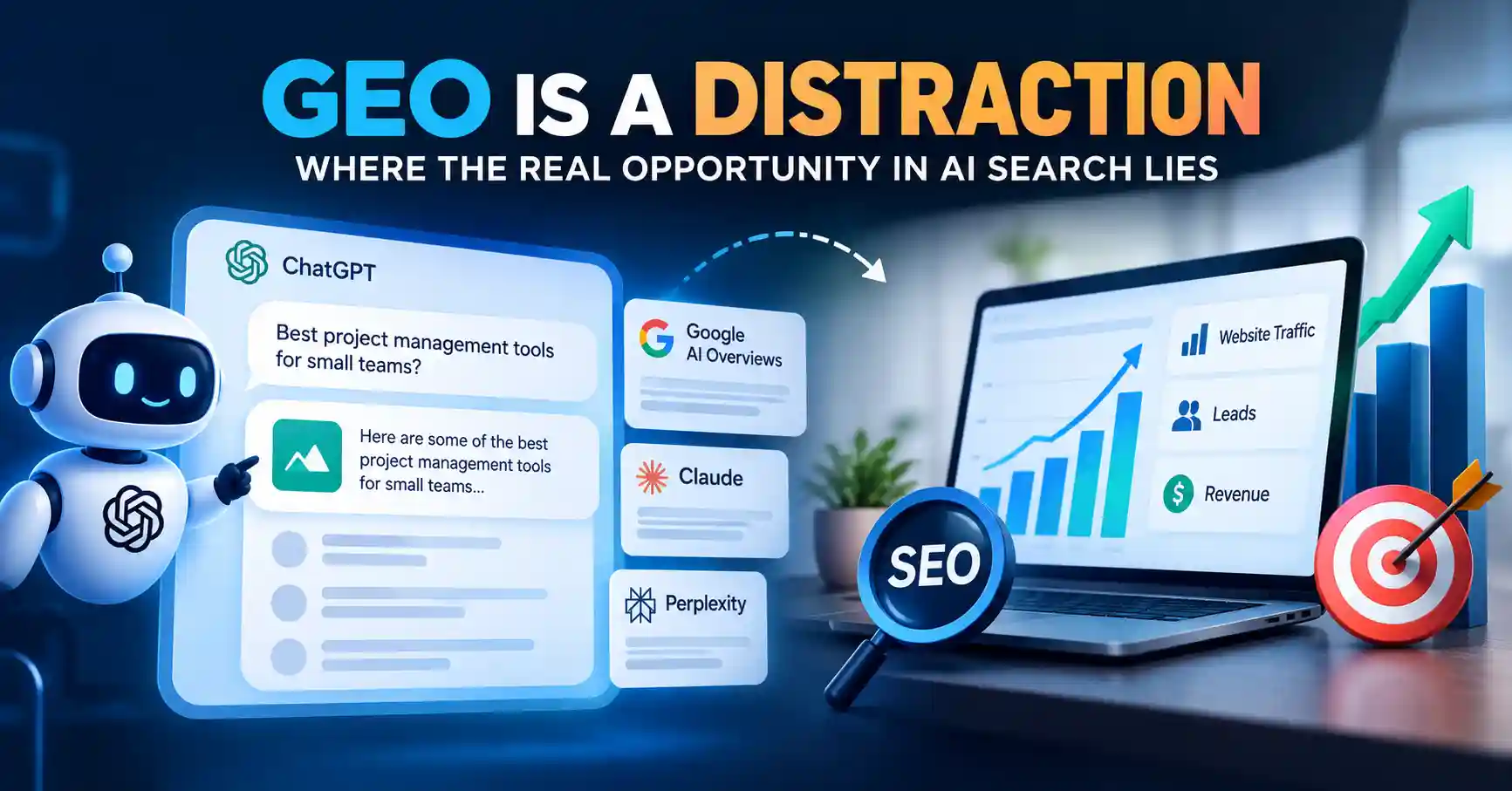
Generative engine optimization (GEO) has become a major talking point in digital marketing. Businesses want their brands to appear in ChatGPT responses, earn citations from AI search engines, and get recommended when potential customers ask for advice.
It’s easy to see why. People are changing how they search for information, compare products, and discover services. But there’s a catch: an AI mention doesn’t automatically bring website traffic, qualified leads, or revenue.
For bloggers, marketers, and business owners, the real opportunity lies in understanding how AI search influences customer discovery and turning that knowledge into measurable business results.
Rather than chasing every new GEO tactic, businesses should focus on strong SEO foundations, useful content, better conversion paths, and reliable performance tracking. GEO has a place in the strategy, but it shouldn’t drive every marketing decision.
Why GEO Has Become Such a Big Conversation
What generative engine optimization actually means
Generative engine optimization is the practice of improving a brand’s chances of appearing in AI generated answers through mentions, citations, or recommendations. Common approaches include publishing authoritative content, presenting information clearly, maintaining consistent brand details, and ensuring important pages are accessible to search engines.
Consider a company that sells project management software. It might want an AI assistant to recommend its product when someone asks which project management tools work best for small teams.
That exposure can introduce the brand to potential customers. However, being mentioned is only one step in the buying journey. The person might never visit the website, choose a competitor, or simply be researching without any intention to buy.
Why marketers are tracking AI mentions and citations
AI visibility gives marketers another way to understand how people discover brands. They can monitor whether their content appears in relevant answers, which sources AI systems cite, and how their businesses are described.
The problem starts when marketers treat these observations as evidence of business growth.
A brand might appear regularly in AI answers without attracting much qualified traffic. Another might receive fewer mentions but bring in visitors who are more likely to become customers.
The objective isn’t to maximize AI mentions. It’s to become a credible, useful choice when potential customers need what you offer.
GEO vs. SEO: What Should Businesses Prioritize?
Traditional search still matters in an AI driven landscape
The GEO vs. SEO debate often makes marketers feel they must choose between traditional optimization and AI visibility. In reality, the two frequently overlap.
Technical accessibility, helpful content, clear page structure, relevant internal links, and accurate information all contribute to discoverability across search experiences.
Google’s official documentation confirms that established SEO practices remain relevant to AI features such as AI Overviews and AI Mode. There isn’t a separate set of special AI optimization requirements that guarantees inclusion in these experiences.
Instead of rebuilding an entire strategy around a new acronym, businesses should address existing weaknesses and create content that genuinely serves their audience.
How Google AI Overviews and AI Mode change discovery
AI powered search can answer questions directly, summarize information from different sources, and link to websites for people who want to explore a topic further.
This changes how some users discover information. Someone researching email marketing software, for example, might see an AI generated comparison before visiting individual vendors’ websites.
For businesses, that creates an opportunity and a challenge. A website might be cited as a source, yet some users will get the information they need without clicking through.
That’s why impressions, clicks, referral visits, and conversions should be measured separately. Each reveals something different about the discovery process.
Why SEO fundamentals support AI search visibility
Google recommends publishing helpful, reliable, people first content rather than creating pages primarily to manipulate rankings.
Start with the technical basics. Review your technical SEO for AI search to check whether important pages are crawlable, indexable, internally linked, and easy to understand.
Then focus on content quality. Explain concepts clearly, support claims with trustworthy sources, answer relevant questions, and bring original analysis to the discussion.
These practices serve readers first while making your content easier for search systems to interpret.
The Real Opportunity Is Connecting Search to Business Results
Search visibility has value, but what happens after someone discovers your website matters more. A visitor who requests a product demo may be more valuable than someone who reads an informational article and leaves.
Measure qualified traffic, leads, and revenue
Start by identifying the actions that matter to your business. A SaaS company might track demo requests and paid subscriptions. A blogger might focus on newsletter sign ups, affiliate clicks, or digital product sales.
Use these metrics to evaluate performance:
- Qualified traffic: Are visitors relevant to your audience and offers?
- Conversion rate: What percentage of visitors complete a desired action?
- Lead quality: Do enquiries develop into genuine sales opportunities?
- Revenue contribution: Which landing pages and acquisition sources contribute to sales?
A practical example
Imagine a software company attracting visitors from Google organic search and AI assistants. Instead of treating every visit equally, its marketing team compares qualified leads, demo requests, and eventual sales from each source.
The results might show that organic search brings more visitors, while AI referrals generate fewer visits but a higher proportion of demo requests. Or AI referrals might contribute very little measurable business value.
Neither outcome should be assumed beforehand. The company needs reliable data to understand the pattern before reallocating its marketing budget.
The principle is straightforward: measure each channel’s contribution before deciding where to invest more.
Four Areas Worth Prioritizing Before Chasing GEO Metrics
1. Improve technical SEO and indexability
Make sure important pages can be crawled and indexed, internal links work properly, and content is accessible. Fix broken links, duplicate page issues, and technical problems that prevent users or search engines from finding valuable information.
2. Publish original, experience led content
Publishing more articles isn’t necessarily the answer, especially when several pages cover the same ground. Focus on original analysis, practical examples, useful comparisons, and evidence that helps readers make informed decisions.
Google’s guidance on helpful, reliable, people first content emphasizes usefulness and originality. It also cautions against producing large amounts of low value content primarily to manipulate search rankings.
3. Improve high intent landing pages
Once visitors arrive, make their next step clear. Explain product benefits, provide transparent pricing where appropriate, address common objections, and use calls to action that match their needs.
For instance, an article comparing email marketing platforms should help readers identify the right tool for their requirements. Sending every reader toward the same affiliate offer, regardless of fit, does little to build trust.
4. Strengthen analytics and conversion tracking
Use Google Analytics 4 (GA4) to understand acquisition sources, landing page performance, and key events. Check that forms, purchases, and other important actions are being recorded accurately.
You can also use AI to improve SEO workflows by automating repetitive research and reporting tasks. Keep human review in the process to maintain accuracy, relevance, and editorial quality.
How to Measure AI Search Visibility Without Losing Sight of ROI
A useful reporting process doesn’t need to be complicated. What matters is tracking the right information consistently.
- Establish a baseline. Record organic search sessions, identifiable AI referral traffic, leads, and sales.
- Track key events. Confirm that GA4 measures meaningful actions rather than page views alone.
- Review landing pages. Identify which pages attract relevant visitors and contribute to conversions.
- Monitor AI mentions selectively. Check whether your brand appears in relevant answers, but treat mentions as a supporting metric.
- Review results monthly. Compare performance over time and investigate changes before attributing them to a particular tactic.
Keep attribution limitations in mind. AI assisted discovery may not appear as a clearly identifiable referral, and a customer’s journey can involve several channels. Referral data alone won’t reveal every influence on a purchase.
The Next Opportunity: Preparing for Agentic Search
AI search may develop beyond answering questions to helping people compare products, complete tasks, and make purchases.
For ecommerce businesses, this makes accurate product feeds, prices, availability, and Merchant Center information worth reviewing. Service businesses can focus on clear service details, convenient booking systems, and effective self service tools that reduce friction for customers.
Emerging concepts such as the Universal Commerce Protocol and WebMCP point toward more interactive experiences between websites and AI agents. Their relevance and implementation requirements will vary, however, and not every business needs to invest in them immediately.
A more measured approach is to test small improvements. Update product information, simplify a booking process, or experiment with an interactive calculator. Expand investment when an experiment addresses a genuine customer need or demonstrates a credible business benefit.
A Practical 30 Day Action Plan for Marketers
Use the next month to strengthen existing marketing activities before committing additional resources to GEO.
| Timeline | Action | Expected outcome |
| Week 1 | Audit technical SEO, analytics, and conversions | Identify gaps |
| Week 2 | Improve high value pages and original content | Better user experience |
| Week 3 | Fix landing page friction and conversion tracking | Clearer performance data |
| Week 4 | Test one AI visibility or referral initiative | Evidence for future decisions |
At the end of the month, compare the work completed with changes in qualified traffic, leads, and conversions. Don’t expect every improvement to produce an immediate ranking increase. Use the results to decide what deserves further attention.
FAQ’s
Yes, when it supports a clear business objective. Monitoring AI visibility and improving how your brand is represented can be useful. However, expensive tools and extensive reporting aren’t worthwhile if they don’t help you make better decisions.
No. Google’s guidance confirms that established SEO practices remain relevant to AI Overviews and AI Mode. Helpful content, crawlability, and sound technical foundations still matter. See Google’s guidance on AI search features for details.
Track identifiable AI referral traffic, qualified leads, conversions, and revenue where measurement is possible. Citation and brand mention monitoring can provide additional context, but analytics won’t capture every AI assisted interaction.
Start with technical SEO, useful content, relevant landing pages, conversion tracking, and a clear understanding of customer needs. Once these foundations are in place, test AI visibility initiatives on a small scale before committing a larger budget.
Conclusion
GEO isn’t inherently a distraction. The real mistake is treating AI visibility as a business outcome in itself.
Marketers need to understand how AI is changing discovery while keeping attention and commercial value separate. A citation might introduce someone to your brand, but a useful website experience, a credible offer, and a clear conversion path give that interest somewhere to go.
Focus on solving your customers’ problems, whether they find you through Google, an AI assistant, or another channel. Then measure what happens next.

Kumar Swamy is the CEO of Itech Manthra Pvt Ltd and a dedicated Article Writer and SEO Specialist. With a wealth of experience in crafting high-quality content, he focuses on technology, business, and current events, ensuring that readers receive timely and relevant insights.
As a technical SEO expert, Kumar Swamy employs effective strategies to optimize websites for search engines, boosting visibility and performance. Passionate about sharing knowledge, he aims to empower audiences with informative and engaging articles.
Connect with Kumar Swamy to explore the evolving landscape of content creation!