What happens when someone searches your company name on Google and, instead of simply seeing your website first, Google starts answering the question for them?
That’s becoming a much more important SEO question.
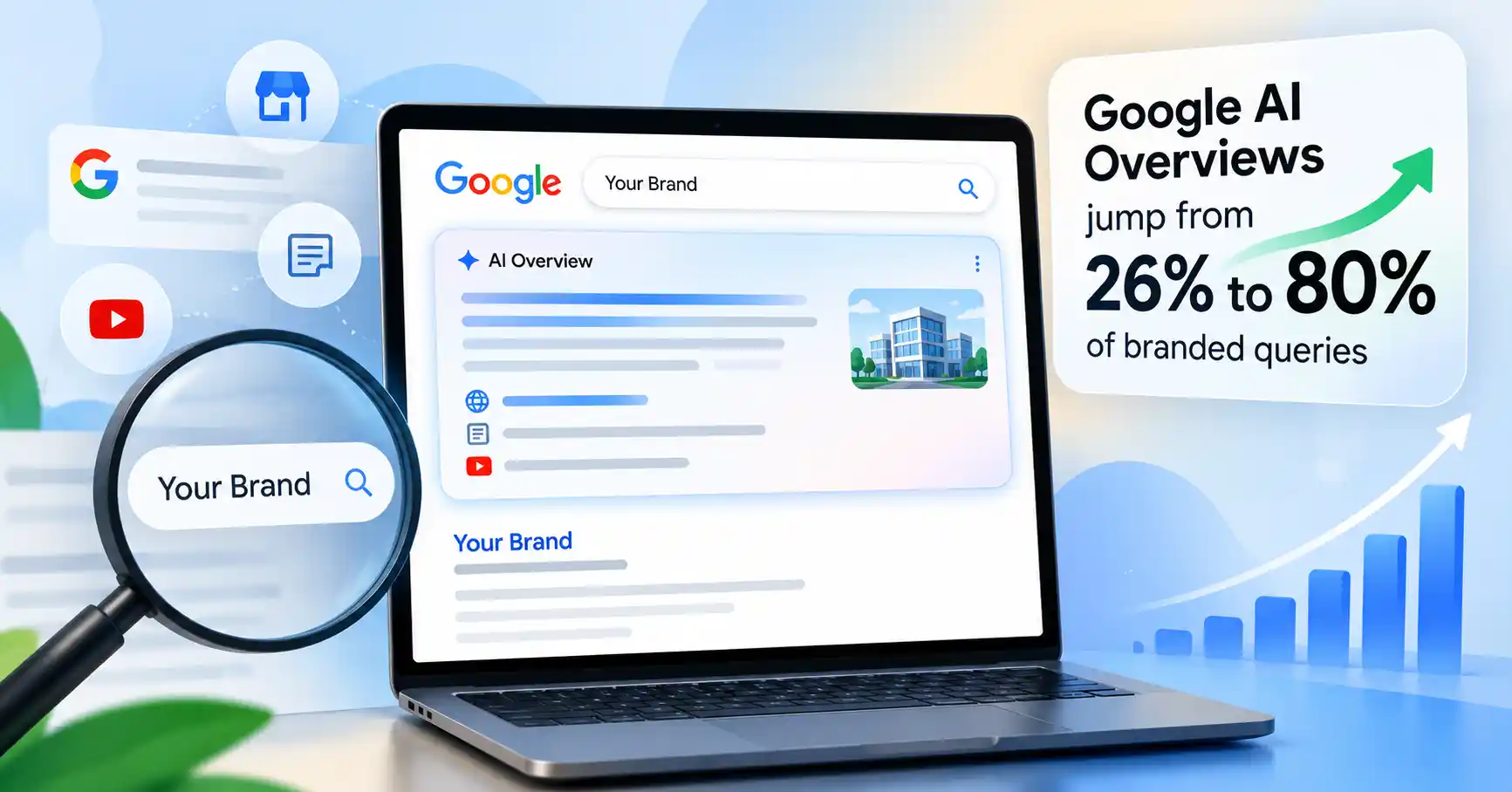
New September 2026 data shows that Google AI Overviews appeared on more than 80% of tracked branded queries toward the end of the month. DemandSphere recorded AI Overview presence on just 26.12% of its tracked branded keywords on September 1, before the figure climbed to 90.48% on September 27 and remained above 80% for the next two reported days.
That’s a huge change in a very short period.
And it matters because branded search has traditionally been one of the safest areas of SEO. When someone searches for your company, product, or service by name, you’d expect your website to control the conversation.
AI search is changing that assumption.
Why did Google AI Overviews suddenly appear on so many branded searches?
The biggest story here isn’t simply that AI Overviews are becoming more common. It’s how quickly they appeared across branded queries.
DemandSphere’s daily tracking shows AI Overview presence sitting mostly around 26%–35% during much of September. Then the numbers became much more volatile. The rate reached 57.43% on September 18, dropped again, climbed above 55% on September 23 and 24, and then jumped to 69.21% on September 26.
The following day, it reached 90.48%.
It settled at 80.23% on September 28 and 82.06% on September 29.
DemandSphere described the change as AI Overviews having “more than tripled” during September for branded queries. Google, however, hasn’t publicly announced a specific change explaining this increase.
That distinction is important.
We can clearly see the change in the data. We can’t yet say with confidence exactly what caused it.
Blame testing, tweaks, or shifting AI systems. Usually, multiple triggers hit at once. For SEOs, the reality is stark, Branded search isn’t just a few blue links anymore. Expect nothing to stay put.
What does the new branded search data actually tell us?
There’s an important detail that can easily get lost in the headline.
An AI Overview appearing for a branded query doesn’t necessarily mean Google mentioned or cited that brand inside the generated answer.
DemandSphere’s measurement was based on whether an AI Overview appeared on the search results page. The brand itself didn’t have to be cited for the query to count.
That means it’s more accurate to say:
AI Overviews are appearing on a large share of branded searches.
It would be inaccurate to say:
Google is citing brands in 80% of branded searches.
Those are two different things.
There’s another useful data point from Ahrefs. Its analysis of 232.8 million US desktop Google search result crawls found that AI Overviews appeared on 82.91% of branded keyword SERPs as of September 29. Its monthly branded query average also increased from 61.3% in July to 65.1% in August and 73.3% in September.
The datasets aren’t identical, but together they point in the same direction: AI search is moving deeper into branded search.
Why is this a big deal for brands and SEO teams?
Think about what happens when someone searches for a brand.
Previously, the journey was fairly predictable:
Brand name → company website → product page → conversion.
Now there’s another step:
Brand name → Google AI Overview → sources, opinions, competitors and brand information → possible click.
That changes the visibility equation.
Your site might still hold the top rank. Yet users often read Google’s summary first. They learn everything about your products, pricing, reputation, rivals, or key features without ever clicking your homepage.
And that’s where search visibility becomes more complicated.
A brand needs to care not only about where its website ranks, but also about what Google says about the brand and which websites Google uses to support that answer.
Search Engine Roundtable’s reporting adds another interesting wrinkle: many of the branded AI Overviews observed by Chris Long appeared lower down the results page rather than directly above the brand’s primary result. In other words, an AI Overview doesn’t necessarily replace the traditional result but it can still influence what users see while researching the brand.
How should businesses adapt to AI search optimization?
The answer isn’t to start writing hundreds of pages specifically for AI.
In fact, Google says the opposite.
Google says skip the fancy code or special markup if you want a shot at AI Overviews and AI Mode. The old SEO playbook still runs the show. Pages just need to be crawlable, genuinely useful, and tied together with solid internal links. That is basically it.
That makes the strategy surprisingly familiar.
First, make sure your important brand information is easy for Google to find. Your homepage, product pages, pricing information, About page, documentation and other important resources shouldn’t be buried.
Second, publish information that adds something beyond what everyone else is saying.
Google’s latest AI search guidance specifically emphasizes unique, valuable and non commodity content. First hand experience, original analysis, expert opinions, useful examples and genuinely helpful information can give your site something that generic AI generated content doesn’t have.
This is also where technical SEO matters. If you want a deeper look at the technical side, our guide on Technical SEO for AI Search covers the fundamentals that help search engines discover, access and understand your content.
Does this mean traditional SEO is becoming less important?
Not really. The better way to look at it is that SEO is becoming broader.
Google insists AI search still depends on classical tech. Crawling rules. Ignore solid links, true quality, and pure relevance at your absolute peril. The old basics simply win every single time.
What’s changing is the final presentation.
For years, SEO teams mainly asked:
“Where do we rank?”
Now they also need to ask:
“What does Google understand about our brand?”
“Which sources does Google trust when discussing us?”
“Are competitors being mentioned alongside us?”
“Is our website being cited?”
“Are customers seeing accurate information?”
“Are people clicking through after seeing the AI answer?”
Those questions belong to the new Google AI search environment.
It also means branded SEO shouldn’t be treated as a simple navigational keyword report anymore. A company might have excellent rankings and still have a visibility problem if third party sources dominate the AI generated conversation around its brand.
What should you check before your next SEO report?
Start with your own brand.
Search your company name, major products, services and important branded variations. Don’t just look at the first result. Read the AI Overview carefully.
Check what Google gets right.
Then look for what it gets wrong, what it leaves out and which websites it cites.
Next, check competitors. Are they appearing in the same AI answers? Are review websites, Reddit, YouTube, LinkedIn, publishers or industry sites being used as supporting sources?
Finally, connect those observations with actual performance data.
Google says AI Overviews are included in Search Console’s overall Web performance reporting, while Google’s newer guidance also points site owners toward the Generative AI performance reporting available in Search Console.
For marketers who want to go deeper, our guide to AI Search Visibility Tracking explains why traditional attribution doesn’t always tell the whole story anymore.
Stop chasing every single AI search metric out there. That misses the point. The real question is simpler: can people actually find your brand, get what you do, and trust you?
What does this mean for the future of branded search?
The biggest lesson from September isn’t that Google suddenly “killed” branded SEO.
It’s that Google is taking a bigger role in the conversation around brands.
That matters.
Brand searches put buyers on a knife edge. They weigh features, sniff out reputations, hunt for discounts, and question whether the company actually delivers. Period.
When an AI answer slides into that mix, businesses must ensure the facts stay anchored to reality. They need bulletproof sources.
And yet, an entirely different shift is quietly taking root underneath all of this. Trust works differently now.
Your website is no longer the only place where your brand needs to be visible.
Your website still matters enormously. But so do the pages, publications, reviews, videos and communities that Google may use to understand your brand.
That’s why modern SEO isn’t just about owning the number one result anymore. It’s about owning as much of the surrounding conversation as you reasonably can.
FAQ’s
Google AI Overviews sit right inside search results for specific queries, they hand you a quick summary, plus drop links to back it all up. Pretty neat, right?
Recent tracking shows a sharp increase in AI Overview presence for branded queries. However, Google hasn’t publicly confirmed a specific reason for the September 2026 increase.
Not necessarily. Current data just shows AI Overview presence. It doesn’t actually show the impact on clicks, conversions, or revenue. Brands need to check their own Search Console and analytics first. Don’t just assume traffic will drop.
Google claims zero special schema or secret tricks are required for AI Overviews. The real trick? Just stick to core technical SEO, genuinely useful content, clean internal links, and actual original insight.
Absolutely. Traditional SEO remains foundational to Google’s AI search experiences. The difference is that brands now need to consider not only rankings and clicks, but also how they are represented across AI generated search results.
Conclusion
The jump from roughly 26% to more than 80% of tracked branded queries in September is too significant for SEO teams to ignore.
Panic helps nobody. A smarter visibility plan changes everything. Go check what Google actually shows for your brand. Spot which domains sneak into AI Overviews. Fix technical SEO, boost authority, beef up content, and watch those branded search numbers like a hawk.
Google Search is changing quickly. The brands that pay attention now will have a much better chance of staying visible when AI becomes an even bigger part of how people discover and evaluate businesses.

Kumar Swamy is the CEO of Itech Manthra Pvt Ltd and a dedicated Article Writer and SEO Specialist. With a wealth of experience in crafting high-quality content, he focuses on technology, business, and current events, ensuring that readers receive timely and relevant insights.
As a technical SEO expert, Kumar Swamy employs effective strategies to optimize websites for search engines, boosting visibility and performance. Passionate about sharing knowledge, he aims to empower audiences with informative and engaging articles.
Connect with Kumar Swamy to explore the evolving landscape of content creation!