Have you ever looked at a website and thought, “This page clearly explains the business, so why doesn’t AI seem to understand it?”
That’s becoming a surprisingly common SEO problem.
Search is moving beyond simple keyword matching. Google AI Overviews, AI Mode, ChatGPT, Perplexity and other answer engines increasingly need to understand businesses, products, people, services and their relationships as distinct entities. If those connections are unclear, a site can have good content and still struggle to become part of AI generated answers.
That’s where schema for AI search becomes interesting.
Schema markup won’t instantly launch your site to the absolute pinnacle of every AI answer. Not quite. Instead, it quietly drops precise signals. These structural cues help search engines decipher what a page actually is and how its core elements connect. Google calls structured data a standardized method for spelling out page details and sorting out the content.
The bigger opportunity is finding the information your site has failed to make clear the entity gaps and fixing them with better schema, content and internal connections.
What are entity gaps in AI search?
An entity gap exists when an important fact, relationship or entity isn’t clearly represented across your website.
Imagine you run a SaaS company. Your website may mention the company name dozens of times, but AI systems still need to understand things such as:
- What exactly does the company offer?
- Who is the product designed for?
- Which features belong to which product?
- Who founded or manages the company?
- Which industries does it serve?
- What problem does the product solve?
- How does the brand differ from competing solutions?
A keyword focused SEO strategy might concentrate on phrases such as “SaaS billing software” or “subscription management platform.”
Entity SEO looks deeper.
It tries to establish the relationships between the brand, product, features, people, categories, use cases and supporting evidence.
That distinction matters because AI search optimization isn’t simply about getting another keyword onto a page. It’s about making the underlying meaning easier to resolve.
How does schema markup help AI understand your entities?
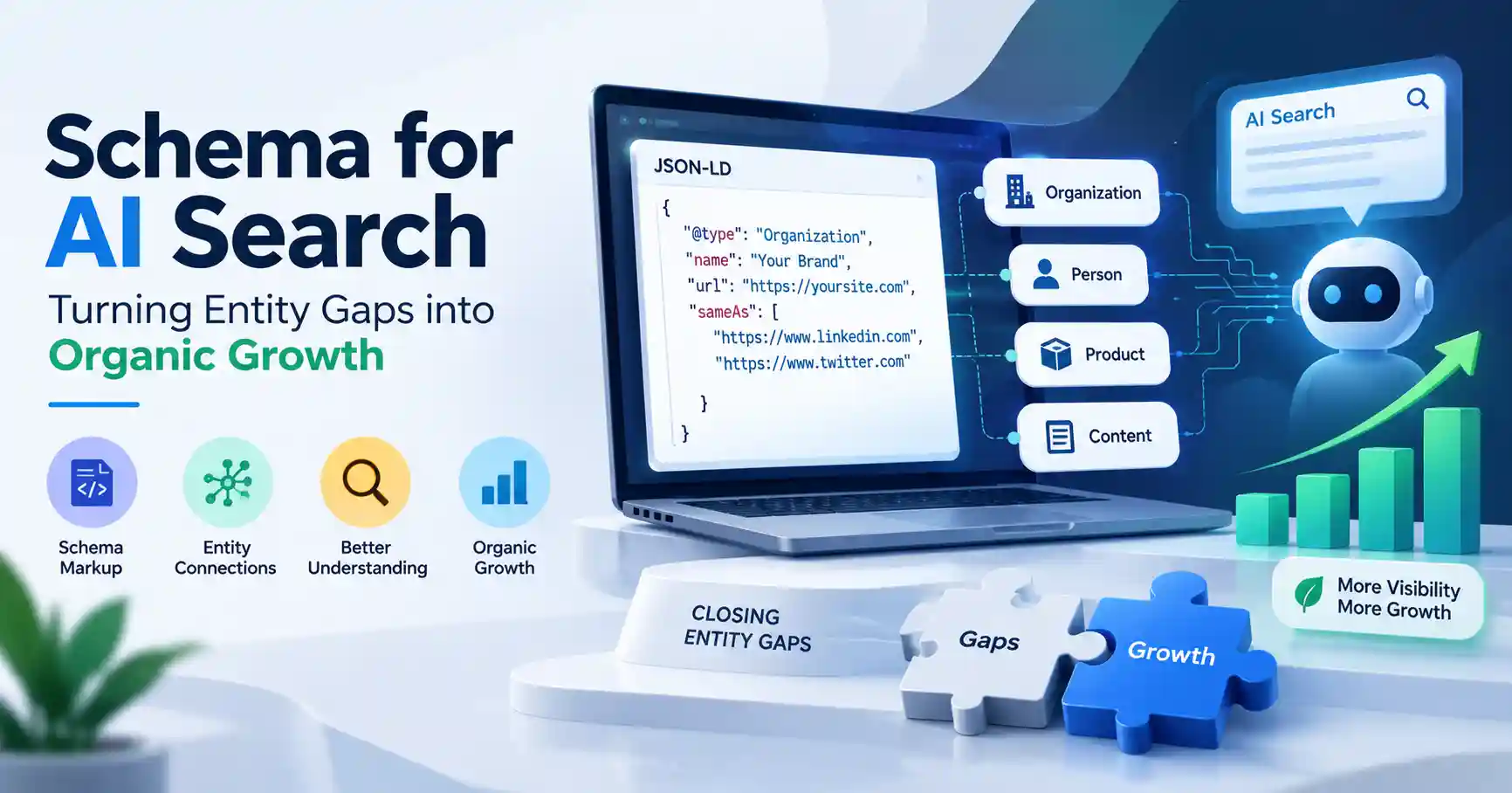
Think of schema markup as a layer of machine readable context.
Your page says, “Acme is a software company that provides subscription billing.”
Schema can help explicitly classify Acme as an organization and connect it with relevant properties, URLs, products, people and other entities.
AI search cares about connections, not isolated markup. Tie an article to its author, link that creator to a business, and bind the whole thing directly to a specific product. That is the real play. Consistent identifiers like @id forge a tight entity graph across sprawling domains. It explains precisely why structured data and knowledge graphs constantly emerge in the same conversation today.
Yet, restraint wins. Dumping every single Schema property into your code just because you can is a flawed strategy. Keep the markup grounded in verifiable facts actually living on the page.
Google also recommends JSON LD as its preferred structured data format when the site’s setup allows it.
For a deeper look at the technical side, see iTech Manthra’s guide to technical SEO for AI search.
Which entity gaps should you fix first?
Not every missing entity deserves the same amount of attention.
A useful way to approach an entity audit is to put missing or weak information into three buckets: legible, ambiguous and unverifiable.
A legible entity is clearly described and supported.
That’s an ambiguous entity for you, the site leaves it wide open. It is unverifiable, floating there without enough data for search engines or AI to pin down the exact concept. This tactic? It directly mirrors the entity gap framework from recent Search Engine Land research.In one higher education analysis, important gaps appeared around curriculum, faculty, admissions and financial aid information rather than simply missing keywords.
For most businesses, start with your money pages.
Look at product pages, service pages, category pages and important landing pages. Ask a simple question:
If an AI system had to explain this page without seeing the rest of the website, would it have enough evidence to describe the business accurately?
If the answer is no, you’ve probably found an entity gap.
How can content and schema work together for AI search?
This is where many schema strategies fall apart.
A marketer discovers a missing property, adds it to JSON LD and moves on. But if the visible page doesn’t support that information, the markup isn’t solving the underlying problem.
The stronger approach is to fix the content and structured data together.
Suppose your product schema says your software supports three billing models, but the product page only vaguely says “flexible billing.”
That’s an information gap.
Improve the visible copy first. Explain the three billing models clearly, identify which customers they’re intended for and provide relevant examples. Then make sure the structured data accurately represents the information that can actually be supported.
This bridges human reading with machine vision. Google warns flat out against markup hiding outside the primary page content, Sure, structured data helps you land special search features, but they make zero guarantees. Those perks might appear, Or they might completely vanish. It is always a gamble.
So, schema isn’t a shortcut around content quality.
It’s part of the infrastructure supporting it.
Can entity SEO improve organic growth, not just AI visibility?
Yes, but the important word is can.
Schema markup alone doesn’t guarantee rankings, AI citations or traffic.
What makes entity work interesting is that it can expose weaknesses that traditional keyword audits sometimes miss.
You might discover that a service page ranks for its target keyword but doesn’t clearly explain pricing, eligibility, integrations, outcomes or use cases. Fixing those gaps can make the page more useful to potential customers, regardless of whether an AI system cites it.
Recent Search Engine Land case studies illustrate this distinction. One partner increased AI citations substantially while also improving lead quality another saw organic lead and application growth after combining entity reconciliation with content improvements.
That’s a better way to think about Generative Engine Optimization (GEO).
Don’t chase citations as the only KPI. Improve the underlying information architecture so search engines, AI systems and humans can all understand the same business more clearly.
If you’re already working on AI visibility, this related guide on how to optimize for AI search can help you connect entity work with a broader AI SEO strategy.
What should you check in an AI search schema audit?
You don’t need a giant technical spreadsheet to get started.
Work through your most important pages and check five areas.
1. Organization and brand information: Is your business name, website, logo and identity consistent?
2. People and authors: Are important experts, founders and authors clearly identified?
3. Products and services: Are products connected to the correct brand, categories, features and use cases?
4. Supporting content: Do articles, guides and FAQs reinforce the entities mentioned on commercial pages?
5. Relationships: Are related entities connected through consistent URLs, internal links and identifiers?
Then validate the implementation.
Google suggests using their Rich Results Test for structured data, and inspecting URLs for their rendering. Here’s the thing, though: That information gap? You gotta bridge it way, way before even thinking about markup code.
If the website doesn’t clearly establish a fact, schema shouldn’t be used to manufacture one.
What does this mean for SEO in the AI era?
The old SEO question was often, “Which keyword should this page rank for?”
The newer question is becoming, “What does this page represent, and can search systems confidently understand it?”
That’s a much more useful question.
Treat AI search schema as core infrastructure, never a cheap trick to game rankings. You must build a solid entity model first. Find content gaps, patch them up, and weave related pages tightly together. Structured data cements those connections. Makes sense, right?
And keep checking.
Businesses change. Products change. People change roles. Pricing changes. Features disappear. New services launch. Your entity graph can become outdated surprisingly quickly.
Flashy tech rarely saves a site. Making your core business blindingly obvious does. When Google and modern AI engines can effortlessly decipher who you are, what you offer, the exact audience desperate for it. And how the gears turn, you systematically eradicate any pathetic excuse they might use to bypass your content completely.
FAQ’s
Not directly or automatically. Schema helps search engines understand and classify page information, but it doesn’t guarantee rankings or AI citations.
An entity gap means you are missing vital details. It represents completely unsupported info regarding a key company, product, person, or relationship.
No. Traditional SEO often focuses heavily on queries, keywords and pages. Entity SEO focuses more on clearly defining entities and the relationships between them.
The right type depends on the page. Organization, Person, Article, Product, Breadcrumb and other relevant Schema.org types can be useful when they accurately describe visible page content.
Treat SEO as a living pulse, never a static chore. The moment your offerings, team, or market footing shifts, refresh those crucial entities instantly. Why wait?
Conclusion
AI search doesn’t make traditional SEO irrelevant. It makes clarity more valuable.
The websites that build strong content, consistent entities, useful internal connections and accurate structured data give search systems more context to work with and that’s a far more sustainable strategy than chasing the latest AI search hack.

Kumar Swamy is the CEO of Itech Manthra Pvt Ltd and a dedicated Article Writer and SEO Specialist. With a wealth of experience in crafting high-quality content, he focuses on technology, business, and current events, ensuring that readers receive timely and relevant insights.
As a technical SEO expert, Kumar Swamy employs effective strategies to optimize websites for search engines, boosting visibility and performance. Passionate about sharing knowledge, he aims to empower audiences with informative and engaging articles.
Connect with Kumar Swamy to explore the evolving landscape of content creation!