What happens when someone searches for your product, gets a detailed answer from Google, and never needs to click your ad?
That’s the uncomfortable question marketers are dealing with as AI Overviews become a bigger part of Google Search. Paid search hasn’t disappeared, but the environment around it has changed. The searcher may now see an AI generated answer, supporting sources, organic listings, and paid ads all competing for attention on the same results page.
Google says ads can appear above, below, and in some cases within AI Overviews, with existing Search, Shopping, and Performance Max campaigns eligible for these placements.
For advertisers, that means the old “bid harder and get more clicks” approach isn’t enough anymore.
The smarter question is: Which searches deserve a higher bid, which ones require stronger AI search visibility, and which ones should be handled by demand generation instead?
What are AI Overviews changing about paid search?
Traditional PPC is built around a relatively simple exchange: someone searches, sees an ad, clicks, and potentially converts.
AI Overviews complicate that journey.
A user might search for “best CRM for a small SaaS company” and receive a useful comparison before they ever reach the paid listings. If the answer satisfies their immediate question, the search becomes a zero click interaction.
Research from Seer Interactive found substantially lower paid CTR on queries where AI Overviews appeared in its dataset, although its study covered a limited share of paid search impressions.
That doesn’t mean every AI Overview destroys PPC performance. Transactional searches can behave very differently from informational searches.
Someone asking “what is CRM?” may be happy with an AI answer. Someone searching “buy CRM software for 20 users” has a much stronger reason to visit a website.
That difference in intent is becoming one of the most important parts of a modern paid search strategy.
Should you still fight for the top paid search position?
Yes but only when the click is valuable enough to justify the fight.
This is where commercial intent matters.
Searches containing terms such as “buy,” “pricing,” “quote,” “demo,” “supplier,” “near me,” or specific product names often indicate that the user is closer to making a decision. These are the searches where appearing prominently can still make a meaningful difference.
Google’s own guidance confirms that ads remain eligible around AI Overviews, while the existing ad auction and ranking signals continue to determine eligibility and placement.
So instead of asking, “How do I get more impressions?” ask:
What does one additional top position actually produce?
Look at metrics such as:
- Absolute top impression share
- Impression share lost to rank
- Conversion rate
- Cost per qualified lead
- Cost per acquisition
- Revenue or pipeline generated
- Search term level profitability
If moving from a lower position to the top produces substantially more qualified conversions, the premium may make sense.
If it simply produces expensive clicks from people who already received their answer from an AI Overview, increasing bids may just increase waste.
That’s the difference between managing a PPC account and simply feeding the auction.
How can advertisers influence AI search visibility?
Not every important search should be treated as a bidding opportunity.
Some searches are better understood as AI search visibility opportunities.
Think about informational and research heavy queries. A prospect might search:
“Which project management software is best for a remote team?”
The AI Overview can summarize the options, explain differences, and potentially mention specific brands.
The user may never click the cited websites.
But the brands mentioned in that answer can still enter the consideration set.
That changes the definition of visibility.
Your brand doesn’t necessarily need to win the click immediately. It needs to become one of the credible answers that appears when the buyer researches the category.
This is where PPC, SEO, content marketing and what is increasingly called generative engine optimization need to work together.
Your website should clearly explain products, comparisons, use cases, pricing, features and limitations. Your broader web presence also matters because AI systems rely on information from multiple sources when constructing answers.
Google has also expanded advertising into AI powered Search experiences, including AI Overviews, while encouraging advertisers to use AI powered targeting and high quality creative.
In other words, the future isn’t simply about buying the first position.
It’s about making your brand useful enough to be part of the answer.
For brands working on broader AI visibility, a useful related resource is multilingual websites and AI visibility.
When should you stop chasing clicks and start generating demand?
This is probably the biggest strategic change.
Some searches have become difficult to monetize directly because the user can get enough information without visiting a website.
That doesn’t mean the underlying demand has disappeared.
It may simply mean that search is no longer the best place to create that demand.
Imagine someone researching “how much does enterprise cybersecurity software cost?”
They might read an AI Overview, compare several providers and leave without clicking.
You can keep increasing bids and hope to capture that person.
Or you can reach them earlier through YouTube, social content, thought leadership, webinars, email, community discussions and other demand generation channels.
Then, when that same person later searches for your brand or a commercial product term, your paid search campaign can capture the demand you helped create.
That creates a healthier relationship between demand generation and PPC advertising.
Google’s recent guidance on AI Search also emphasizes the changing customer journey and the growing role of broader, more conversational search behavior.
The important point is measurement.
Don’t judge every demand generation activity purely on last click ROAS. Some of its value may show up later through branded searches, direct traffic, returning visitors, assisted conversions or sales pipeline.
How should you divide your Google Ads budget in the AI search era?
A practical way to approach this is to divide search opportunities into three groups.
1. Protect high intent searches
These are searches where the user has a clear commercial reason to act.
Keep competitive coverage where the economics work.
Focus on profitable search terms rather than chasing maximum visibility for every keyword.
2. Build influence around research searches
These are searches where users are comparing, learning or exploring.
Here, coordinate your Google Ads campaigns with SEO and content.
Your ad can address the immediate question while your website provides deeper evidence, comparisons, case studies and product information.
The objective isn’t always the immediate click. It can also be helping your brand become recognizable during the research process.
3. Create demand where search has become saturated
When AI answers and zero click behavior make informational search less efficient, consider shifting part of the budget toward channels that create interest before the search happens.
YouTube, Demand Gen, social media, original research, newsletters and educational content can all play a role.
Then paid search becomes the capture mechanism when intent becomes stronger.
This three part approach is more flexible than treating every keyword as if it deserves the same bidding strategy.
What should marketers measure beyond clicks and CTR?
CTR still matters, but it shouldn’t be the only number on the dashboard.
AI Overviews are forcing marketers to look at the entire customer journey.
Track:
- Paid search CTR
- Conversion rate
- Cost per qualified lead
- Absolute top impression share
- Impression share lost to rank
- Brand search volume
- Assisted conversions
- Returning visitors
- Pipeline influenced
- Revenue by search intent
- AI Overview visibility and brand mentions where reliable measurement is available
This is especially important because AI Overviews and paid ads can appear together. Semrush’s analysis of more than 600,000 keywords found that AI Overviews were increasingly appearing alongside Google Ads and that keywords with AI Overviews generally showed higher average CPCs across many industries.
The lesson isn’t “AI Overviews are bad for advertisers.”
The lesson is simpler: the same CPC doesn’t necessarily represent the same opportunity anymore.
What does the future of paid search look like with AI Overviews?
Paid search isn’t going away. It’s becoming more contextual.
Google is already using the query and the content of the AI Overview when determining which ads can appear within these experiences.
That means advertisers need to think beyond individual keywords.
Intent, creative relevance, landing page quality, conversion signals and brand authority all become more important.
As Google’s advertising ecosystem becomes more automated, clean conversion data also matters. If you tell the system that every form fill is equally valuable when only a small percentage become qualified opportunities, automation can optimize toward the wrong outcome.
The practical rule is straightforward:
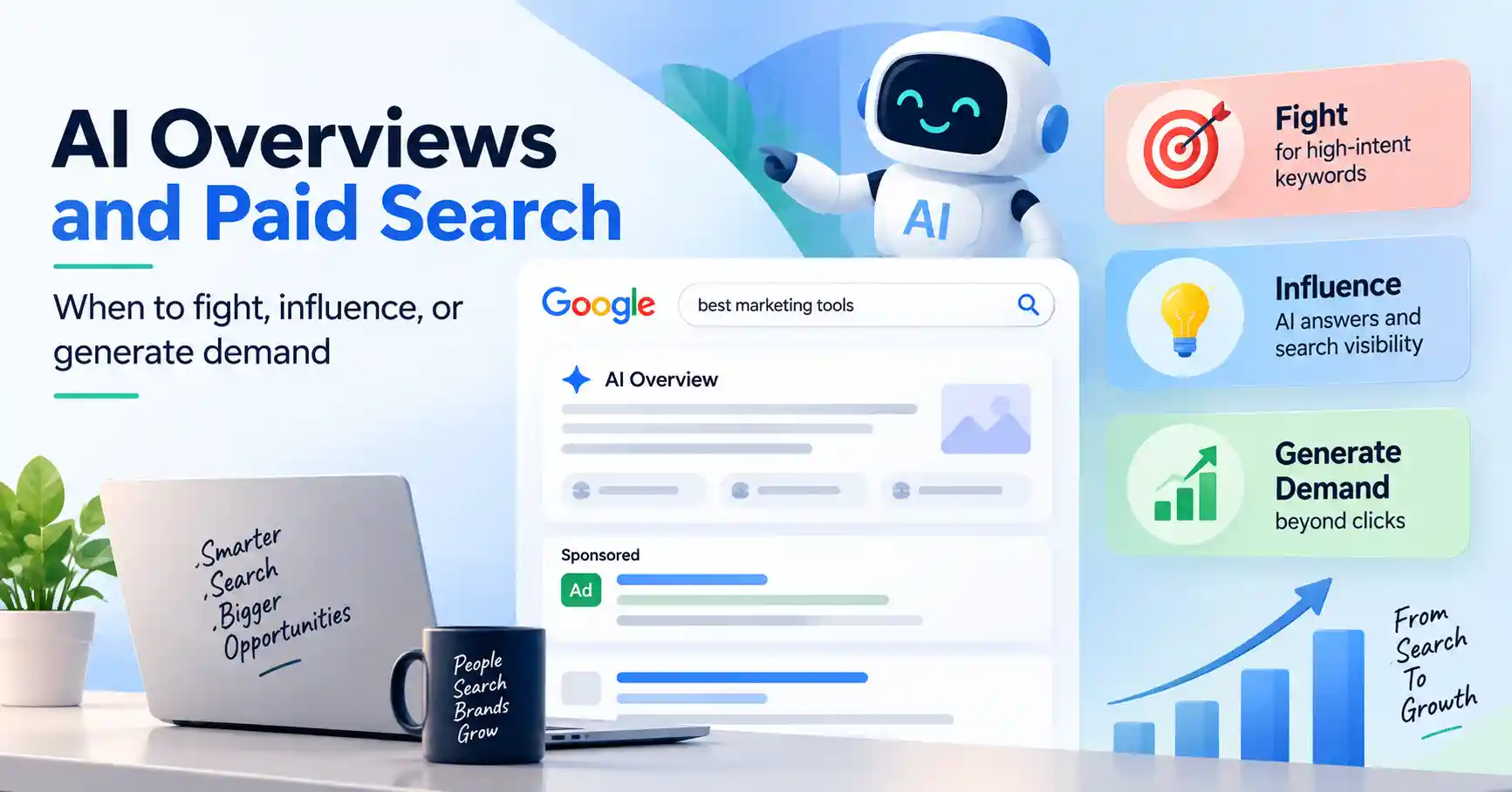
Don’t fight AI Overviews everywhere. Don’t ignore them either.
Fight where commercial intent and economics justify it.
Influence where AI answers shape consideration.
Generate demand where informational searches are increasingly being satisfied without a click.
That mindset gives paid search a role beyond simply buying traffic.
FAQ’s
They can, particularly on informational and research focused searches where the AI Overview answers the user’s question before they interact with traditional results. The effect varies considerably by query, industry and intent.
Yes. Google says eligible Search, Shopping and Performance Max ads can appear above, below or within AI Overviews in supported markets and experiences.
Not automatically. Start by separating high intent commercial searches from informational searches and compare conversion quality, CPA and revenue rather than looking only at CTR.
Longer, more specific and conversational searches can create new opportunities because they often reveal stronger context and intent. Google’s 2026 India research also highlights the growth of conversational and multimodal search behavior.
Combine strong paid search fundamentals with SEO, useful first party content, accurate conversion data and broader brand building. Your goal should be to remain visible throughout the journey, not depend on one position on the Google results page.
Conclusion:
AI Overviews haven’t made PPC irrelevant. They’ve made the old definition of PPC incomplete.
The winning strategy is no longer about getting every possible click. It’s about understanding what the searcher is trying to accomplish and deciding whether your marketing should capture that demand, influence the answer, or create demand before the search happens.
For some queries, the best move will still be an aggressive paid search position. For others, SEO and AI search visibility will matter more. And for increasingly competitive informational searches, demand generation may be the smarter place to invest.
Search is changing quickly, so your budget strategy should change with it.

Kumar Swamy is the CEO of Itech Manthra Pvt Ltd and a dedicated Article Writer and SEO Specialist. With a wealth of experience in crafting high-quality content, he focuses on technology, business, and current events, ensuring that readers receive timely and relevant insights.
As a technical SEO expert, Kumar Swamy employs effective strategies to optimize websites for search engines, boosting visibility and performance. Passionate about sharing knowledge, he aims to empower audiences with informative and engaging articles.
Connect with Kumar Swamy to explore the evolving landscape of content creation!