Have you noticed that Google search is starting to answer questions before you even click a website? AI Overviews, ChatGPT, Gemini, Perplexity and other AI powered search experiences are changing how people discover information. And for businesses, that creates a new challenge: it’s no longer enough to rank well. You also want your brand and content to become sources that AI systems trust and cite.
That’s where AI search optimization and generative engine optimization (GEO) come in.
The good news is that you don’t need to throw away everything you’ve learned about SEO. In fact, many traditional SEO fundamentals still matter. The difference is that you now need to make your website easy for machines to understand, useful enough for people to remember, and authoritative enough for other websites to reference.
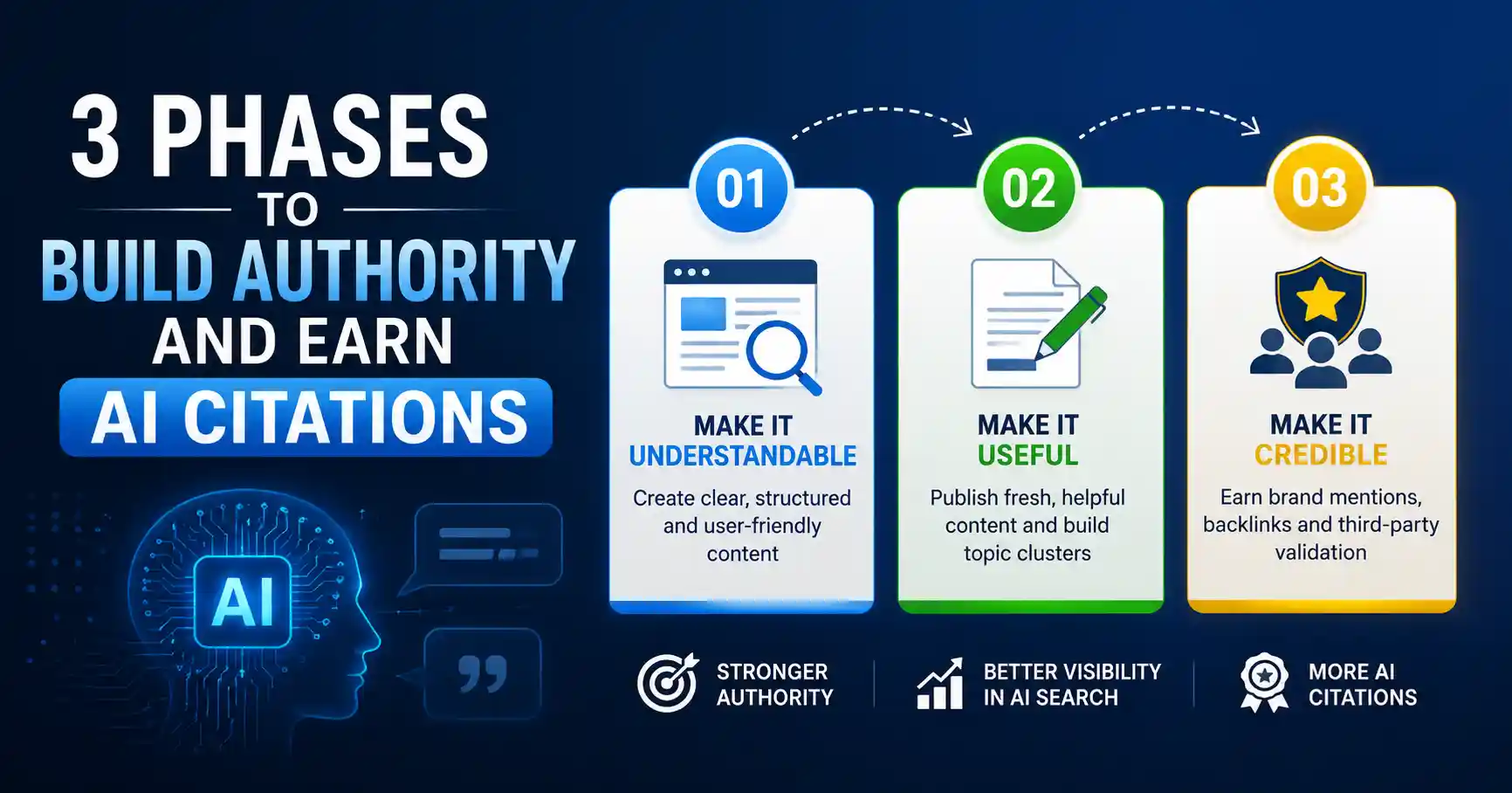
Here’s a practical three phase approach to build authority and earn more AI citations.
What does it take to build authority and earn AI citations?
Think of AI visibility as building trust, not chasing keyword tricks. An algorithm wants three basic facts about your brand: who you are, your actual expertise. And whether trusted sources back you up. Period. That is precisely why spamming dozens of AI articles rarely ever works. Google itself says focus on accuracy and genuine relevance instead of churning out empty digital noise that adds zero value to anyone.
Current research also suggests that traditional rankings and AI citations overlap, but they aren’t identical. Ahrefs’ 2026 analysis found that about 38% of pages cited in AI Overviews also appeared in the top 10 traditional search results, meaning a significant portion came from elsewhere.
In other words, ranking still helps. But authority has become bigger than rankings.
Phase 1: How can you make your website easier for AI to understand?
Start with the foundation.
Before worrying about digital PR or chasing mentions on big websites, make sure your own website clearly explains what your business does.
Use descriptive page titles, logical H1 and H2 headings, short sections, meaningful internal links and straightforward language. Your important pages should be easy for both visitors and search crawlers to navigate.
For example, a service page shouldn’t make visitors hunt through five paragraphs to understand what you actually offer. Put the answer where people expect it.
The same applies to product pages. Clearly explain features, benefits, comparisons, use cases and frequently asked questions.
This matters for Google AI Overviews because AI search systems need to retrieve and interpret information from web pages before they can use that information in an answer.
Don’t forget your basic technical SEO either. Make sure important pages can be crawled, indexed and rendered properly. Keep your navigation sensible, fix broken internal links and update outdated information.
One useful rule is simple: if a human has trouble understanding your page, an AI system probably won’t have an easier time with it.
You can also strengthen your overall strategy by building on page and technical foundations alongside your broader AI SEO strategy.
Phase 2: How does fresh content help your brand get noticed by AI?
Once your website is understandable, the next step is giving AI systems something genuinely useful to understand.
This is where content strategy becomes important.
Instead of publishing random articles based on whatever keyword happens to have search volume, build content around the questions your audience actually asks.
For example, a SaaS company shouldn’t only create a page targeting “project management software.” It could build a complete topic cluster around project management, including:
- How to choose project management software
- Project management software for small businesses
- Project management vs task management
- Common project management mistakes
- Project management workflow examples
- How to improve team productivity
This creates a much clearer picture of the brand’s expertise.
Topic clusters also fit naturally with the way modern AI search works. AI systems can break complex questions into related queries and gather information from multiple sources before constructing an answer.
Freshness matters, too.
Don’t assume an article is finished forever once it has been published. Statistics change. Products change. Search behavior changes. Even terminology changes.
Review your strongest pages regularly. Update outdated examples, replace old statistics, add new information and improve sections that no longer answer the user’s question properly.
And don’t think “fresh content” always means starting from scratch.
A strong article can become a LinkedIn post, infographic, short video, newsletter section or social discussion. One useful idea can create several connected content assets.
As Search Engine Land’s Eric Hoover explains, the goal isn’t simply to get an AI system to understand your brand third party sources can play an important role in getting the brand actually cited.
That’s where the third phase comes in.
Phase 3: Why do brand mentions and digital PR matter for AI citations?
Here’s the part many businesses overlook.
Your own website can tell everyone how great you are. But independent sources can provide something you can’t create for yourself: outside validation.
This is why brand mentions are becoming increasingly important in AI search optimization.
Think about how people make buying decisions. They don’t only read the company’s website. They check reviews, comparisons, industry publications, Reddit discussions, YouTube videos, expert opinions and other independent sources.
AI systems have access to many of those same information ecosystems.
Research from Search Engine Journal has highlighted the importance of third party content in AI search citations, with different AI platforms drawing from different combinations of sources such as YouTube, Reddit, LinkedIn and industry publications.
So don’t make your digital PR strategy all about getting one huge publication to mention you.
A respected niche publication can be extremely useful. An expert podcast can help. A relevant industry comparison can help. A genuine customer review can help. A useful discussion on a community platform can help.
The goal is to create a consistent trail of credible information around your brand.
This also means your messaging needs to match.
Your website says one thing, your social profiles claim another, and random articles tell a third story. That creates a mess. You are confusing actual humans and AI systems alike. Nobody can figure out what your business actually is.
Consistency builds confidence.
Can small businesses really compete for AI citations?
Absolutely. And this is one of the more interesting parts of the shift.
You don’t need a huge brand or tons of backlinks. A small business with real expertise can publish original research, drop useful case studies, answer niche questions. And build solid relationships with relevant publishers. It works.
In fact, highly specific expertise can sometimes be more useful than generic content.
Suppose you’re a local cybersecurity company. Instead of trying to compete immediately for “cybersecurity,” create genuinely useful resources around questions your ideal customers ask:
“Cybersecurity checklist for small accounting firms”
“How should a 20 person business protect customer data?”
“Common phishing attacks targeting small businesses”
That kind of focused content gives search engines and AI systems more context about your expertise.
The broader lesson from current GEO research is that authority is increasingly topic specific. Being famous online isn’t enough if you aren’t clearly associated with the subject being searched.
How should SEO, GEO and content marketing work together?
Don’t treat generative engine optimization as a replacement for SEO.
Treat it as another layer.
Traditional SEO helps your pages become discoverable. Good content helps them become useful. Digital PR and third party mentions help establish credibility.
Put the three together and you have a much stronger foundation for AI visibility.
A simple workflow looks like this:
Make it discoverable → Make it useful → Make it credible → Keep it fresh → Measure AI visibility → Improve what works.
And don’t obsess over one AI platform.
Google AI Overviews, AI Mode, ChatGPT, Gemini and Perplexity don’t necessarily use exactly the same sources or produce the same answers. Visibility can move around as models, indexes and search experiences change.
That means your long term goal shouldn’t be “get cited once.”
It should be become consistently recognizable as a useful source within your topic.
If you want to understand the wider shift from traditional SEO toward AI driven discovery, our guide to SEO in the age of AI provides useful context.
What should you do first to improve AI visibility?
Don’t try to do everything at once.
Start with your most important pages and work through the three phases.
First, check whether search engines and AI systems can clearly understand your website. Next, identify content gaps and build useful topic clusters around real customer questions. Then look outside your website and find opportunities for reviews, expert mentions, industry publications, partnerships and digital PR.
Finally, measure what happens.
Track traditional rankings, organic traffic, brand mentions and, where possible, AI citations and AI visibility. Current AI search research shows that citation patterns can change considerably, so checking performance once and forgetting about it isn’t enough.
The biggest mistake would be chasing an “AI ranking hack.”
There probably isn’t one.
The brands that win over time will be the ones that make their expertise easy to discover, easy to understand and difficult to ignore.
FAQ’s
AI citations are links or references that AI powered search systems provide to sources used to support an answer. They can appear in experiences such as Google AI Overviews and other AI search platforms.
Yes. Traditional SEO still matters because AI systems need to discover and retrieve web content. However, ranking alone doesn’t guarantee an AI citation. Current research shows that many cited pages don’t occupy the traditional top search positions.
Generative engine optimization, or GEO, is the practice of improving a brand’s content and online presence so generative AI systems can understand, mention and potentially cite it in their answers.
They can. Independent mentions help create a broader picture of a brand across the web. Research and industry studies increasingly point to third party content as an important source of AI citations
There is no set timeline. It all depends on your current authority, content quality, niche competition, technical setup, and brand mentions. Treat AI visibility as a continuous authority building grind instead of a simple SEO checkbox.
Conclusion
Building authority and earning AI citations isn’t about stuffing another AI related keyword into your content. It’s about becoming a source worth citing.
Make your website accessible. Create genuinely useful and fresh content. Build topic clusters around real questions. Then earn credibility through third party mentions, reviews, partnerships and digital PR.
The three phases work together. A technically strong website gives AI something to find. Useful content gives it something to understand. Independent authority gives it a reason to trust you.
And that’s the real opportunity in AI search: don’t just try to rank for the answer. Build a brand that becomes part of the answer.

Kumar Swamy is the CEO of Itech Manthra Pvt Ltd and a dedicated Article Writer and SEO Specialist. With a wealth of experience in crafting high-quality content, he focuses on technology, business, and current events, ensuring that readers receive timely and relevant insights.
As a technical SEO expert, Kumar Swamy employs effective strategies to optimize websites for search engines, boosting visibility and performance. Passionate about sharing knowledge, he aims to empower audiences with informative and engaging articles.
Connect with Kumar Swamy to explore the evolving landscape of content creation!