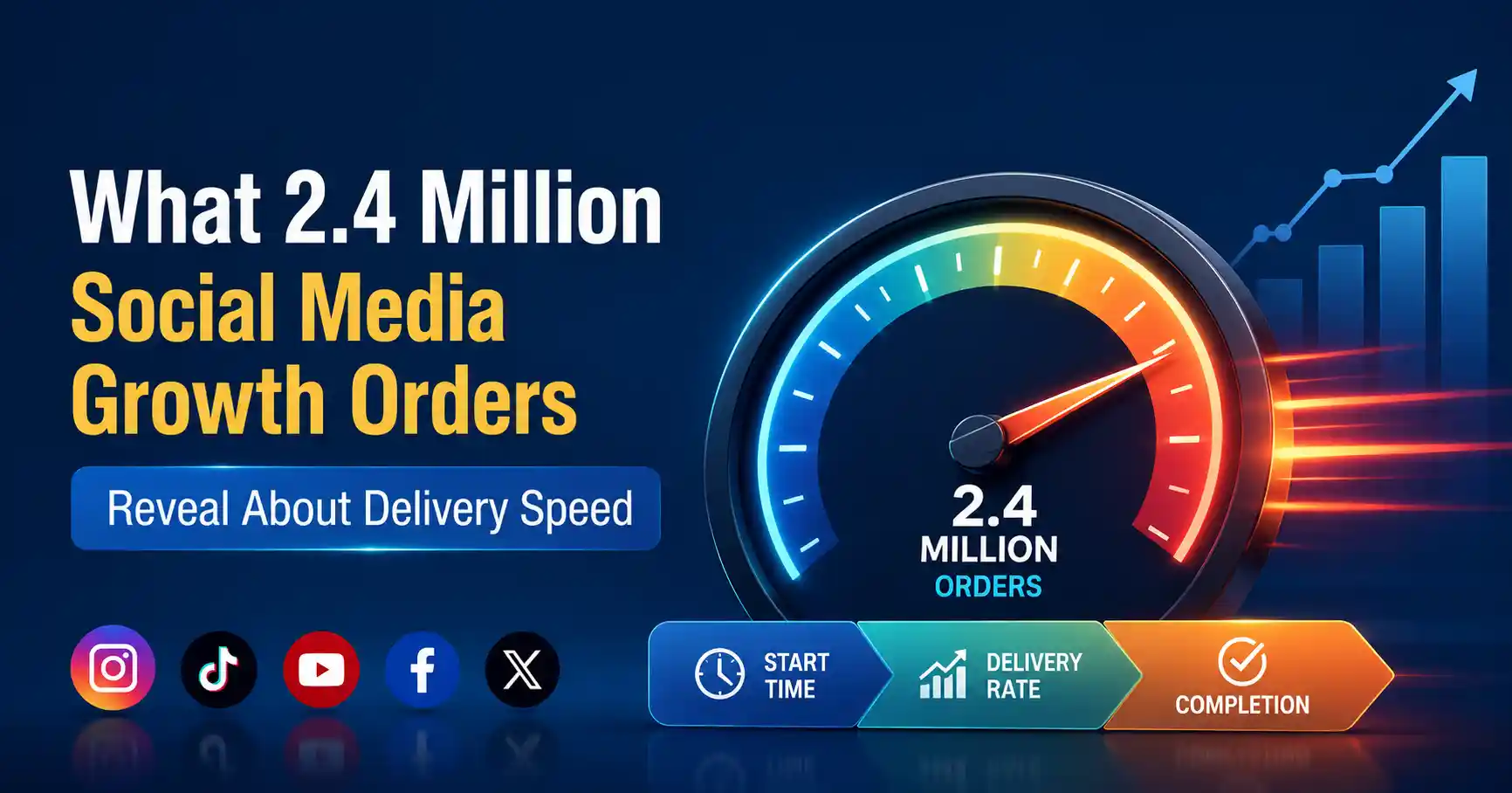
In social media marketing, delivery speed is often treated as a simple promise. Buyers see words such as “fast,” “instant” or “rapid” and assume every order will follow the same timeline. In practice, fulfillment is influenced by the platform, service category, order quantity, demand and the accuracy of the information submitted.
More than 2.4 million social media growth orders offer a broader lesson for marketers: delivery speed should be understood through patterns, not isolated claims. A large order history does not mean every service moves at the same rate. Instead, it shows why agencies and buyers need to distinguish between start time, delivery rate and completion.
Delivery Speed Has Three Stages
The first stage is the time an order waits before activity begins. The second is the delivery rate, which describes how quickly the requested engagement is added after processing starts. The final stage is completion, when the full ordered quantity has been delivered.
These stages can create different experiences. One order may begin within minutes but progress gradually. Another may remain pending for longer before moving faster. Both may still be operating within their stated expectations.
For marketing teams, this distinction matters. A campaign planned around an “instant start” description may still need several hours before the full result appears. Reading service details is more useful than relying on one speed label.
Order Size Changes the Timeline
Quantity is one of the clearest reasons delivery times vary. A small order for likes or views may be completed more easily than a large order involving thousands of followers, subscribers or engagements. Higher quantities require more capacity and may be processed in stages.
Agencies handling several client accounts should also consider total workload. Placing multiple large orders at the same time can produce different completion windows, even when the services appear similar. Building a reasonable buffer into campaign plans helps agencies avoid promising deadlines that may be too narrow.
Starting with a smaller test order can provide useful information. It allows the buyer to observe how quickly the service begins, how steadily it progresses and whether the description matches the experience.
Different Services Follow Different Patterns
Social media services should not all be judged by the same timeline. Views, likes, followers, comments, shares, subscribers and live-stream engagement have different fulfillment requirements. Delivery can also vary between Instagram, TikTok, YouTube, Facebook, Telegram and X. Since each platform has its own discovery algorithms, understanding social search visibility can also help marketers optimize campaigns beyond engagement metrics and improve long-term content performance.
A high-volume view service may move differently from a customised comment service. A follower service may also be delivered at a controlled pace rather than all at once. These differences do not mean one service is better than another; they reflect how each service is structured.
A global SMM panel should provide enough information for buyers to compare expected start times, delivery rates and service conditions before ordering.
Price and Speed Should Be Considered Together
Price is another part of the delivery discussion. The least expensive option may suit a flexible campaign, but it may come with a different speed, refill condition or retention expectation. A higher-priced service may offer a quicker start, steadier delivery or additional targeting features.
This does not mean buyers should choose solely by price. When using an International SMM Panel, the full-service description should be assessed more carefully. A flexible campaign may not need premium-speed delivery, while a scheduled launch may require a predictable window.
Platforms such as SMM World allow marketers and agencies to review available services and select options according to budget, timing and campaign requirements. The objective is not simply to find the fastest listing, but to choose a service that fits the campaign.
Unrealistic Speed Claims Create Risk
Claims of immediate or guaranteed completion can create problems when buyers interpret them too literally. Social platforms change, services undergo maintenance and heavy demand may affect processing. Incorrect links, private accounts or duplicate orders can also cause delays.
Reliable providers set expectations clearly rather than presenting every order as instant. Buyers should review estimated start times, completion notes, refill terms and cancellation conditions before paying. Agencies should then communicate those expectations honestly to clients.
Clear information protects both sides. It reduces support requests and helps marketers plan campaigns without relying on promises that may be difficult to maintain.
Conclusion
More than 2.4 million social media growth orders show that delivery speed is not one fixed number. It is shaped by order size, service category, platform conditions, demand and the way fulfillment is managed.
For agencies and marketers, the strongest approach is to compare service details, test before scaling and build realistic timelines. Consistency and transparency are more valuable than an impressive “instant” label. When buyers understand how delivery works, they can select services confidently, communicate accurately and plan campaigns around practical expectations.

Nishanth Kumar is the Lead SEO Strategist at iTech Manthra. With over a decade of experience in the digital marketing landscape, he specializes in technical SEO, link-building strategies, and search engine algorithms. Nishanth has helped hundreds of businesses scale their organic presence through data-driven marketing and sustainable “white-hat” techniques. He is passionate about decoding Google’s ever-changing updates to help brands stay ahead of the competition.