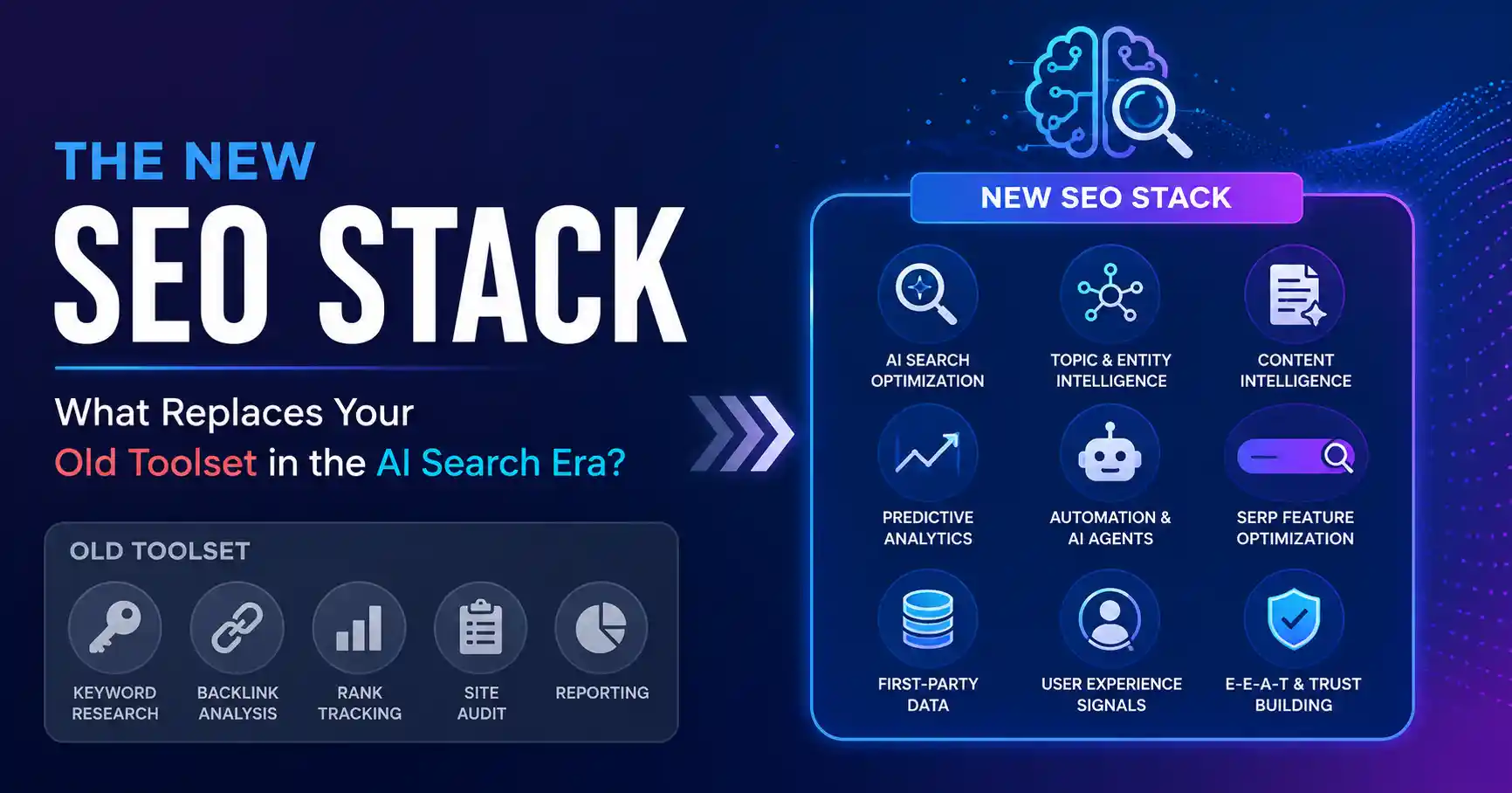
Remember when SEO tools felt like magic? Now, a couple of years later, they barely scratch the surface of our real questions. What happened?
Ranking reports still matter. Keyword research is still important. Technical audits remain crucial, no doubt, but AI search, it’s fundamentally reshaping how people discover, engage with brands, and ultimately purchase. Merely eyeing rankings and backlinks just won’t cut it anymore.
Honestly, SEO professionals require a truly contemporary toolkit today. It demands a synergy of traditional optimization with AI visibility, robust automation, acute analytics, entity comprehension, and content intelligence.
Is your current toolbox stuck in the past? Chances are, your SEO strategy is too.
So, let’s explore this updated SEO stack and grasp its newfound importance.
Why is the traditional SEO toolset no longer enough?
For years, SEO success depended on a familiar workflow:
- Keyword research
- On-page optimization
- Link building
- Rank tracking
- Technical audits
These activities are still valuable, but they’re no longer the complete picture.
Modern search now includes:
- AI Overviews
- Conversational search
- Entity-based understanding
- Personalized results
- Multimodal search experiences
That means marketers need to measure far more than rankings.
As digital strategist Nina Lopez says:
“The best SEO teams today don’t replace their old tools. They expand their stack to understand how AI interprets brands, content, and user intent.”
What should the modern SEO stack include?
The best SEO stack combines traditional optimization with AI-driven insights.
A modern toolkit should include five core areas:
1. Technical SEO platform
Technical health remains the foundation of search visibility.
Look for tools that help monitor:
- Crawlability
- Indexing
- Core Web Vitals
- Structured data
- Internal linking
- Site architecture
Without a technically healthy website, even excellent content can struggle to perform.
2. AI-powered keyword and intent research
Keyword research is evolving.
Instead of targeting isolated phrases, marketers should understand:
- Search intent
- Topic clusters
- User questions
- Semantic relationships
- Entity relevance
This creates content that performs well in both traditional search and AI-generated answers.
3. Content optimization and topical authority
Publishing hundreds of articles isn’t the goal anymore.
Dominate your niche using content clusters. Dig deep, these massive guides must exhaustively answer every single question.
High-quality content should:
- Solve real problems
- Demonstrate expertise
- Include original insights
- Stay updated
- Cover related entities naturally
Businesses interested in AI-powered workflows should also explore Turn your SEO process into AI-powered tools, which explains how automation can improve productivity without sacrificing quality.
How does AI change the SEO workflow?
Artificial intelligence isn’t replacing SEO professionals.
It’s changing how they work.
Today’s AI tools can assist with:
- Content briefs
- SERP analysis
- Topic discovery
- Content gap analysis
- Internal linking suggestions
- Workflow automation
AI tackles the drudgery, sure, freeing marketers for actual ingenuity. But it’s not foolproof, not by a long shot. Your sharp ideas, your industry smarts, your solid judgment, still your undeniable edge.
Why is entity SEO becoming part of the new SEO stack?
Search engines increasingly understand brands as entities rather than collections of keywords.
That means your SEO strategy should help search engines understand:
- Who you are
- What you do
- Which topics you specialize in
- Why users should trust you
This includes:
- Consistent brand information
- Structured data
- Expert content
- Author profiles
- Digital mentions
- Topical consistency
If you’re interested in this shift, read Google’s LLM patent suggests a new goal for SEO Teaching AI Who You Are, which explores how AI models increasingly rely on entity understanding.
Which metrics matter most in the new SEO stack?
Modern SEO reporting goes beyond rankings.
Track metrics such as:
- Organic traffic
- AI search visibility
- Branded search growth
- Click-through rate
- Engagement
- Conversions
- Assisted conversions
- Customer lifetime value
- Topic authority
These KPIs provide a more complete picture of business impact.
What role does automation play?
Automation is becoming a standard part of SEO.
The goal isn’t to remove marketers from the process.
The goal is to eliminate repetitive tasks.
Automation can help with:
- Site monitoring
- Technical audits
- Rank tracking
- Content workflows
- Reporting
- Internal linking opportunities
The most effective SEO teams combine automation with expert review.
How can businesses build a future-ready SEO stack?
Start with these priorities:
- Maintain a technically healthy website.
- Create authoritative content clusters.
- Optimize for entities, not just keywords.
- Monitor AI search visibility.
- Automate repetitive workflows.
- Measure business outcomes instead of rankings alone.
For official guidance on technical optimization, Google recommends following the best practices in the Google Search Central documentation.
Final Thoughts
The SEO stack? It’s changing because search itself is changing.
Sure, technical SEO, content optimization, and backlinks still matter a lot. But now, you’ve got to add AI search visibility, entity optimization, automation, and advanced analytics to the mix.
Businesses that upgrade their SEO tools right now will be way more ready for what tomorrow’s search world throws at them.
It’s not about your current tools still doing their job.
It’s about whether they’ll actually help you win in the search future.
What’s new in your SEO toolkit these days? Drop your thoughts below.
FAQs
What is an SEO stack?
Your SEO stack, that’s everything you use. All platforms and workflows managing technical SEO, content, analytics, and your rankings.
Why is the SEO stack changing?
AI-powered search, entity understanding, and changing user behavior require marketers to track more than traditional rankings and keywords.
Do traditional SEO tools still matter?
Yes. Yes, tech SEO and keywords absolutely matter. They’re fundamental, but surviving now means embracing automation and entity tools too.
What is the biggest addition to the modern SEO stack?
AI-assisted workflows, entity SEO, and visibility measurement across AI-powered search experiences are among the biggest additions.
How can small businesses build a modern SEO stack?
Nail technical SEO first. Then, write. Lean heavily on Search Console alongside your analytics. Start with one solid AI workflow, though, Branch out later.

Kumar Swamy is the CEO of Itech Manthra Pvt Ltd and a dedicated Article Writer and SEO Specialist. With a wealth of experience in crafting high-quality content, he focuses on technology, business, and current events, ensuring that readers receive timely and relevant insights.
As a technical SEO expert, Kumar Swamy employs effective strategies to optimize websites for search engines, boosting visibility and performance. Passionate about sharing knowledge, he aims to empower audiences with informative and engaging articles.
Connect with Kumar Swamy to explore the evolving landscape of content creation!