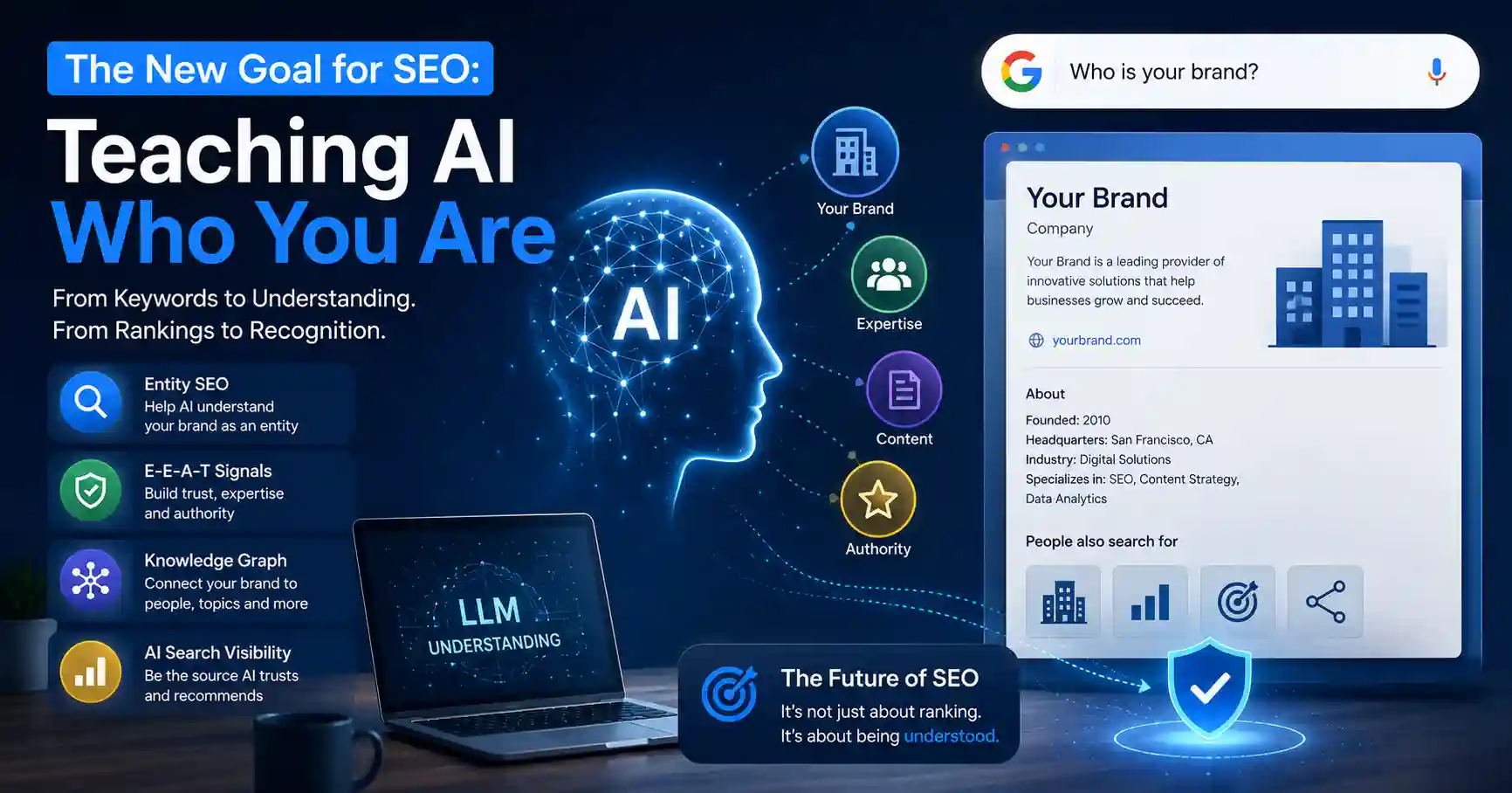
Have you ever wondered whether search engines truly understand your business, or are they simply matching keywords to queries?
For years, SEO has focused on helping Google understand web pages. We optimized titles, built backlinks, improved site structure, and created content around relevant keywords.
But artificial intelligence is changing the rules.
A recently discussed Google LLM patent points toward a future where search engines may not just analyze pages. They may try to understand entities, brands, expertise, relationships, and context on a much deeper level.
If that future becomes reality, a new SEO objective emerges: teaching AI who you are.
That shift could be one of the most important developments in modern search marketing.
What does Google’s LLM patent reveal about the future of AI search?
Large Language Models, usually called LLMs , are built to interpret information in a way that is rather different compared to traditional search algorithms.
Instead of dwelling only on keywords, they try to sense the meaning, like how a person connects ideas:
- Context
- Meaning
- Relationships
- Intent
- Entities
This means future AI-powered search systems may evaluate businesses based on how well they understand an organization’s identity.
In simple terms, AI may increasingly ask:
- Who is this company?
- What topics is it known for?
- Why should users trust it?
- What expertise does it demonstrate?
This evolution aligns closely with the growing importance of AI search optimization.
As content strategist Nina Lopez explains:
“The future of SEO isn’t just teaching Google what a page is about. It’s teaching AI what your brand stands for.”
That distinction is becoming increasingly important.
Why is entity SEO becoming more important than keyword SEO?
Keywords remain valuable.
However, AI systems increasingly lean on entity SEO, to understand people , organizations , products, and even concepts in a more grounded way.
An entity is a thing that exists on its own, and it can be clearly recognized and named, without too much ambiguity.
Examples include:
- Companies
- People
- Products
- Locations
- Organizations
Rather than seeing isolated keywords, AI attempts to understand connections between entities.
For example:
Instead of simply recognizing “SEO agency,” AI may understand:
- Company name
- Services offered
- Industry expertise
- Customer reputation
- Content authority
This helps search systems generate more accurate answers and recommendations.
As AI search expands, entity recognition may become a major ranking factor for visibility.
How can businesses teach AI who they are?
This is where modern SEO becomes especially interesting.
Teaching AI who you are requires consistency.
Strong brand authority is built when your business communicates the same identity across multiple sources.
Important signals include:
Consistent brand messaging
Use the same company descriptions across websites, social profiles, directories, and content.
Topical expertise
Publish content that demonstrates deep knowledge within your industry.
Structured data
Help search systems understand important business information.
Digital mentions
Earn references from reputable websites and industry publications.
Content depth
Create comprehensive resources that reinforce expertise.
Together, these signals help AI build confidence about your organization’s identity.
Businesses already working on visibility should also understand AI search visibility tracking when attribution falls short, as measuring AI-driven discovery is becoming increasingly important.
Visibility begins with understanding.
And understanding begins with clear entity signals.
What role does E-E-A-T play in AI powered search?
Google has repeatedly brought up Experience , Expertise , Authoritativeness, and Trustworthiness. Not always in the exact same way, but the idea stays there.
People often call it E-E-A-T, which is a shorthand for how content quality gets judged.
In a search world that is powered by AI, this framework can become even more important, and maybe faster to matter too.
Why?
Because AI systems need confidence before recommending information.
Signals that support E-E-A-T SEO include:
- Expert authorship
- Accurate information
- Industry recognition
- Trustworthy sources
- Strong brand reputation
AI systems are increasingly designed to identify reliable entities and prioritize trustworthy information.
Businesses that invest in expertise and authority today may benefit as AI search evolves.
How could LLMs change search visibility in the future?
Traditional search rankings are relatively straightforward.
Users search.
Google returns a list of results.
AI-powered search changes that experience.
Instead of simply showing links, AI may generate:
- Summaries
- Recommendations
- Comparisons
- Explanations
- Direct answers
This creates new challenges for search visibility.
A website may contribute information without receiving the same visibility opportunities available in traditional search results.
That means businesses need to think beyond rankings alone.
Future optimization may involve:
- Brand recognition
- Entity understanding
- Knowledge graph presence
- AI citations
- Topical authority
Organizations exploring future search trends should also review Google AI opt out feature visibility strategy, which examines how AI-driven discovery is influencing content visibility.
The search landscape is becoming increasingly relationship-driven rather than keyword-driven.
What practical SEO actions should businesses take today?
Fortunately, getting ready for AI-powered search dos not mean giving up traditional SEO
Instead, businesses should make their current foundations stronger, more sturdy and even a bit adaptive.
Recommended actions include:
Build topical authority
Create clusters of high-quality content around core expertise areas.
Strengthen brand identity
Ensure consistency across all digital properties.
Improve structured data
Use schema markup to clarify business information.
Focus on trust signals
Showcase expertise, reviews, credentials, and achievements.
Create original insights
Unique perspectives help distinguish brands from generic content.
These steps support both traditional SEO and future AI search systems.
For marketers seeking official guidance on structured data and search understanding, Google Search Central Structured Data Documentation provides valuable recommendations.
Could teaching AI become the next generation of SEO?
Many experts believe so.
Search engines are evolving from information retrieval systems into understanding systems.
That shift changes the purpose of optimization.
Instead of just helping search engines surface pages , businesses may end up leaning more into helping AI interpret identity, know-how, and credibility.
Put differently : the next chapter in SEO might mean showing AI who you are , not only which phrases you aim for.
That’s a meaningful shift.
And it could rearrange search marketing for years to follow.
Final Thoughts
Google’s LLM patent gives an interesting peek into what search might become later on.
Even if keywords, backlinks, and technical SEO still matter a lot, the AI driven search trend is steering optimization toward more meaning, like the deeper understanding of brands, entities, and real expertise.
Companies that keep investing in authority, trust, clear structured information, and a steady brand identity will probably end up positioned better as the whole search landscape keeps changing.
The objective is not just about pushing your pages up.
More and more, the objective could be to help AI recognize exactly who your business is and why it actually matters.
How do you think AI powered search will change SEO in the next few years? Drop your thoughts in the comments below.
FAQs
What is an LLM in SEO?
An LLM, or Large Language Model, is an AI system that understands language, context, and relationships between concepts.
What is entity SEO?
Entity SEO focuses on helping search engines understand identifiable people, businesses, products, and organizations rather than relying only on keywords.
Why is E-E-A-T important for AI search?
AI systems use trust and authority signals to evaluate information quality and determine which sources deserve visibility.
Does traditional SEO still matter?
Yes. Technical SEO, content quality, and backlinks remain important, but entity understanding is becoming increasingly valuable.
How can businesses prepare for AI-powered search?
Focus on brand authority, structured data, topical expertise, and consistent digital presence across platforms.
