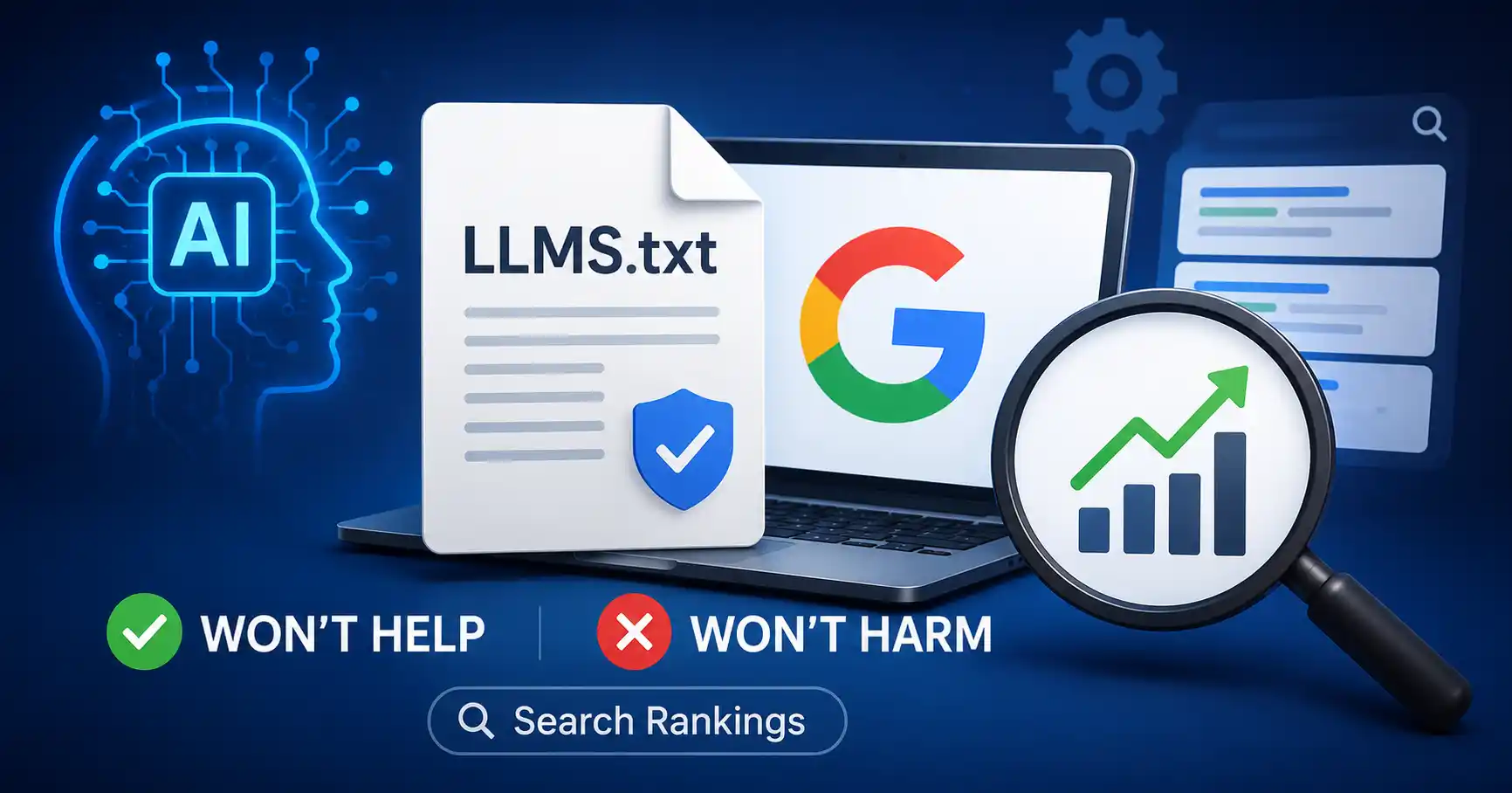
If you’ve been following AI and SEO trends lately, chances are you heard about LLMS txt files already. Some folks call them the “robots.txt for AI” while others think they might be the next big thing for search optimization. But then Google showed up and said something unexpected, LLMS txt files wont harm or help your search rankings.
So does that mean site owners should ignore them completely. Not really.
As AI-powered search experiences keep growing, figuring out where LLMS txt fits into the wider landscape matters more each week, for publishers for SEOs and for businesses too.
What is an LLMS txt file and why is everyone talking about it?
An LLMS txt file is a proposed standard meant to help websites talk with large language models or other AI systems. Imagine it like a guide, that tells AI crawlers what information they can access or reuse, in practice.
Unlike robots.txt, which search engines have supported for decades, LLMS txt is still rather new, and it does not yet have universal adoption.
Google recently clarified that putting an LLMS txt file in place does not make rankings on Google Search better or worse.
That statement matters because many site owners were beginning to treat LLMS txt as the next SEO ranking factor.
The reality is more nuanced.
While LLMS txt may not affect search rankings right now, it could still matter in how AI systems interact with content later on, perhaps.
As content strategist Nina Lopez says:
“Not every new web standard turns into an SEO signal, but learning it early can create future benefits.”
Businesses preparing for AI-driven search should also understand the growing SEO GEO gap between AI search and organic traffic as user behavior evolves.
Why did Google say LLMS txt files wont affect search rankings?
Google’s position is fairly straightforward.
Search rankings rely on established signals such as:
- Content quality
- Relevance
- User experience
- Expertise and authority
- Technical SEO
At this stage, LLMS txt not part of Google’s ranking system, the way it is claimed to be.
Google representatives said that their crawlers don’t really use LLMS txt files right now, like not as a ranking factor.
This matches the long standing habit from Google too, where fresh technologies are not automatically folded into the search algorithm.
In other words , you could add an LLMS txt file and nothing will instantly boost your visibility, and if you ignore it you won’t see your rankings damaged either.
For publishers, that’s actually reassuring. It means the fundamentals of SEO still matter most.
Could LLMS txt files become important for AI search optimization?
This is where things get interesting.
Although LLMS txt doesn’t affect Google rankings today, AI ecosystems are evolving rapidly.
Large language models increasingly power:
- AI assistants
- AI search engines
- Conversational search tools
- Generative search experiences
As these systems grow, websites may seek better control over how their content is accessed or summarized by AI.
That’s why many experts see LLMS txt as part of the wider push toward AI search optimization, even if the words sound a bit new.
Barry Adams, a well regarded SEO consultant, has often said that publishers should pay attention to the emerging standards very closely because todays experiments can become tomorrows best practice.
Whether LLMS txt will get wider adoption remains unclear, but keeping an eye on these changes is just solid digital strategy.
Research already shows that users behave differently in AI Overviews and AI Mode, suggesting that search behavior itself is changing.
Does LLMS txt replace robots txt or technical SEO?
No. Not even close.
Robots txt remains a widely recognized standard for controlling search engine crawling.
LLMS txt serves a different purpose.
Here’s a simple comparison:
Robots txt
- Controls crawler access
- Supported by major search engines
- Impacts indexing behavior
LLMS txt
- Intended for AI systems
- Still experimental
- No confirmed ranking impact
This distinction matters because some website owners mistakenly assume LLMS txt can replace traditional technical SEO practices.
It can’t.
Your website still needs:
- Fast loading speed
- Mobile optimization
- Structured data
- Quality content
- Strong internal linking
In fact, maintaining strong website optimization remains far more important for rankings than adopting experimental AI standards.
Should website owners implement LLMS txt anyway?
The answer depends on your goals.
If you are actively trying out AI governance stuff, or you are prepping for future AI ecosystems, using LLMS txt might be worth a look, honestly.
Potential benefits include:
- Future readiness
- Content governance
- AI transparency
- Early adoption experience
However, if resources are limited, most businesses should prioritize proven SEO activities first.
Those include:
- Publishing helpful content
- Improving page speed
- Strengthening E E A T signals
- Enhancing user experience
- Building authority
SEO specialist John Mueller keeps saying to publishers that if you aim at user value it will almost always bring stronger outcomes than trying to chase unverified tactics. You know, the message is pretty consistent, more practical rather than speculative.
That’s good advice here as well.
For those wanting to understand evolving AI content standards, Google’s official guidance on AI generated content and search offers valuable context.
What does this mean for the future of search and AI?
The conversation around LLMS txt highlights a bigger trend.
Search is no longer just about search engines.
It’s increasingly about AI assistants, chat interfaces, and personalized discovery experiences.
Today’s websites need strategies that support both traditional SEO and emerging AI systems.
While Google says LLMS txt files won’t help or harm rankings today, that doesn’t mean the conversation ends here.
The web is changing quickly.
Publishers who stay informed without overreacting to every new trend often gain the biggest long-term advantage.
Final Thoughts
Google’s note about LLMS txt is honestly refreshingly clear don’t assume you get ranking gains just because you drop in a brand new file
For now the basics still rule , content caliber , how people experience the page, and technical excellence stay the foundation of SEO success.
Still LLMS txt feels like a meaningful signal, pointing to where the web might be heading next.
The wisest move isn’t total adoption, or full rejection. It’s careful trying while you learn, use informed experimentation.
What do you think? Are you planning to use LLMS txt on your site, or will you wait for wider adoption? Put your take in the comments.
FAQs
Does LLMS txt improve Google rankings?
No. Google has explicitly stated that LLMS txt files do not improve or hurt search rankings.
Is LLMS txt the same as robots txt?
No. Robots txt controls search engine crawlers, while LLMS txt is designed for AI systems.
Should every website add an LLMS txt file?
Not necessarily. Businesses should first prioritize proven SEO strategies before experimenting with emerging standards.
Can AI search engines use LLMS txt?
Potentially, yes. However, adoption varies across AI platforms and remains an evolving area.
Will LLMS txt become important in the future?
It’s possible. As AI ecosystems mature, standards like LLMS txt could become more widely used.

Kumar Swamy is the CEO of Itech Manthra Pvt Ltd and a dedicated Article Writer and SEO Specialist. With a wealth of experience in crafting high-quality content, he focuses on technology, business, and current events, ensuring that readers receive timely and relevant insights.
As a technical SEO expert, Kumar Swamy employs effective strategies to optimize websites for search engines, boosting visibility and performance. Passionate about sharing knowledge, he aims to empower audiences with informative and engaging articles.
Connect with Kumar Swamy to explore the evolving landscape of content creation!