Have you noticed how fast advertising is sliding into AI-powered experiences?
A few years back, marketers leaned pretty hard on Google Ads , Meta Ads , and marketplace advertising. Now it feels like AI platforms are becoming discovery engines, where people ask questions , compare offerings, and then land on a purchase decision without ever opening a normal search engine.
So OpenAI’s latest announcement really does deserve attention.
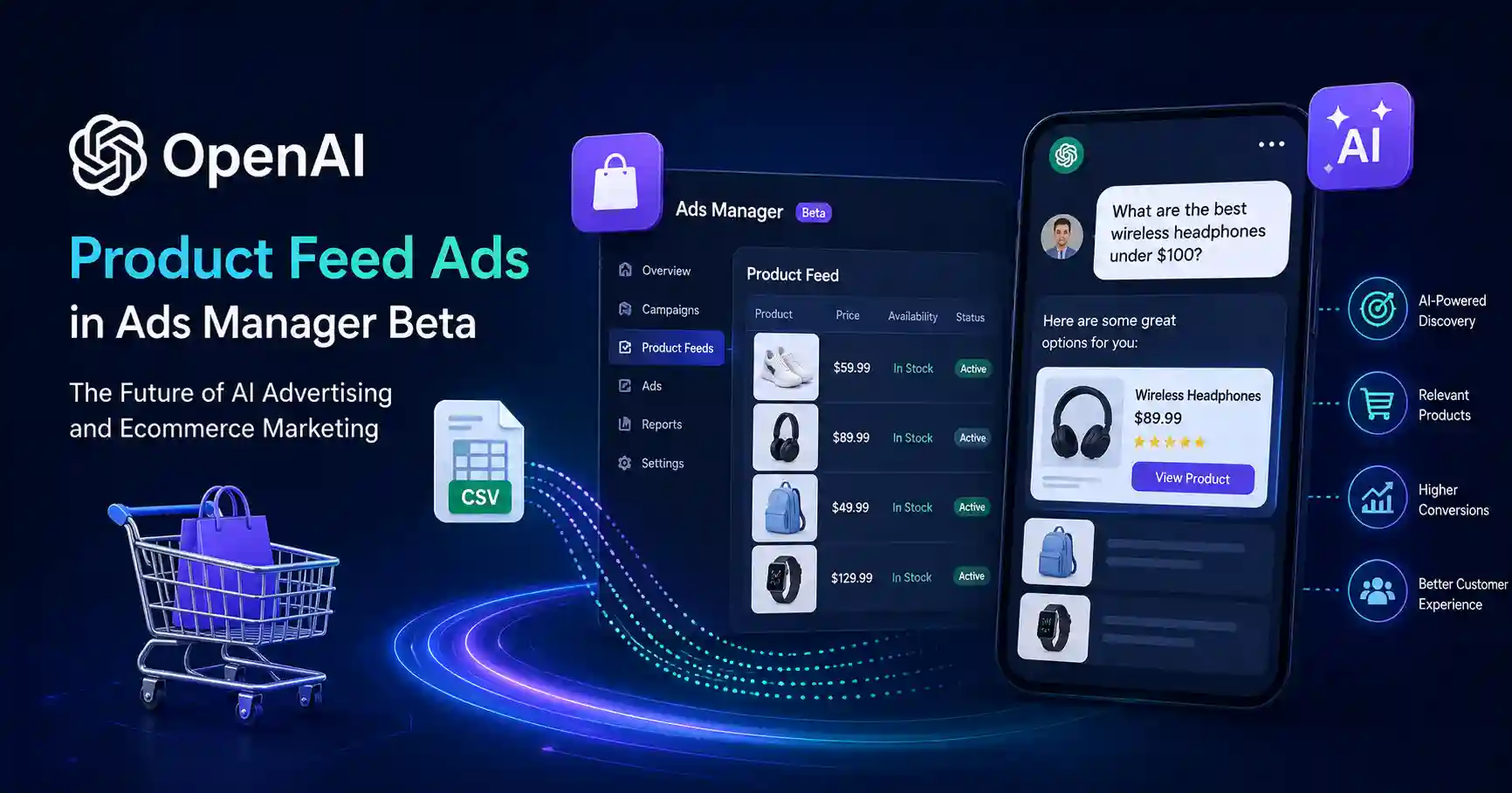
OpenAI has officially rolled out Product Feed Ads inside its Ads Manager beta. This brings a fresh way for businesses to draw attention on products inside AI-led experiences. Even though the function is still in beta, it feels like more than just another advertising tweak. It hints at a coming moment where AI powered commerce, conversational advertising, and product discovery get braided tightly together, nearly like they run on the same system.
For ecommerce brands, digital marketers, and advertisers, this could turn into one of the most important changes in online advertising since the rise of search ads.
What Are OpenAI Product Feed Ads in Ads Manager Beta?
OpenAI Product Feed Ads let advertisers upload and take control of product catalogs, that can then show up inside AI driven conversations with users, yes.
Instead of depending only on keyword based promotion, product feeds give the AI systems a clearer picture of what’s in the catalog. Pricing, availability, product write ups and attributes all help here.
That way it becomes easier for AI platforms to put forward the right items when people ask question about shopping and similar things.
For example, if someone asks:
- What’s the best laptop for students?
- Which running shoes are good for beginners?
- What are the top wireless earbuds under $100?
The AI system can potentially use product feed information to display more relevant product recommendations.
This approach is similar to how product feeds work in Google Shopping Ads, but it’s adapted for conversational AI environments.
As AI search continues evolving, businesses are already learning that traditional search visibility and AI visibility don’t always follow the same rules. Understanding the differences between AI Search vs Organic Traffic can help marketers prepare for these new discovery channels.
Why Is OpenAI Entering the Product Advertising Market?
The answer is fairly straightforward.
Commerce follows attention.
Millions of people now interact with AI platforms every day, to research products compare options and seek recommendations. That makes a pretty natural opening for advertisers. Historically, Google became a strong advertising platform because users came there to discover information. Today, AI assistants are starting to play a similar role, and it is shifting how value flows.
Users aren’t only asking factual questions anymore. They’re asking things like:
- What should I buy?
- Which product is best?
- What do experts recommend?
- What are good alternatives?
These are high-intent commercial queries.
OpenAI’s move suggests the company sees significant potential in becoming a product discovery platform rather than simply a conversational AI provider.
“Where consumer attention goes, advertising eventually follows.”
That’s been true for search engines, social media platforms, and marketplaces. AI platforms are unlikely to be any different.
How Could Product Feed Ads Change Ecommerce Advertising?
For e-commerce businesses, this development could bring entirely new angles to grow and expand.
Traditional digital advertising usually leans on users clicking on ads after they do searches , or while they’re drifting through social media feeds.
AI-powered shopping experiences work differently.
Users typically begin with questions rather than keywords.
Instead of searching:
“buy gaming laptop”
they might ask:
“I’m a college student who needs a laptop for gaming and video editing under $1,200. What do you recommend?”
That’s a much richer interaction.
Product Feed Ads could allow AI systems to match products against detailed user intent rather than simple search terms.
This has the potential to improve:
- Product relevance
- Shopping experiences
- Conversion rates
- Customer satisfaction
- Purchase confidence
It also means brands may need to rethink how they structure product data and catalog information.
Will Product Feed Ads Impact SEO and AI Search Visibility?
Indirectly, yes.
Even if Product Feed Ads are mostly an advertising thing, they still seem to reinforce a wider pattern that’s taking place across the search space.
Search engines and AI platforms, they keep pushing harder on structured information.
The clearer a business spells out its products, services, pricing, and features, the more manageable it becomes for AI systems to interpret it and later recommend it.
This movement matches up well with the rise of Generative Engine Optimization, and also AI Search Optimization.
Organizations that put money into structured content, product data, and credible context tend to be positioned better for both organic reach and AI based discovery.
Publishers and marketers are already shifting due to Google’s growing emphasis on trusted sources. Knowing about Google AI Overviews Preferred Sources can give businesses an angle on how AI systems judge credibility and relevance.
The point is pretty simple: strong information architecture is turning into a real competitive edge.
What Should Advertisers Do Before OpenAI Ads Become Widely Available?
While the beta is still evolving, marketers can start preparing now.
The brands that adapt early often gain the biggest advantages when new advertising channels emerge.
Here are several areas worth focusing on:
Improve Product Feed Quality
Product titles, descriptions, specifications, and attributes should be accurate and comprehensive.
Invest in Structured Data
Schema markup helps search engines and AI systems understand content more effectively.
Build Strong Product Content
Detailed buying guides, comparisons, FAQs, and reviews help support AI-driven product discovery.
Monitor AI Search Trends
Consumer behavior is changing rapidly as users become more comfortable asking AI assistants for recommendations.
Strengthen Brand Authority
AI systems often favor trusted brands and reliable information sources.
According to the Google Product Structured Data documentation, well-structured product information helps search systems better understand and present product details.
Could AI Advertising Become the Next Major Marketing Channel?
It’s certainly heading in that direction.
Search advertising transformed digital marketing in the early 2000s.
Social advertising reshaped customer acquisition over the following decade.
AI-powered advertising may represent the next major shift.
What’s particularly interesting is that AI platforms operate differently from both search engines and social networks.
Users engage through conversations.
That creates opportunities where suggestions get more personalized, product comparisons go deeper, and advertising can end up feeling more relevant for the person, even if it is not always obvious at first.
Of course there are challenges too, not everything is smooth.
Issues tied to transparency, user trust, the clarity of ad labeling, and measurement will keep shifting as the technology gets more mature.
Still, the direction seems clear.
AI platforms are becoming discovery platforms.
And discovery platforms eventually become advertising platforms.
“The future of advertising may look less like interrupting users and more like helping them make decisions.”
FAQs
What are OpenAI Product Feed Ads?
Product Feed Ads let advertisers upload their product catalogs that , in practice, can end up being used inside AI based shopping and recommending experiences.
Are Product Feed Ads available to everyone?
Right now, the feature is being rolled out via OpenAI’s Ads Manager beta, and it may not yet be accessible for every advertiser, so keep that in mind .
How are Product Feed Ads different from Google Shopping Ads?
They are made for conversational AI setups, where suggestions come out via casual language exchanges, not through keyword searching.
Will Product Feed Ads affect SEO?
Not directly, but I’d say businesses that have product info nicely laid out might get more AI visibility and be easier to find, so in a way it helps with discoverability too.
Why should ecommerce brands care about this update?
Since AI driven product discovery is growing fast, and it might even become a big customer acquisition channel later on , you know, for sure in the future.
Final Thoughts
OpenAI rolling out Product Feed Ads in Ads Manager beta feels more than just a fresh ad option. It reads like another, real signal that AI platforms are becoming genuine players in how people discover products, shop around, and get served digital advertising.
For marketers, the takeaway is pretty clear, the future of advertising will likely involve a blend of search, social, and conversational AI experiences maybe. I mean, the combo matters.
Brands that begin prepping now, by tightening product data, making content better and more relevant, and really learning how AI-driven discovery works, will be in a stronger place as these platforms keep changing.
What do you think about AI-powered product advertising? Do you believe OpenAI could become a major rival to the traditional ad platforms? Drop your thoughts and join the discussion.

Kumar Swamy is the CEO of Itech Manthra Pvt Ltd and a dedicated Article Writer and SEO Specialist. With a wealth of experience in crafting high-quality content, he focuses on technology, business, and current events, ensuring that readers receive timely and relevant insights.
As a technical SEO expert, Kumar Swamy employs effective strategies to optimize websites for search engines, boosting visibility and performance. Passionate about sharing knowledge, he aims to empower audiences with informative and engaging articles.
Connect with Kumar Swamy to explore the evolving landscape of content creation!