Have you ever hired an SEO agency, paid for a costly SEO tool, or tried a fashionable SEO play, then later wondered if any of it was actually improving your site?
You are not the only one.
One of the hardest parts for business owners is not SEO itself. It’s deciding what input to believe. Between SEO agencies, private consultants, YouTube personalities, AI optimization advice, and software dashboards promising better placements, it is getting harder to tell real know-how from persuasive advertising.
That’s why Google’s newest change to its SEO documentation is worth paying attention to.
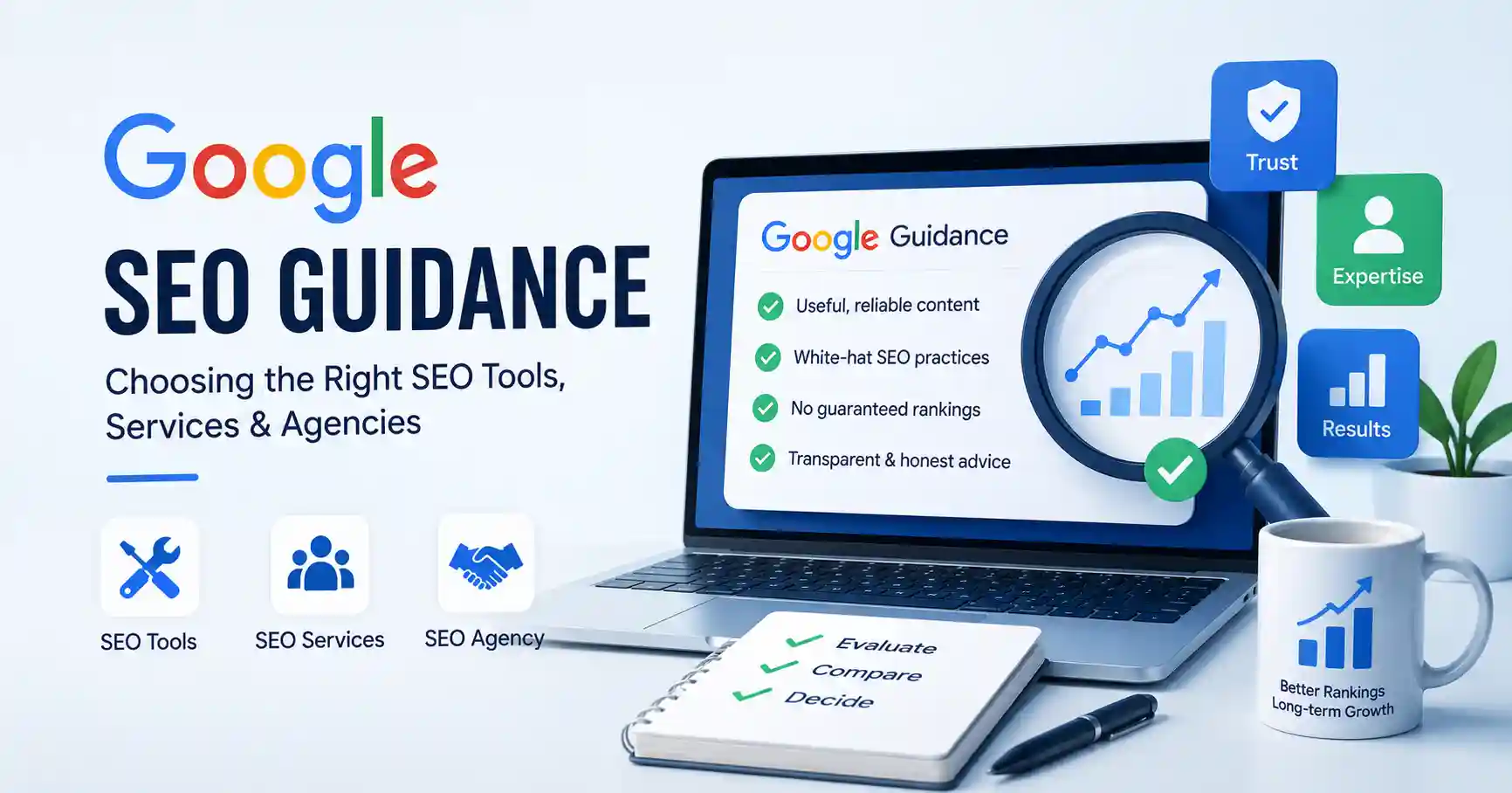
Google has added fresh guidance about outside SEO tools, SEO services, AI optimization recommendations, and it even refreshed its long-running “Do You Need an SEO?” document. It might seem like a normal documentation tweak, but it still carries a message for website owners. In other words, pause and think before you blindly accept any SEO tool, agency, or AI optimization platform.
The update arrives at a moment when companies are more and more putting money into Search Engine Optimization, AI Search Optimization, Technical SEO, and Generative Engine Optimization (GEO), yet not always getting how these services function in practice.
Why Did Google Release New SEO Guidance for Website Owners?
Google says the purpose of this update is pretty simple: help companies look at SEO advice a bit more critically, not just accept it.
Over the last years, the SEO industry has exploded, with new tools, services, and all that. A few of them are actually helpful. Some others make bold claims that sound great, but there is no real evidence behind them, whatsoever.
In the newer documentation, Google suggests site owners should check outside SEO recommendations against official Google guidance, instead of taking every suggestion at face value. Google also stressed that it does not back third-party SEO tools or agencies, even if those vendors hint in that direction.
This is even more relevant right now because AI focused optimization services are popping up everywhere.
Things like AEO (Answer Engine Optimization), GEO (Generative Engine Optimization), AI Search Optimization, and LLM Optimization are becoming more and more common. Still, even if some of these approaches have value, Google wants companies to know one thing clearly no outside provider has access to Google internal ranking systems.
Can SEO Tools Really Improve Google Rankings?
This is where many website owners get confused.
SEO tools are incredibly helpful, but they are not ranking tools.
They are analysis tools.
A keyword research platform can show search volume. A site audit tool can identify technical issues. A backlink tool can help monitor link profiles. But none of these tools can directly influence rankings.
Think of it this way.
Owning a gym membership doesn’t automatically make someone fit.
Likewise, paying for an SEO platform doesn’t automatically improve search visibility, you still have to do the work.
The real value shows up only when the insights are interpreted in context and then applied with intent.
Google’s new guidance, basically reminds people that third party tools do not get access to Google’s internal ranking data. So if a tool claims guaranteed rankings, guaranteed traffic growth, or guaranteed AI visibility, it should be treated with care.
As search keeps evolving, understanding the tie between classic SEO and AI driven discovery is getting more important every month. Companies that want to adapt to modern search behavior should also understand what’s different between AI Search vs organic traffic. User journeys now look very different from what they did just a few years ago.
What Should Businesses Look for When Hiring an SEO Agency?
Google’s updated “Do You Need an SEO?” document includes some practical advice that many businesses overlook.
One of the most important recommendations involves access permissions.
If an SEO provider wants to conduct an audit, Google advises giving read-only access to tools like Search Console initially rather than full administrative control. This allows the agency to analyze the website without immediately making changes.
Businesses should also ask questions such as:
- What specific work will be performed?
- How will success be measured?
- What SEO tools are being used?
- What realistic results can be expected?
- How long will improvements take?
A trustworthy SEO professional will usually welcome these questions.
A questionable provider often avoids them.
“Good SEO agencies explain their strategy. Bad SEO agencies sell certainty.”
That’s particularly important because search rankings depend on hundreds of factors, many of which are outside an agency’s control.
No one can legitimately guarantee a number one ranking.
If someone does, that’s usually a sign to keep looking.
How Does Google’s Guidance Affect AI SEO and GEO Services?
This is arguably the most interesting part of the update.
For the first time, Google directly acknowledged optimization advice related to AI experiences, Answer Engine Optimization (AEO), and Generative Engine Optimization (GEO).
That doesn’t mean Google is rejecting these concepts.
Instead, Google is encouraging businesses to evaluate AI optimization recommendations with the same level of scrutiny applied to traditional SEO advice.
Many AI optimization vendors claim they can guarantee citations in ChatGPT, AI Overviews, Gemini, or other AI systems.
The reality is more complicated.
AI search platforms use different models, retrieval systems, ranking signals, and citation methods. No external provider can fully control those outcomes.
Businesses should focus on building authority, expertise, trustworthiness, and content quality rather than chasing shortcuts.
This aligns closely with Google’s broader push toward high-quality content and topical authority.
Companies interested in AI visibility should also understand how Google evaluates sources in AI-generated answers. Our guide on Google AI Overviews Preferred Sources explains many of the trust signals that influence modern AI search experiences.
Why Is Google Warning Against Blindly Following SEO Advice?
The answer comes down to context.
SEO advice often works differently depending on:
- Industry
- Competition level
- Website age
- Technical setup
- Content quality
- User intent
A tactic that improves rankings for one website might do very little for another.
Google’s new guidance encourages businesses to verify recommendations against official documentation and think critically about claims being made by third parties.
This is actually good news for businesses.
Instead of running after every new SEO trend, website owners can focus on understanding why a recommendation is being made, and if it matches up with Googles published guidance.
“The best SEO advice usually sounds practical. The worst SEO advice often sounds magical.”
What Does This Mean for the Future of Search Engine Optimization?
The broader message behind Google’s update is surprisingly simple.
SEO isn’t becoming less important.
It’s becoming more complex.
Businesses now have to evaluate:
- Traditional SEO services
- Technical SEO recommendations
- AI Search Optimization
- GEO and AEO platforms
- SEO software providers
- Content optimization tools
Also, at the same time Google is giving everyone a reminder that no tool, agency, or consultant has a straight access, into its ranking systems, or anything similar.
That is why expertise, transparency, and evidence based recommendations matter more than ever now.
Companies that aim for lasting website quality, technical health, authoritative content, and user experience will probably gain more than the ones chasing shortcuts or promises, even if they look tempting at first.
If you need extra direction, Google’s official Google Search guidance about third party SEO tools and services gives a helpful way to evaluate SEO advice and providers.
FAQs
Does Google recommend any SEO tool?
No. Google specifically states that it does not endorse third-party SEO tools. However, it does recommend using Google Search Console for direct search performance insights.
Can an SEO agency guarantee rankings?
No legitimate agency can guarantee specific rankings because search results depend on many factors outside their control.
What is Google’s biggest concern about SEO tools?
Google warns that some tools make claims that cannot be verified and do not have access to Google’s internal ranking systems.
Are GEO and AEO legitimate SEO strategies?
They can be useful when focused on improving content quality and visibility, but businesses should be cautious of vendors promising guaranteed AI search results.
Should I trust SEO advice from social media?
Not automatically. Google recommends verifying recommendations against official documentation and evaluating claims critically.
Final Thoughts
Google latest SEO guidance isnt really an attack on SEO agencies, consultants, or software providers. More like a reminder that companies should make informed decisions based on evidence not on big promises, and yes there’s a difference.
Good SEO work still boils down to the basics: publishing helpful content, tightening technical performance, getting a clear read on user intent, and earning credibility steadily, over time.
As AI search, GEO, and older-school SEO keep changing, organizations that prioritize lasting value instead of quick fixes will end up with the best footing for long term success.
Got questions about Googles newest SEO guidance or AI search optimization? Drop your thoughts and jump into the discussion below.

Kumar Swamy is the CEO of Itech Manthra Pvt Ltd and a dedicated Article Writer and SEO Specialist. With a wealth of experience in crafting high-quality content, he focuses on technology, business, and current events, ensuring that readers receive timely and relevant insights.
As a technical SEO expert, Kumar Swamy employs effective strategies to optimize websites for search engines, boosting visibility and performance. Passionate about sharing knowledge, he aims to empower audiences with informative and engaging articles.
Connect with Kumar Swamy to explore the evolving landscape of content creation!