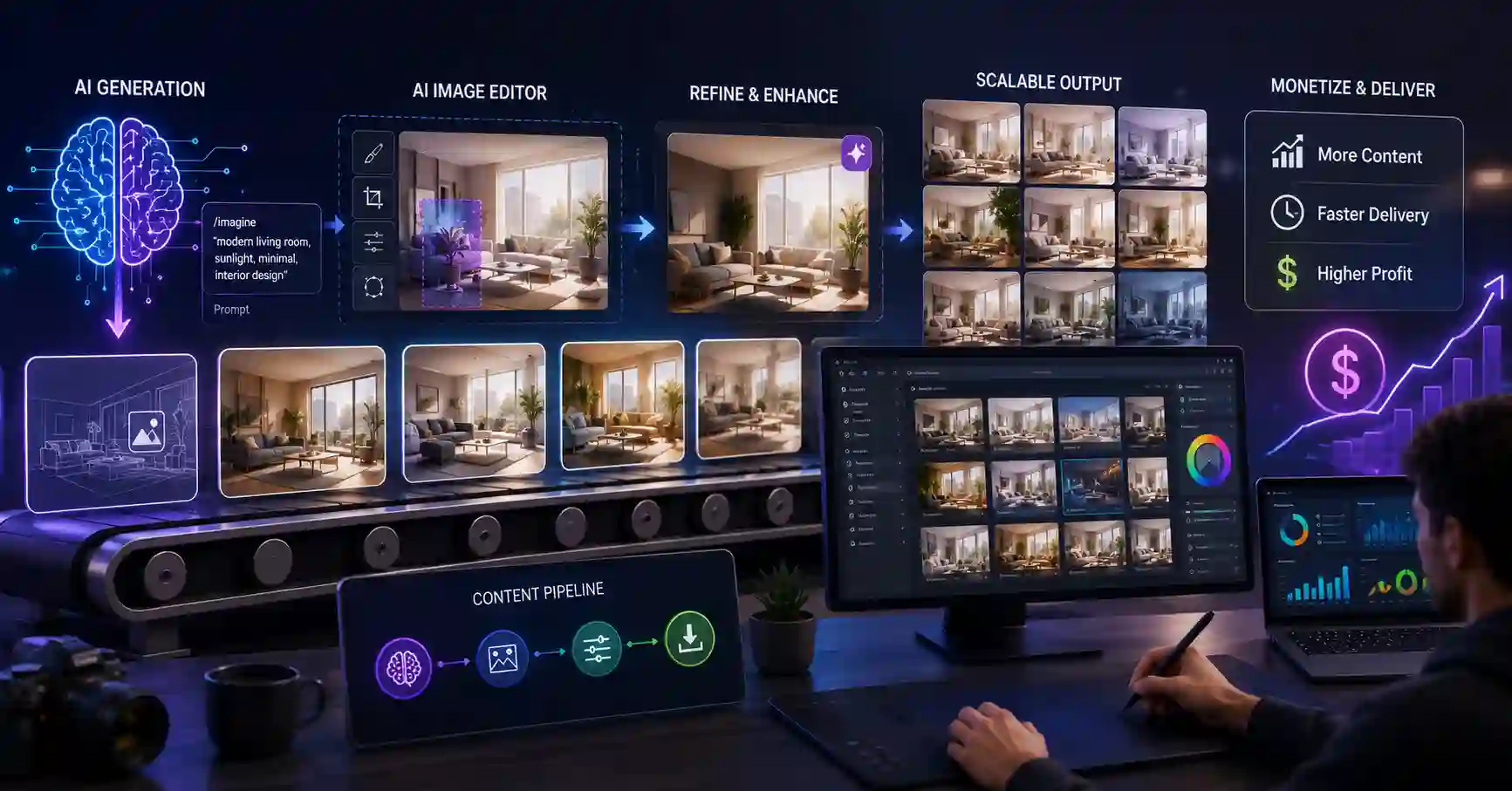
The “magic trick” phase of generative AI is effectively over for professional creators. In late 2022, a designer could win a contract or get massive social buzz just by putting forward a high fidelity image that, didn’t exist five minutes prior. Today, that novelty is basically gone. Clients and audiences do not really care anymore that an image was produced by an algorithm; they care whether that image does the right strategic work, follows a tight brand guide, and lands on time for a campaign launch.
For those looking to monetize these tools in a crowded market, the shift is from “prompting” to “production.” This is the era of the industrialized creator a professional who views generative models not as a source of inspiration, but as industrial infrastructure. When your revenue depends on the throughput of your media pipeline, the technical nuances of your stack become the difference between a profitable agency and a hobbyist struggling with overhead.
Beyond the Magic Trick: AI as Industrial Infrastructure
The transition from a hobbyist mindset to a professional one requires a cold look at unit economics. In a traditional creative agency model, the primary cost is human hours. Generative tools change this by front-loading the cost into “compute” and “curation.” However, if a creator spends four hours fighting a model to get the right finger placement or eye color, they haven’t industrialized anything; they’ve simply replaced one manual labor with another.
Commercial viability in the current landscape demands three things: predictable costs, repeatable quality, and extreme output speeds. Most off-the-shelf generative tools are designed for the “one-off” win the beautiful landscape that goes viral on a forum. They are often poorly suited for a high-volume social media campaign that requires 50 variations of a product in different lifestyle settings, all maintaining a specific hex code and lighting profile. To compete, creators are building systems that treat the AI Image Editor as a surgical tool rather than a lottery ticket.
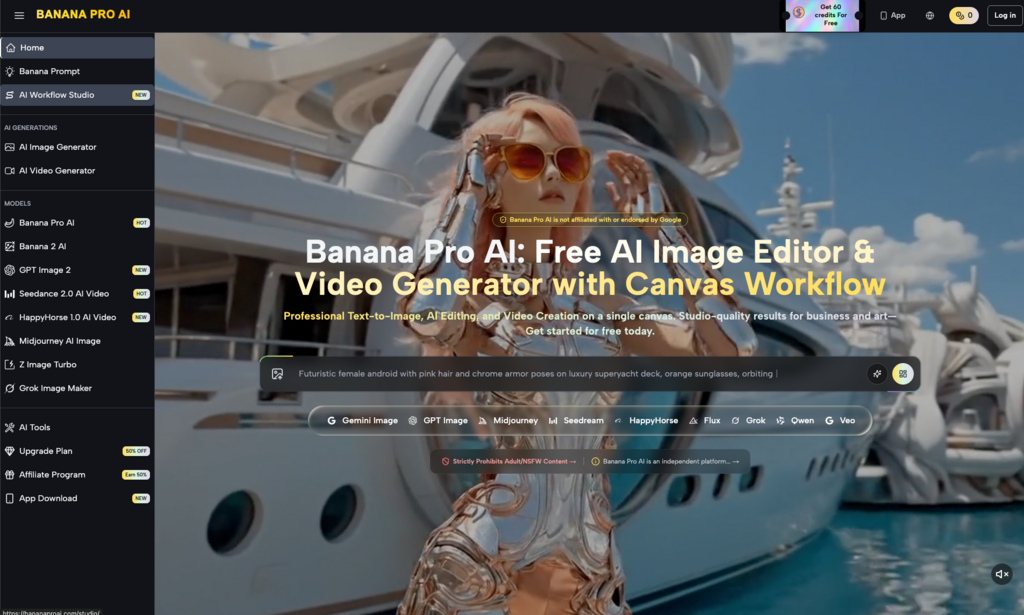
Throughput at Scale: Why Nano Banana Pro Changes the Margin
In the world of professional content delivery, latency is the enemy of profit. Every second spent waiting for a render or a generation is a second where a creative director is idly burning billable time. This is where the specific architecture of the tools matters. High-fidelity, slow-diffusion models have their place in hero assets, but the heavy lifting of modern content creation the storyboarding, the social iterations, the rapid prototyping requires a different gear.
Using a high-speed model like Nano Banana Pro shifts the creator’s role from a solitary artist to a high-speed editor. When generation happens in near real-time, the feedback loop between an idea and its visual manifestation is virtually eliminated. This allows for a “fail fast” methodology where 100 concepts can be discarded in the time it used to take to render a single draft. For agencies managing multiple client accounts, this throughput allows for a volume of testing that was previously cost-prohibitive.
The economics are simple: if you can produce a week’s worth of multi-platform content in an afternoon, your margin on that contract triples. However, speed without direction leads to digital noise. The Banana AI ecosystem works best when it is integrated into a workflow that values the human “eye” for curation above the machine’s ability to fill a canvas.
Structural Control via the AI Image Editor
One of the biggest trouble spots in turning AI media into something monetized is the “prompt gap”, the distance between what a client expects and what raw text to image stuff hands back. A client doesn’t only want “a woman drinking coffee” they want “a woman in her 30s, with a navy blue blazer on, sitting in a mid-century modern chair, and with a lighting setup that is very specific.”
Text prompts are kind of a blunt tool for these exact needs. Here is where the structural control from an integrated editor becomes really required. Professional creators are moving farther away from pure text to image pipelines, and they are leaning more toward image to image and in painting approaches. With an editor in place to mask exact regions, rebalance the composition, or lock in a specific color range , the creator can steer the result so it lands “on brand” instead of “on prompt.” As generative media becomes more competitive, creators are also focusing on AI content optimization strategies to improve discoverability, engagement, and platform visibility across search engines and AI-driven recommendation systems.
Keeping visual continuity across a series of assets is the holy grail of content monetization really. Whether it is a run of YouTube thumbnails or a full ad campaign, everything should look like it comes from the same universe. A more sophisticated idea is to use a base image, like a low-res sketch or an available stock photo, and feed it into the Nano Banana engine to get a consistent style. That way the bones of the image stay structurally solid and can be reviewed and approved by the client before the generative skin gets painted over it, or whatever phrase makes sense.
Defining the Workflow: From Canvas to Client Deliverable
Building a repeatable content system requires a move away from the “chat box” interface. The most efficient creators are now using canvas-based workflows that allow for non-linear editing. Instead of generating a single image and starting over, a canvas allows you to branch off different versions, keep track of successful seeds, and drag-and-drop elements across a visual workspace.
A typical industrial workflow might look like this:
- Ingestion: Bringing in a brand’s existing asset library stock photos, previous campaign shots, or raw product photography.
- Transformation: Utilizing the image-to-image capabilities of Banana Pro AI to modernize these assets or place them in new environments without losing the product’s physical integrity.
- Refinement: Using the Nano Banana toolset to iterate on specific lighting or background elements.
- Scaling: Batch processing the successful “look” across a dozen different aspect ratios for Instagram, TikTok, and LinkedIn.
This “template-first” mindset minimizes creative fatigue. When a creator gets to the high volume sprint part of the project, most of the big creative decisions have already been settled, and the AI is basically just doing the heavy work of pixel generation. It is not really brainstorming anymore, more like grinding through outputs, day after day.
The Unconquered Territory: Narrative Logic and Brand Cohesion
While the speed of Nano Banana Pro is revolutionary, it is important to acknowledge where the technology currently hits a wall. We have not yet reached a point of perfect automation. One of the most significant limitations in current generative media is “temporal and character consistency.” While we can generate a stunning character, keeping that character’s exact facial geometry and clothing consistent across 20 different cinematic angles in a video sequence remains a highly manual, often frustrating task.
There is an ongoing uncertainty about when we will achieve true “one-click” consistency for long-form narrative content. Currently, it requires a patchwork of Lora training, post-production masking, and sometimes frame-by-frame correction in traditional software. Creators who promise “perfect AI film production” to clients often find themselves underwater when the model refuses to cooperate with a specific camera move.
Furthermore, there is a looming risk of “visual blindness.” As the market gets saturated with generative aesthetics, audiences are starting to build a subconscious filter for “AI-looking” content. If every creator keeps leaning on the same high contrast perfectly smooth vibe, the brand message just disappears in that generic sheen, and it feels unmoored somehow. The most successful monetized systems are those that use Banana Pro AI as a foundation but overlay it with grain, texture, and human-led design choices to break the “perfect” look that signals “artificial.”
Future-Proofing the Production Desk
The role of the creator is evolving from “editor” to “director” of generative systems. Back then, being a great video editor meant getting good at the timeline and, the shortcut keys, without too much thinking. Now it s more about knowing how to conduct a set of AI models, so they land on a clear business result, as expected.
The primary value driver for the modern creator is no longer their ability to use the tool everyone will eventually have access to high-speed models like Nano Banana but their proprietary workflow. The way you chain together the initial generation, the surgical refinement in the editor, and the final upscale is what makes your output unique and, therefore, billable.
Building a sustainable business around generative media means committing to constant trial and testing. As models update , and new workflows emerge, the creators who stay profitable will be the ones who treat their production desk as a kind of laboratory. They zoom in on that intersection between tool speed and creative judgment, and they understand that even while the machine delivers the pixels, the human is the one with the strategy. The objective isn’t only making content, it’s putting together a content factory that runs fast and still feels inventive.

Nishanth Kumar is the Lead SEO Strategist at iTech Manthra. With over a decade of experience in the digital marketing landscape, he specializes in technical SEO, link-building strategies, and search engine algorithms. Nishanth has helped hundreds of businesses scale their organic presence through data-driven marketing and sustainable “white-hat” techniques. He is passionate about decoding Google’s ever-changing updates to help brands stay ahead of the competition.