
Introduction
- Google’s Search team says llms.txt isn’t required for AI search visibility, but Chrome Lighthouse now highlights its presence as part of new agent-friendly architecture audits.
- Machine readability and agent compatibility are emerging concerns, not the same as search ranking signals.
- For most small businesses chrome-lighthouse-llms-txt-guide, core content quality and structured markup carry more weight than installing an llms.txt file.
Understanding the Confusion
- You spend months optimizing your site, then an audit report flags a missing llms.txt file.
- Chrome Lighthouse calls it out as part of agentic browsing, creating confusion for marketers.
- Google’s search team clarifies llms.txt is not required for AI-assisted search results or AI Overviews.
What Is llms.txt and Why Does Lighthouse Check for It?
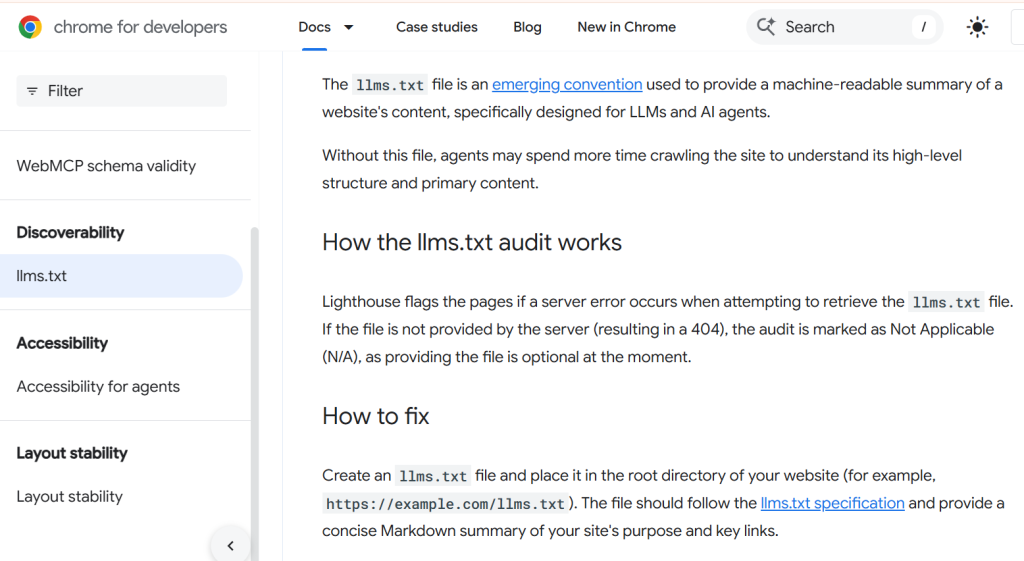
- Direct answer: llms.txt is a plain text file signaling how AI agents should interact with your site, similar to robots.txt but aimed at AI systems.
- Lighthouse includes a check under agentic browsing audits to evaluate machine readiness.
- Deeper context: The audit is about interpretability, layout clarity, and explicit instructions for machines. It does not affect search rankings or AI visibility.
Does llms.txt Affect Search Rankings or AI Answers?
- Direct answer: No solid proof shows that llms.txt affects rankings or AI summaries and chrome-lighthouse-llms-txt-guide. Many marketers misinterpret Lighthouse warnings as ranking issues. Some webmasters report AI traffic increases after implementing llms.txt, linked to crawling behavior by non-Google LLMs, not rankings.
Why Google’s Tools Send Mixed Signals
- Different teams at Google focus on AI search visibility versus agent-friendly architecture.
- Search systems prioritize content quality, structured data, link authority, engagement metrics, and entity understanding.
- Agentic browsing audits prepare for autonomous agents interacting with the web differently from traditional crawlers.
- Sentence summary: llms.txt sits between search visibility and machine friendliness, emphasized differently by different teams.
Implications for Small Businesses
- Direct answer: Focusing heavily on llms.txt is unlikely to move the needle compared to strong content, markup, and site architecture.
- Key priorities for small businesses:
- Ensure content meets user intent.
- Use structured data for entities, products, and dates.
- Maintain coherent internal linking and well-written metadata.
- Situations to test llms.txt:
- Site already optimized for AI discovery.
- Technology providers with clients using LLM crawlers that respect llms.txt.
- Frequent LLM crawler activity in server logs.
How to Think About llms.txt Strategically
- 1. Prioritize core content and user value.
- 2. Implement structured markup and schema.
- 3. Use Lighthouse agentic checks as guidance, not gospel.
- 4. Experiment cautiously if resources allow.
- **5. Measure impact objectively in AI referrals and crawler logs.
- Sentence summary: Use llms.txt strategically and experimentally, not as a must-have.
llms.txt vs robots.txt: A Comparison
| Feature | robots.txt | llms.txt |
|---|---|---|
| Target audience | Web crawlers | AI agents |
| Affects search ranking | Indirectly by crawl control | No proven impact |
| Supported widely | Standard | Emerging |
| Purpose | Crawl directives | Machine interaction guidance |
| Adoption level | Near universal | Low to moderate |
| Current use in search | Critical | Optional |
| AI system use | Some respect instructions | Experimental |
- Bold takeaway: Unlike robots.txt, llms.txt is optional and not currently a search ranking mechanism.
Specific Example: AI Crawl Behavior
- Structured llms.txt file listed key content sections and canonical paths.
- Defined language targets and content types.
- Server logs showed increased third-party LLM crawler visits and modest rise in AI referral traffic.
- Effect tied to crawl behavior, not search ranking.
- Sentence summary: In niche contexts, llms.txt can improve AI system crawling but not search position.
Conclusion: Bottom Line for Marketers
- Focus on today: Strong content, structured data, internal linking, credibility, and user-centered architecture.
- Future-proofing: Experiment with llms.txt while maintaining SEO fundamentals.
- Tight budgets: Deprioritize llms.txt and invest in measurable impact areas.
- Final sentence: llms.txt is an emerging machine friendliness marker useful for experimentation, but not a replacement for foundational search and content strategy.

Kumar Swamy is the CEO of Itech Manthra Pvt Ltd and a dedicated Article Writer and SEO Specialist. With a wealth of experience in crafting high-quality content, he focuses on technology, business, and current events, ensuring that readers receive timely and relevant insights.
As a technical SEO expert, Kumar Swamy employs effective strategies to optimize websites for search engines, boosting visibility and performance. Passionate about sharing knowledge, he aims to empower audiences with informative and engaging articles.
Connect with Kumar Swamy to explore the evolving landscape of content creation!