
Introductio:
• Semantic SEO is about user intent and relational context, being meaning, not focusing just on keywords.
• By automating processes, programmatic SEO extracts content of relevance to a vast domain; it broadens that off to get coverage for long-tails and niche topics.
• Semantic Programmatic SEO can be of much help to small businesses, as it is distributed widely through sharing and engaging social media, without being overly dependent on big budgets.
What does SEO mean to you? Link Building? Keyword stuffing?
The old age-old tactics that dominate the field for decades? Well, then, find new ones. According to the new definition, SEO is undergoing a sea change, and such attempts, following the age-old rules, would fail to recognize this paradigm shift in how search engines perceive and rank content.
Semantic programmatic SEO is a new trend that feels like a game-changer to businesses trying to make a change in their online marketing strategy. In simple words, it’s not just massively stuffing your articles with keywords, but rather creating content that is genuinely relevant to search intent and then scaling it out magnificently with a data-driven approach. Small businesses are uniquely positioned to take advantage of this new paradigm provided they learn how to maximize its effectiveness.
So let us come down and discuss the meaning and then delve into the applications and advantages for small businesses to leverage the new fervor in boosting their SEO.
What Is Semantic Programmatic SEO?
Semantic SEO is the inserting of content that jibes with the user’s search intent behind the query rather than hitting individual key phrases. It is not the chasing of high-hit keywords; it is rather about content that discusses the why, the how, and the what of the search.
Rather, Programmatic SEO affects its automation through data science to create a high flow of web content focused heavily on specific search queries something like millions of hyper-targeted landing webpages.
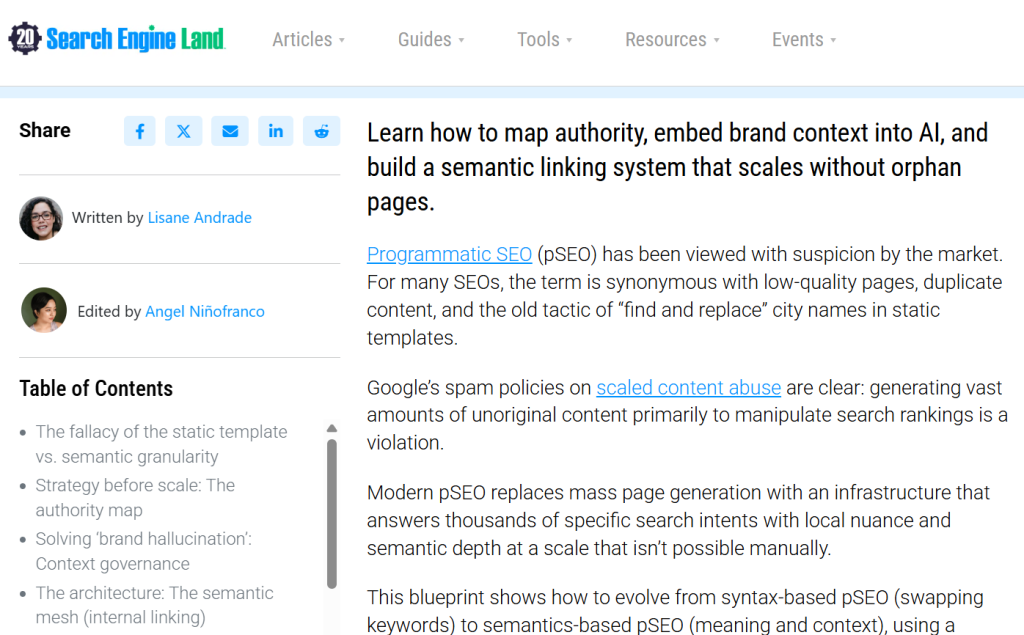
The blend yields a strategy that does not only blend in well with the emergent patterns of Google algorithms but makes the scaling of SEO for small businesses more feasible sans large teams or fancy budgets to support the big business.
Argument: Business now gets highly searched types of keywords on the basis of programmatic SEO by putting focus on-page and title tags on-the-fly, support the effort with earned pieces like on-page SEO and other off-page assets.
What Should Really Get Small Businesses Thinking About Semantic Programmatic SEO?
Small businesses usually lack resources, which could be anything from funds, time, or expertise. But that does not always mean small businesses are precluded from competing with the bigger players. Semantic programmatic SEOs have the goods for the small guys who want to hit above their weight. Here’s why…
• Cost Savings: Small businesses lack the luxury of inhouse armies of content writers or massive media budgets. Conversely, there is the scale of content that can be created using such a semantic programmatic SEO model, minimized costs production due to automation.
• Better Relevance of Content: On the flip side, if you have ever been thinking of a by-niche-targeting and may-of-late wondered whether, of all generic and unfocused content write-ups, none could be of importance, then this is the answer you’ve been seeking.
• Better Interaction of End Users: Results garnered from interactive searches lead to improved user interaction. Quite simply, it is the user’s engagement that underlines the requirement for relevant content, content in which the answer to their questions lies.
On the flip side: This is true, but only to the extent that you eliminate high-quality content from the core message. Keyword stuffing is bad; a-individual click will be great.
The outcome: Small business entities can use semantic programmatic SEO for content scalability, niche targeting, and improved engagement at a very affordable price.
What will be our role in redefining the experience for the next digital transformation?
Redefining the Customer Experience as no longer being an ‘Experience’?
Digital technology is poised to breathe its very essence through the conduct of customer service. UX and CX as labels, however, need to provide the undertone to customers about what businesses promise. If these are what businesses offer, great! However, these labels, after all, represent just a handshake that should resonate with what one is actually doing. Why is it called an experience in the first place? So much focus is given to understanding user behavior that it is up to UX, as some may see it, to gauge its performance level on detail. Somehow, it doesn’t take into account what’s false; just holding up the norm of goodness we all harbor within.
In some cases, optimizers have had some success finding contextual questions and targeting those from buyers’ standpoint, based on the intentions of their potential same-type customers to derivative-sales buy used vehicles. For example, a smaller used car dealer could put out numerous blog posts concerning very specific-line answers to be found on deductibility issues when pursuing automobile acquisitions. As opposed to simple enumerations like “used cars for sale”, he would create along the lines of “how-to-inspect used cars before purchase” or “financing used car” material. Addressing the deeper context of purchasing used cars is likely to ensure good search intent about content once it is published for better results.
Synopsis: Semantic SEO is termed after the user-friendly method of answering questions, which are mostly context-driven and so tend to raise more interest, keeping possible choices nearer to the top.
Programmatic SEO: Automation and the Transformation of Content Strategy
The “programmatic” part is one that we must talk about. While semantic SEO helps you create content that fits user intent, programmatic SEO takes it a step beyond itself by automating content generation. It is possible to leverage data, AI, and algorithms to create thousands if not millions of pages that target specific long-tail keywords and niche topics.
The Process of Programmatic SEO
- Identifying High-Intent Queries: Utilize tools like Google Keyword Planner, Ahrefs, or SEMrush to pinpoint long-tail potential keywords that mirror the user’s intent.
- Data-Driven Content Generation: Use automated tools (for instance, Python scripts, SEO APIs) to generate content on a mammoth scale. This might entail pulling in product data, reviews, or user-generated content to create optimized landing pages.
- Optimization: Proofreading to ensure the content is optimally semantically loaded is advisable, including seeing that the additional content such as scope for answering a few other questions, seeding structured data, and ensuring that content type aligns itself with user category.
- Automated SEO: Leverage GPT-3, or any other AI SEO tool, to auto-generate titles, descriptions, internal links, etc.
Relevance and reach enjoy a significant lift from the partnership between programmatic SEO and semantic understanding; it could also foster ease in automating and widening content creation approaches for small-scale businesses.
Tools for Semantic Programmatic SEO: Which are Best?
All good tools are not tools that can be used. If you want to perform semantic programmatic SEO at scale, you’d better have the right tools. Let’s get to some essential tools:
| Tool | Purpose | Pros | Cons |
|---|---|---|---|
| SurferSEO | On-page SEO optimization | Easy content audits, keyword clustering | Can be complex for beginners |
| ClearScope | Content optimization | Great for semantic suggestions | Expensive for small businesses |
| Frase.io | Content generation and research | Automates content creation | Limited customization options |
Major Takeaway: The amalgamation of tools like SurferSEO and Frase.io will help small businesses to automate and scale semantic SEO, so that it becomes easier to produce high-quality, target-driven content.
Why Small Businesses That Do Only Programmatic or Only Semantic SEO
Ironically, semantic and programmatic SEO are best together than standalone entities. Why?
• Bulk Production: Programmatic SEO enhances the content creation production ability of small businesses whereas semantic SEO beefs up to ensure the content thrives on staying relevant, engaging the public.
• Data-Driven: Through this interconnected teamwork, your targeted content will serve the needs required by search engines and human readers, i.e., content creators aim for dualism. That way businesses are hacking into higher ROIs by utilizing tools that give algorithm insights.
Conclusion: In case you are constrained by budget constraints and are small, programmatic SEO should be your decisive path simply because this way, you will bolster the SEO power without having to shell out money to hire any additional manpower to feed your content machine.
Conclusion: How to Kick-off with Semantic Programmatic SEO
- A good beginning would be to choose the long-tail keywords.
- Dive into the bandwagon of automated data and semantic content engines.
- Now, you must really spend some quality time in monitoring and analytics; anything else will keep you behind.
- Prioritize highly the purpose of prospective clients; generate good content on an automated basis only if it answers their needs.
Thus, using this formula, the SEO regime for the small business could be nurtured over time and adjust with the changing requirements while driving in traffic and committing to marketing without raising the burden. In this way, the smaller businesses no longer need to think that this new approach belongs exclusively to the big ones.

Kumar Swamy is the CEO of Itech Manthra Pvt Ltd and a dedicated Article Writer and SEO Specialist. With a wealth of experience in crafting high-quality content, he focuses on technology, business, and current events, ensuring that readers receive timely and relevant insights.
As a technical SEO expert, Kumar Swamy employs effective strategies to optimize websites for search engines, boosting visibility and performance. Passionate about sharing knowledge, he aims to empower audiences with informative and engaging articles.
Connect with Kumar Swamy to explore the evolving landscape of content creation!