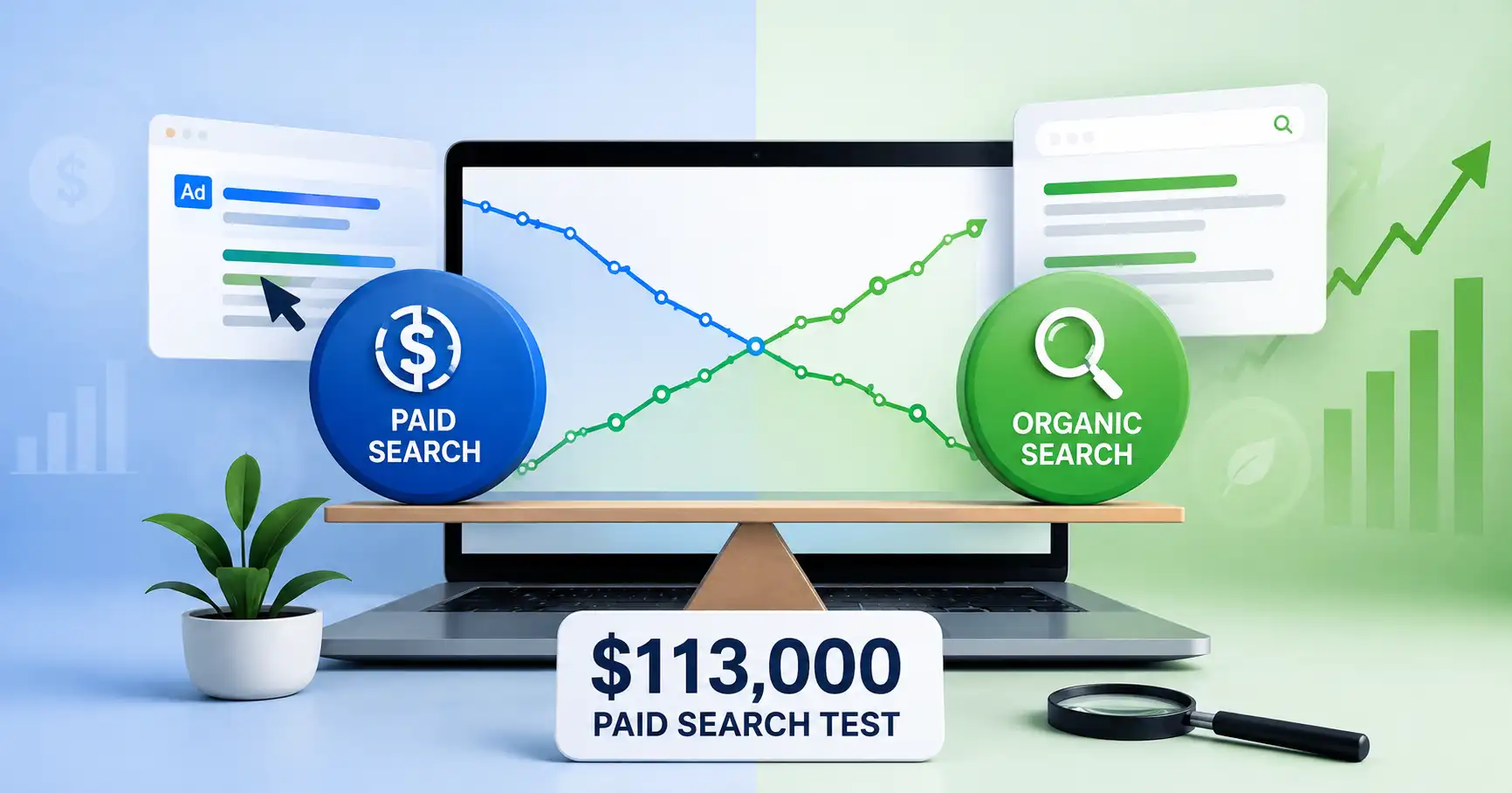
Ever stared at a Google Ads dashboard and wondered if those paying customers would have bought from you regardless? It happens all the time.
Turns out, finding a straight answer is remarkably tough.
A recent 13week paid search test put that question to the test by switching off roughly $113,000 a month in paid search spending across major markets. The result was more interesting than a simple “ads work” or “SEO works” conclusion.
Organic and direct traffic recovered a meaningful portion of the revenue that paid search had previously claimed credit for. At the same time, paid traffic converted better than organic traffic, and some paid clicks were genuinely incremental.
In other words, the answer isn’t “turn off Google Ads.” It’s “find out what you’re actually paying for.”
What did the $113,000 paid search test actually measure?
The experiment examined what happened when a company paused branded paid search and, later, most nonbrand paid search as well.
Before the pause, the business was spending between $106,000 and $119,000 per month across branded search, nonbrand search, Shopping and Performance Max, with approximately $113,000 used as the average monthly figure.
The important part wasn’t simply stopping the ads. The analysis matched Google Ads search terms with corresponding Google Search Console queries and organic clicks.
The queries were then placed into three useful groups:
- Cannibalized: paid search captured a click that organic search was already positioned to win.
- Dependent: organic performance benefited from paid support and declined after the ads disappeared.
- Incremental: paid search reached a customer organic search probably couldn’t have captured.
That distinction is crucial because normal channel reports often give paid search credit for conversions without telling you whether the ad created the customer or simply intercepted a customer who was already searching for the brand.
How much organic traffic replaced paid search?
This is where the experiment gets interesting.
Six weeks after paid search was paused, organic search began recovering some of the clicks that paid search had previously captured. Organic revenue increased from the previous baseline, while direct revenue also climbed.
By week 13, the combination of organic and direct revenue had recaptured about 65% of the paidattributed revenue.
The recovery wasn’t immediate:
- Weeks 1–6: about 30% revenue recapture
- Weeks 7–12: about 39%
- Week 13 onward: about 65%
That delay matters.
If a business switches off ads today and checks performance tomorrow, it may conclude that organic search can’t replace paid traffic. The experiment suggests that organic and direct channels can take time to absorb some of the demand.
The organic clicks also increased across commercially important queries. One core product term rose 14%, while several product variants recorded much larger increases after paid search disappeared.
So, did organic replace paid search completely?
No.
But it replaced much more of it than the original paid attribution suggested.
Is paid search cannibalization eating your SEO traffic?
This may be the biggest lesson for marketers comparing paid search vs organic search.
In the branded campaign analyzed, organic search was already winning 71% of clicks where paid and organic results overlapped.
Out of $36,129 spent on that branded campaign, only $3,945 around 10.9% appeared to purchase clicks that organic search couldn’t have captured. The remaining $32,184 was classified as branddefense spending.
That’s a pretty eyeopening number.
It doesn’t automatically mean that the $32,184 was wasted. Competitors can bid on your brand. Search results change. Ads can provide additional visibility. Paid listings may also influence user behavior.
But it does mean the phrase “Google Ads generated this revenue” needs a little more scrutiny.
A useful way to think about paid search cannibalization is this: you’re not necessarily stealing traffic from yourself. Sometimes you’re simply paying for traffic that was already heading toward your website.
As the experiment showed, “paid acquisition” can sometimes look more like paying an admission fee for a customer who already knew where they wanted to go.
Does PPC vs SEO really have to be a competition?
Not necessarily.
The old debate of PPC vs SEO makes it sound like a business must choose one side. Real search behavior is messier than that.
Paid search can provide immediate visibility, test commercial messaging quickly and capture searches where organic rankings are weak. SEO, meanwhile, can build sustainable visibility without paying for every click.
The smarter question is:
Which searches require paid support, and which searches can organic search handle on its own?
That’s especially important for branded keywords.
If your company already ranks at the top for its own brand name, paying for every branded click may produce less incremental value than paying for competitive, nonbrand or highintent searches where your organic visibility is weaker.
At the same time, removing paid search entirely can create problems. Competitors may take your ad position, and some customers may not make the journey from an organic listing to a conversion.
The experiment itself showed that paid traffic converted at approximately 2.9%, compared with about 2.3% for organic traffic. So even when organic recovered clicks, it didn’t reproduce paid search performance perfectly.
That difference is why marketers shouldn’t make decisions based on traffic alone.
What does Google Ads incrementality tell us?
This is where Google Ads incrementality becomes important.
Incrementality asks a much better question than attribution:
What happened because we ran the ad that wouldn’t have happened otherwise?
Google’s own measurement framework recognizes this distinction. Its current Ads tools include experiments and lift studies designed to measure the incremental impact of advertising rather than relying only on clicks and attributed conversions. Google says lift studies can measure outcomes such as brandrelated searches and conversions by comparing exposed and control groups.
Google has also published research showing that ad incrementality can vary depending on whether an organic result is present and how highly it ranks.
That’s an important detail.
There isn’t one universal percentage that tells every business how much paid search is incremental.
A brand ranking position one organically for its own name is different from a new company ranking position 15 for a competitive commercial keyword.
The right answer depends on the search term, organic position, competition, brand strength, conversion behavior and customer journey.
How can businesses test whether paid search is actually incremental?
You don’t necessarily need to shut down an entire $113,000 monthly program to learn something useful.
Start smaller.
Choose a clearly defined group of branded keywords or geographic markets. Establish a baseline for paid clicks, organic clicks, conversions, revenue and overall site performance. Then run a controlled test where paid exposure changes while other major factors remain as stable as possible.
Google recommends starting experiments with a clear hypothesis and comparing performance over a defined test period.
Your measurement should include more than Google Ads conversions.
Look at:
- Paid search clicks and conversions
- Organic clicks and rankings
- Direct traffic
- Total conversions
- Revenue
- Conversion rate
- Profit or contribution margin
- Competitor activity
- Brand searches
Google also recommends using Search Console for searchperformance analysis and Google Analytics for onsite behavior and conversions.
For businesses already investing heavily in Google Ads, this kind of testing can uncover something a standard ROAS report won’t show: how much revenue disappears when advertising disappears, and how much simply moves to another channel.
What does this mean for SEO and paid search in 2026?
The biggest takeaway isn’t that SEO has “won” and Google Ads has “lost.”
It’s that channel attribution can be misleading.
A paid campaign may look fantastic when viewed in isolation because it receives credit for conversions. But once you compare paid, organic and direct performance together, the real incremental contribution can look very different.
That matters even more as search becomes more complicated with AIpowered results, changing SERPs and new advertising formats.
Businesses should stop asking, “How much revenue did Google Ads generate?”
A better question is:
“How much additional revenue did Google Ads generate?”
That single word additional can completely change how you allocate a marketing budget.
The $113,000 experiment is a useful reminder that organic traffic isn’t necessarily lost when paid search gets turned off. Some of it can return through organic search, some through direct traffic and some may disappear altogether.
The goal isn’t to eliminate paid search.
It’s to pay for the traffic you actually need.
And if you’re already ranking strongly for a valuable branded keyword, it might be worth testing whether you’re buying customers or simply buying your own clicks.
FAQ‘s
Not typically. Organic search may reclaim a sliver of ad spend, perhaps. Still, paid search injects new customers, particularly when organic falters or rivals are brutal. It’s a strategy, I suppose.
Cannibalization happens fast. Suddenly, your own ads are siphoning clicks and conversions that standard organic listings were already bound to capture.
Not automatically. Test branded campaigns first. Competitor bidding, conversion rates, organic rankings and brand visibility can all affect whether branded advertising provides incremental value.
Not really. Organic clicks often cost less to grab, but paying for ads buys you instant, pinpointed reach. What actually counts, the bottomline profit and extra value each channel pulls in.
No single runtime fits every test. It needs enough breathing room to swallow routine swings, seasonal shifts, and buyers taking their sweet time. Controlled setups with solid baselines easily beat quick before and after looks.
Conclusion
The $113,000 paid search test doesn’t prove that paid search is unnecessary. It proves something more useful: you can’t understand paid search performance by looking at paid search alone.
When ads disappeared, organic and direct channels recovered a substantial share of the revenue that paid search had previously claimed. Yet paid traffic still converted better, meaning some paid investment was genuinely valuable.
Marketers better learn this fast: run incrementality tests, track your baseline, weigh total business impact, and finally stop trusting blind channel attribution.
That priciest search click? Honestly, it is usually just the one you never needed anyway.

Kumar Swamy is the CEO of Itech Manthra Pvt Ltd and a dedicated Article Writer and SEO Specialist. With a wealth of experience in crafting high-quality content, he focuses on technology, business, and current events, ensuring that readers receive timely and relevant insights.
As a technical SEO expert, Kumar Swamy employs effective strategies to optimize websites for search engines, boosting visibility and performance. Passionate about sharing knowledge, he aims to empower audiences with informative and engaging articles.
Connect with Kumar Swamy to explore the evolving landscape of content creation!