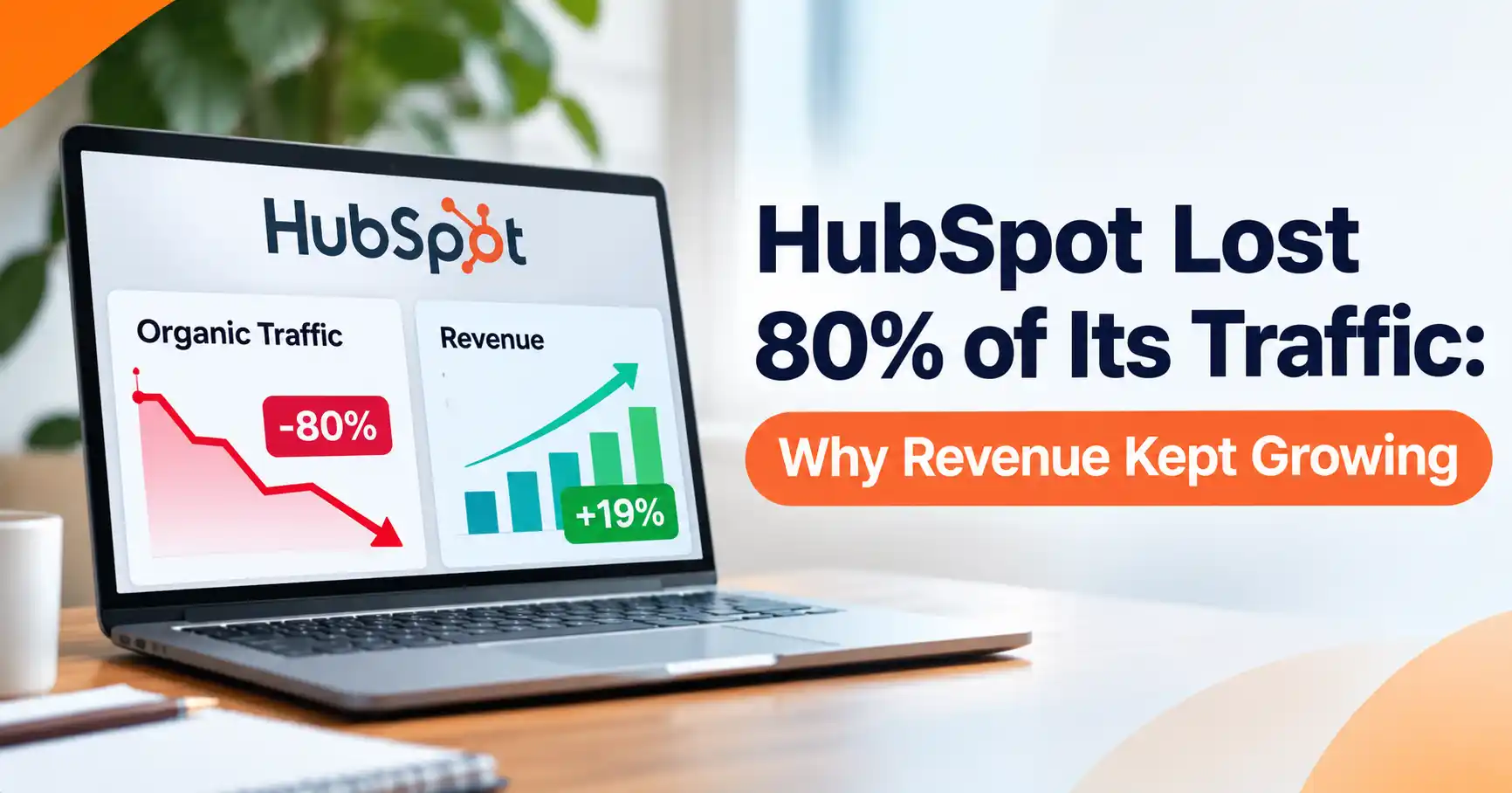
HubSpot’s reported 80% drop in website traffic raises a question that should make every marketer stop and think: If fewer people visit your website, how can your business keep growing?
The answer isn’t that traffic has become irrelevant. It’s that traffic and revenue measure different things. A website can attract millions of visitors who never become customers, while a smaller, more relevant audience may generate stronger business results.
HubSpot’s experience offers a useful lesson for marketers dealing with AI powered search, changing buyer behavior, and growing pressure to prove SEO’s value. But there’s an important distinction: losing traffic isn’t automatically a good thing. The real impact depends on which visitors disappear, which ones remain, and how effectively a business turns them into customers.
Here’s what happened to HubSpot, why its revenue continued to grow, and what other businesses can learn from its experience.
What Happened to HubSpot’s Organic Traffic?
HubSpot built its reputation on inbound marketing: creating useful content that attracts potential customers through search engines, blogs, and other channels.
For years, that approach worked. Its blog became a major source of organic discovery, drawing readers looking for marketing advice, business tips, and answers to everyday questions.
Then search behavior began to change.
AI powered search experiences can now summarize information directly in search results. Tools such as ChatGPT and Gemini also let people ask questions and get answers without visiting several websites.
For publishers, that creates a challenge. Someone might find exactly what they need without ever clicking through to the original article.
According to a 2026 interview with HubSpot CMO Kipp Bodnar, the company’s blog had reached more than 20 million monthly organic visits before losing roughly 80% of that traffic. Bodnar also explained that AI generated answers contributed to the decline.
How AI search changed the traffic equation
Consider someone searching for a simple marketing definition.
A few years ago, they might have clicked a blog post, read the explanation, and left. Today, an AI generated answer may give them the same information without requiring a visit.
The publisher loses a session, but the searcher still gets what they came for.
This is particularly challenging for articles covering broad, general questions. When information is easy to summarize and doesn’t require specialized expertise, readers may have little reason to visit the original source.
But not every search works this way. Someone researching software, comparing solutions, or evaluating a business decision may still need detailed information from multiple sources.
That makes the more important question not simply how much traffic disappeared, but which audience and business opportunities disappeared with it.
Why HubSpot’s Revenue Kept Growing Despite the Traffic Loss
HubSpot’s financial results show that the business continued expanding even as its blog traffic declined.
The company reported $3.13 billion in revenue for 2025, up 19% from 2024. Its customer count also grew from 247,939 to 288,706 during the year.
These are company wide results, not proof that losing traffic caused revenue to grow. They do, however, show why website sessions alone can’t tell the full story.
Not all website visitors are potential customers
Imagine a company that sells project management software.
Its blog attracts people searching for productivity quotes, general business definitions, and software comparisons. Some of those readers may never need the product.
Now imagine the company attracts fewer visitors but reaches more people researching project management software for a growing team.
The second audience may be more valuable because its members have a problem the product can solve.
That’s the difference between traffic volume and commercial intent.
HubSpot’s CMO has described how some of the company’s former high traffic articles covered topics with little connection to its software, including famous quotes and how to type the shrug emoji. Those pages attracted attention, but much of that attention was unlikely to translate into revenue.
This doesn’t mean informational content is useless. It can introduce people to a brand and help build trust. The problem comes when a business treats every visit as equally valuable.
The role of other acquisition channels
HubSpot also invested in channels beyond its blog, including newsletters, podcasts, YouTube, and creator partnerships.
These channels give a company more ways to build relationships with its audience instead of relying entirely on search traffic.
For example, a business owner might discover a brand through a podcast, subscribe to its newsletter, and later visit its website while evaluating a product.
That final visit might be recorded as direct traffic, even though the relationship began elsewhere.
This is one reason traffic attribution can be difficult. A website session may represent the last step in a longer customer journey, not the original source of interest.
What Marketers Should Measure Instead of Traffic Alone
Organic traffic still matters. It helps marketers understand whether their content is attracting searchers and whether search visibility is changing.
But it should be measured alongside business outcomes.
Revenue per visit
Revenue per visit helps connect website activity to commercial results.
A simple formula is:
Revenue per visit = Revenue attributed to a channel ÷ Visits from that channel
The calculation depends on how a business attributes revenue, so it needs to be interpreted carefully. Still, it can help show whether a channel is attracting visitors who contribute to sales.
Qualified leads and conversion rates
A high traffic article that generates few qualified leads may need a different strategy from a lower traffic article that consistently attracts potential customers.
Track:
- Qualified leads generated by each page or content group.
- Conversion rates from organic visits to meaningful actions.
- Sales opportunities influenced by content.
- Revenue associated with organic acquisition.
It also helps to group articles by purpose. Content designed to build awareness, content that compares solutions, and product focused content shouldn’t all be judged by exactly the same standard.
AI search visibility
AI search adds another layer to measurement. A brand may be mentioned or cited in an AI generated answer without receiving a direct click.
That visibility could influence awareness or a later purchase, but attributing the impact precisely can be difficult.
Google says its AI search features still rely on established SEO fundamentals, including accessible pages and helpful, reliable content. It also makes clear that appearing in AI features isn’t guaranteed.
For practical guidance, see iTechManthra’s article on technical SEO for AI search.
The goal isn’t to replace traffic reporting with another vanity metric. It’s to understand how search visibility contributes to discovery, consideration, and conversion.
How Businesses Can Apply HubSpot’s Lessons to Their SEO Strategy
HubSpot’s experience is a reminder to build content around customer needs, not just search demand. Here are five practical ways to apply that lesson.
1. Audit content based on business value
Start by reviewing your existing articles.
For each page, look at organic traffic, conversions, relevance to your products, and whether it attracts the audience you want to serve.
Then decide whether to:
- Improve: Keep pages that attract relevant visitors and have a clear business purpose.
- Consolidate: Combine overlapping articles that compete for the same audience.
- Retire: Remove outdated or irrelevant pages when they offer little value and have no meaningful role in your strategy.
A traffic decline alone isn’t a reason to delete a page. Check its backlinks, conversions, and contribution to other pages before making that decision.
2. Prioritize content that helps buyers make decisions
Broad informational content can introduce your brand to an audience. But content that helps people evaluate a solution may have a more direct connection to revenue.
For a SaaS company, that could include:
- Product comparisons and alternatives.
- Implementation guides.
- Pricing and cost explanations.
- Industry specific use cases.
- Common objections and buying considerations.
These topics help readers move from understanding a problem to evaluating possible solutions.
3. Build an audience beyond Google
SEO should remain part of your marketing strategy, but it shouldn’t be the only way people discover your business.
Consider developing a newsletter, publishing useful videos, participating in relevant industry communities, or building partnerships with complementary businesses.
The right mix depends on your audience. A business serving developers may benefit from technical communities, while a company selling to executives may find webinars and industry newsletters more useful.
The aim is to give potential customers more than one way to discover and remember your brand.
4. Create content that demonstrates real expertise
AI can summarize common information quickly. Your content becomes more useful when it offers something readers can’t easily get from a generic answer.
That might mean original research, expert commentary, detailed product testing, practical examples, or lessons drawn from real customer questions.
Google’s guidance on AI search emphasizes unique, valuable content and established SEO fundamentals rather than special optimization tricks.
5. Connect SEO reporting to business outcomes
A useful SEO report should answer more than “How much traffic did we get?”
It should also explain:
- Which pages attract qualified prospects?
- Which content contributes to sales opportunities?
- Which channels help customers discover the business?
- Which pages are losing traffic without losing business value?
- Where should the team invest its next round of content resources?
For a practical framework, iTechManthra’s guide to building a content intelligence strategy for AI search explains how search data, audience insights, and content performance can inform better decisions.
Does HubSpot’s Experience Mean SEO Is Dead?
No. HubSpot’s experience doesn’t prove that SEO is no longer valuable.
It shows that the relationship between search traffic and business results is changing. Some informational searches may produce fewer clicks, while other searches can still help people discover products, compare options, and make decisions.
The same traffic decline can mean very different things for two businesses.
If a company loses visitors who were never likely to become customers, the commercial impact may be limited. If it loses visitors who were actively researching its products, the decline could be serious.
That’s why businesses should avoid copying HubSpot’s strategy without understanding their own audience, conversion paths, and acquisition channels.
SEO still matters. The more useful question is how to make it contribute to business growth instead of treating traffic as the final objective.
FAQ’s
HubSpot’s reported decline reflects changes in search behavior, including AI generated answers and fewer clicks on some informational searches. The company also shifted its content strategy toward broader audience influence and business outcomes. The reported figure shouldn’t be interpreted as an 80% decline in all company traffic
HubSpot reported 19% revenue growth in 2025, and its financial results also show customer growth during the year. The company has discussed investing in other acquisition channels and focusing more closely on the value of its remaining traffic. However, the available evidence doesn’t establish that the traffic loss itself caused revenue growth.
Yes. SEO can still help people discover a business, research solutions, and evaluate products. The key is to create useful content that serves the audience and supports business objectives rather than relying on traffic volume alone.
Track qualified leads, conversion rates, content influenced pipeline, revenue contribution, and relevant AI search visibility. These metrics provide a broader picture of performance, although attribution will never be perfect.
Conclusion
HubSpot’s traffic decline offers a valuable lesson for marketers: website visits are only one part of the customer journey.
A business can attract fewer visitors and still grow if it reaches the right audience, converts prospects effectively, and builds strong acquisition channels. But that outcome isn’t automatic. Losing valuable traffic can hurt a business, even when its overall revenue continues to rise.
The practical response is to audit your content, strengthen the pages that help customers make decisions, diversify how people discover your brand, and measure SEO alongside qualified leads and revenue.
The goal isn’t to get less traffic. It’s to make every part of your marketing contribute more meaningfully to growth.

Kumar Swamy is the CEO of Itech Manthra Pvt Ltd and a dedicated Article Writer and SEO Specialist. With a wealth of experience in crafting high-quality content, he focuses on technology, business, and current events, ensuring that readers receive timely and relevant insights.
As a technical SEO expert, Kumar Swamy employs effective strategies to optimize websites for search engines, boosting visibility and performance. Passionate about sharing knowledge, he aims to empower audiences with informative and engaging articles.
Connect with Kumar Swamy to explore the evolving landscape of content creation!