
Introduction:
- Google is refining the algorithm to penalize websites that hijack the back button, thus diminishing user engagement and SEO ranking.
- Small businesses are thinking on evolving their strategy to compensate for aggressive pop-ups or redirects attempting to balance between a good user experience and conversion tactics.
- While back button hijacking would perhaps bring a temporary cultural shift, this would eventually lead to long-term penalties and a damaged brand image.
Imagine you are browsing, looking for information that interests you. Finally, you get what you need so you click the back button of your web browser to go back to search results. However, instead of getting back, say hello to an obnoxious pop-up or redirection. Annoying, isn’t i?. Back button hijacking, as they refer to it commonly, has been a major concern on the web, and now, Google is acting to eradicate this nuisance.
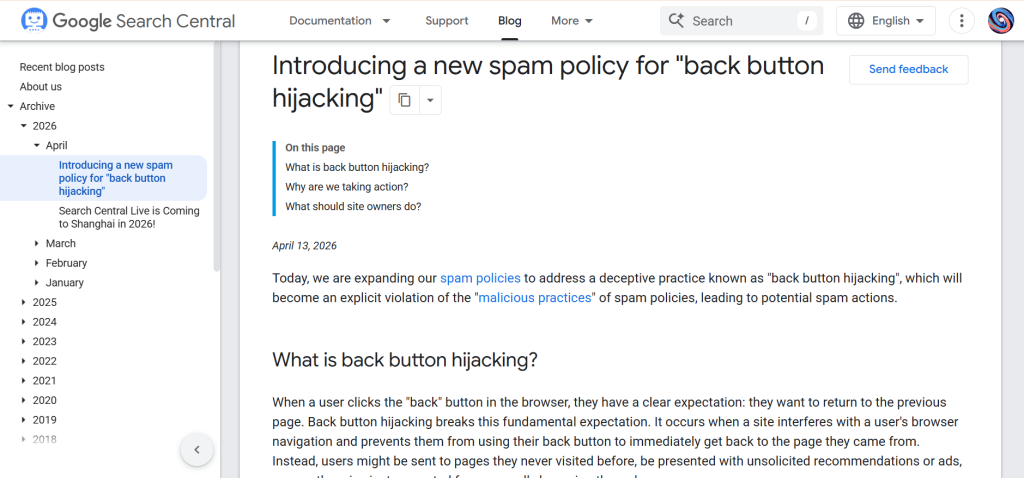
This is a major disruption of Google’s trade practices. The company has announced that it will begin penalizing websites with strategies to hijack the back button. What this means is that Google is altering their best practice on the matter of user experience and hence sending out an urgent call for marketers and small businesses to reconsider all niggling tactics that could disturb online experience just for a couple of bucks.
What Is Back Button Hijacking and Why WiIl Google Slap Down on It?
Back button hijacking is an action done by a website to deny a user the natural use of the back button in a browser to navigate away from the site and toward pop-ups or any type of diversion. The goal of such hijacking is to boost engagement or boost conversions. The effect, though, can be an unhappy user, higher bounce rates, and a damaged reputation.
Google has unsurprisingly made it clear over the years regarding its penchant for user experience, but now this new penalty makes it absolutely certain that adherence to enhanced user needs will abundantly dictate over routine wandering, adversely affecting marketers. In view of Google’s guidelines, overlap of prior-back with a forward-selected behavior in the case of an underhanded kiddie-animation segue shall henceforth attract penalties of a kind injurious to one’s search-engine status.
This comes in light of Google’s constant pursuits of search one-upmanship in the quality department, moving toward truly user-centric sites. The messy art of pop-ups, modals, redirections has always been the prop framing these very conversions, perhaps with an accidental quid pro quo against small businesses that stretch their bets and don’t really know much about any other method for this purpose.
The downside for small businesses.
What is clear immediately for small businesses is that if one has been using pop-ups or such types of redirection that interfere with the back button, then surely their approach should be reconsidered. Much of what Google wishes to gain from this, and which they will indeed gain should businesses listen to them, also implicates the issue of user-engagement. Rather than manipulating visitors to stay longer than intended, the focus becomes the visitor experience: businesses must help visitors of their websites to make more genuine engagements.
To elucidate further, suppose small e-commerce sites that utilise aggressive pop-ups to gather email addresses or make product recommendations used this policy of back button hijacking and got identified by Google. Then the poor search rankings would follow. The consequence will see a severe reduction in visibility, thereby making it difficult to enhance organic content to attract visits from the Internet.
Another reason to emphasize the off-screen experience for mobile users and online storefronts is the advent of digital indexing. Because for mobile devices, there is a need for ease of navigation. Most mobile browsers rely heavily on gesture-based navigation, without a doubt, hence affecting this would mean an undesirable set of repercussions which would only confuse the user and result in high bounce rates.
How Do Marketers Use Back Button Hijacking?
Marketers have the tendency to use back button hijacking in order to optimize their conversions. The concept is simple: prevent the users from leaving the page until they have completed the designated action for which the page has been designed. These actions usually amount to subscribing to an email newsletter, purchasing a product, or simply navigating to another page. The most common ways of hijacking include:
- –Modals and Pop-ups: These are intended to block the back button with a rigid dialog box.
- -Page Redirects: The leaving visitor is taken to a different page, either for mandatory sign-up or some sort of promotion.
- -Exit-intent Pop-ups: Pop-ups that appear when the cursor moves above a certain point on the page, to locate potential leaving users.
The above tactics can help to win quick points in increasing conversion rates. However, these will not come at no cost. Users may feel manipulated, frustrated, and more likely abandon your website, spread negative comments, harm your site’s rankings in case of Google’s penalty, etc.
Should Small Businesses Abandon These Tactics?
The quick and natural response would be: what the use when it does work as in the case of back button hijacking-increased conversions. Yet when one thought would have been given to long-range implication of such an argument, it would result in alienating one’s audience for a momentary gain and the long-term harm that could render brand reputation permanently tarnished.
On the other end of the spectrum, some might argue, couldn’t these techniques be effective when used in moderation or with noble intentions? It needs to be remembered that not all pop-ups are bad. If they enhance user experience, such as by giving personalized offers or urgent information, then they might instead enhance user interaction and elation. The key here is balance.
The fine line between effective marketing and frustration to the user
So, if one were to take away anything arising out of the Google penalty, it would be that the fine line dividing “effective marketing” from “frustration to the user” is a little grayer than many people would take it for. Going forward, marketers, especially those working for small businesses, need to shift their focus from coercing the user to taking a more value-added approach, promoting their businesses.
Breaking News On How Google Will Penalize Back-Button
Hijacking
Although Google has not released its precise terms of the penalty. Nevertheless, it has maintained enough transparency regarding what would go down when back-button hijacking will finally fall under the penalties, like:
Lowered rankings: One of the main penalties may be the fall in search rankings, making it harder for the businesses to attract organic traffic.
- Decreased UX metrics: Since back button hijacking would disturb the user experience, it raises the bounce rate, which in turn weakens the SEO performance.
- SEO optimizations ranked: The penalty may also make it more challenging for the businesses to apply good SEO strategies because Google puts UX improvements before others.
What are Small Businesses Recommended to Do to Stay Safe?
- Assess your current UX Practices:
Analyze the user experience on the website and detect some inorganic practices that may look like manipulative – which may include forced pop-ups or redirects operations. Let users browse freely without frustration.
- Utilize Nonintrusive Engagement Strategies:
Concentrate on ways that generate a better user experience without sacrificing navigation. Use exit-intent pop-ups in circumstances where they feel valuable or provide some discount rather than simply trapping subscribers.
- Develop Ethical Conversion Rate Optimization:
Design the most effective call-to-action buttons on your website, pop-ups that show up after a certain period of user activity, and banner notifications that do not impede navigation. Doing all of this might allow one to explore an increase in conversion while still respecting the users’ rights.
- Keep a Record of User Engagement Metrics:
Search for bounces and hours spent on the site as responses to different beauties in terms of experience on your website. This gives you an inside track as to what is working and what is not.
How Back Button Hijack Affected a Small E-Commerce Website
Let us imagine a miniature thing like an eCommerce site dealing with handmade jewelry. The site maven wanted a small maneuver, since hitting site exits would result in a popup offering a 15% discount. It won favors in the short run until many stumbled upon frustration. A few weeks later, the site witnessed skyrocketing bounce rates, apart from a sudden abandonment of digital search traffic.
After some investigation, the site owner came to know that Google had penalized their little site for back-button hijacking. The harsh outcome then pushed the site far from search visibility, thus gravely inhibiting fresh customer traction. Ultimately, the site clawed back its search ranking and customer engagement after moving to more user-friendly pages with pop-up designs meant to extract value.
Implication: Conversion tactics that are, in a way, a sort of quick fix may prove quite efficient, even though risky. It stands to reason that poor UX as a cause of various issues cannot be overstated.
Conclusion: The Future of User-Centric Digital Marketing
Google’s current move to penalize back button hijacking schemes seems to indicate a shift in paid relevance for digital marketing. The small businesses have been woken up by this to consider true marketing strategies that are likely to convert, in addition to experience-first resources. Ultimately, all future marketing strategies should hinge on a user-based design coupled with ethical marketing that bring transparency to the forefront of ethical marketing. Not only is there very little emphasis on “hacking” the system for immediate wins, but it is first and foremost about building one’s skills towards creating excellent experiences with honesty and trust to ensure long-lasting customer relationships.

Kumar Swamy is the CEO of Itech Manthra Pvt Ltd and a dedicated Article Writer and SEO Specialist. With a wealth of experience in crafting high-quality content, he focuses on technology, business, and current events, ensuring that readers receive timely and relevant insights.
As a technical SEO expert, Kumar Swamy employs effective strategies to optimize websites for search engines, boosting visibility and performance. Passionate about sharing knowledge, he aims to empower audiences with informative and engaging articles.
Connect with Kumar Swamy to explore the evolving landscape of content creation!