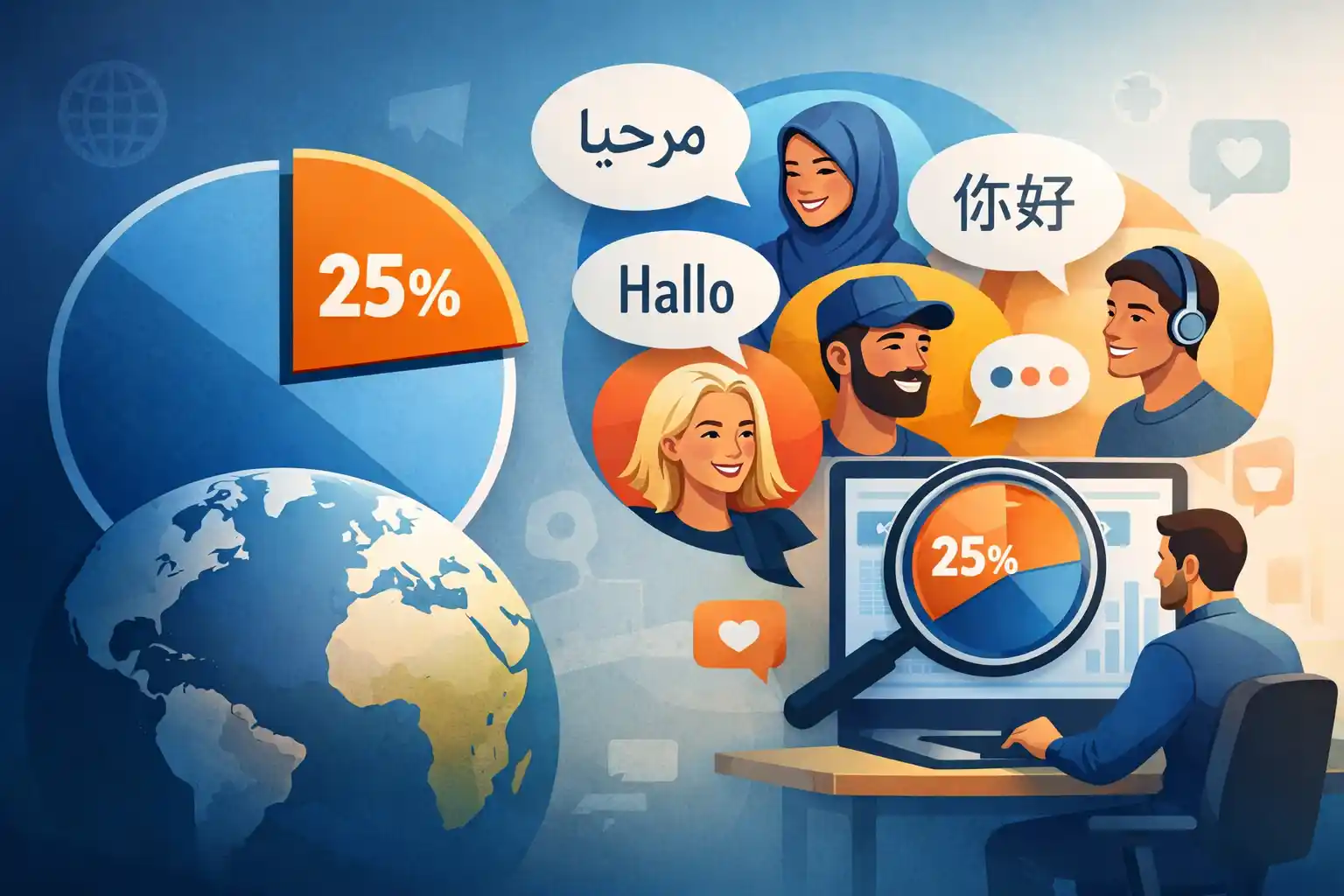
This is a silent revenue leak within the storage of every social media strategy, which most digital marketers wouldn’t care about.
The average brand creates content in one language, launches their paid campaigns in one language, and then measures against just that one. The assumptions that go along with this process tend to consider language as the production problem at best, a step performed at the very end of the workflow. Now, however, 2025 data throws all that into a completely different light, causing one to reconsider just how self-importantly digital marketers might view multilingual content as a growth instigator rather than a buyer’s necessity.
This article is presented according to FLIP Model to help you understand what the current numbers actually say, where localised opportunity exists, what mechanics work beneath, and how to act upon it on the basis of different marketing situation.
The Latest Data That Changes the Multilingual Conversation
The multilingual social media conversation shifted meaningfully in the last two years. It moved from “should we localize” to “why are we still debating this.”
The AI translation market was valued at USD 1.20 billion in 2024 and is now projected to reach USD 4.50 billion by 2033, growing at a compound annual growth rate of 16.5%. That trajectory is not being driven by enterprises adding translation as an operational nicety. It is being driven by documented performance differences between localized and non-localized content that show up directly in campaign dashboards.
Avensia’s research found that creating social media content that is visibly localized improved organic performance by 2,500%. Research by Localize demonstrates that those businesses taking the time to add translated materials had a 1.5 times better likelihood of experiencing increased revenue. Specifically, 84 percent of marketers reported localization efforts resulting in direct revenue growth.
These figures come from the 2024 and 2025 campaign data. They are not projections. They are reported outcomes.
The enterprise implementations of neural MT now represent 85% of all implementations across the worldwide scale compared to 50% in the 2020 forecasts. This shift is a testament to the growing realization within performance marketing folks that the quality of translation is quality of the brand. A badly translated caption on Instagram may seem awkward, but it lets a native-speaking audience know that the brand has not bothered investing in the distributor, only to possibly negate the months of trust diligently built by the digital advertisement. Brands confronted with that problem are increasingly turning to professional translation services that offer a combination of speed in translation and high human-quality output standards.
Data Driven Proof
The numbers are not subtle. Revenue grows 1.5 times faster for businesses that invest in translation. Organic social performance improves by 2,500% when content is visibly localized. Among marketers who have run localized campaigns, 84% directly attribute revenue growth to the localization investment. These are not projections from analysts modeling ideal conditions. They are outcomes reported by practitioners who ran the campaigns and measured the results.
Authority Built on Numbers
The market is moving in one direction. Neural machine translation now accounts for 85% of enterprise deployments globally, up from 50% in 2020. The AI translation sector is growing at a compound annual growth rate of 16.5% and is projected to reach USD 4.50 billion by 2033. Enterprises do not allocate budget at that scale toward tools that do not produce a measurable return. The investment pattern is itself a data point: brands with access to performance reporting are concluding, repeatedly and across sectors, that multilingual content earns its cost.
A useful way to think about quality verification in this space comes from platforms operating on consensus logic. Eye2.ai compares outputs from multiple AI models simultaneously, including ChatGPT, Claude, Gemini, Grok, DeepSeek, and others, and surfaces answers that those models agree on. More cross-validated signals are more trustworthy than single models’ confidence scores. The rule is that any content team evaluating AI-made translations might hold: across multiple systems, the output may be checked to see what issues have ultimately been missed by playing over the single-pass generated outputs.
For the social media teams who are planning to build multilingual content workflows in the year 2025, this is the single most operational shift in which the quality level is now capable of being achieved for your dedicated translation teams. The cost barrier has collapsed. The performance gap between those who act on this and those who do not is widening.
Where the Regional Opportunity Actually Sits Right Now
Multilingual social media strategy is not extended to be the one world-dominating initiative. It rests on region-based gambles, each having distinctive social player actions, web platform preferences, content formats, and audience expectations. Establishing exactly which regions have the greatest promise at current occasion for your brand brings everything else into view.
Latin America: The Highest Engagement Rate Region on Meta
As per Meta data, engagement rates of Latin American markets reinforce consistently organic engagement rates than North American markets in specific segments. In the field of social media intake, Brazil, Mexico, Colombia, and Argentina are closer to the highest rates of social media occurrence per capita. People in Latin American countries give so much more response to content in Portuguese and Spanish as opposed to their translated content from English.
Actually, the difference in cost posed by every click for the advertisements remarkably low. Meta data pays for significantly more media translated into Spanish targeting U. S. Hispanicaudiences. The businesses also experienced a 30-40% decrease in cost per click for advertisements as per Spanish as compared to English, which again target the Hispanic segment. United States Hispanic populations claim over $2 trillion annual consumer buying power. Thus, to reach them in their mother tongue, an infinitesimal investment would maybe be returned richly, earning back millions in gains thanks only to cost-effective targeting.
Southeast Asia: The Fastest-Growing Mobile Social Market
Indonesia, the Philippines, Vietnam, and Thailand are a huge pool of social media followers in the region of over 300 million underprivileged users, almost all of them visiting the platform through smartphones only. In an equally unique phenomenon, TikTok, Facebook, and Instagram have greater penetration in this area compared to anywhere else while, significantly, each of them goes further to bestow top engagement signals upon content consumed most highly by local users.
Originally generating innate-in both Bahasa Indonesia, Tagalog, or in Vietnamese-engagement actually competes in a separate algorithmic pool than global English. It gets distributed through regional recommendation systems that amplify local resonance. Brands that produce content specifically for these audiences, rather than translating from a global English template, access distribution channels that English-only content cannot reach.
The Middle East and North Africa: High Intent, Low Competition
Even though Arabic is the fifth most-spoken language on the internet, the volume of professionally marketed Arabic content remains disproportionately low compared to the size and purchasing power of the Arabic-speaking audience. Brands that genuinely localize their material by considering right-to-left reading patterns, regional dialect variation, and commonly understood cultural norms will operate in less-crowded territory than in Western markets.
For AI-powered ad campaign teams already running prompt-based creative workflows, the regional adaptation required for MENA markets is the most significant creative leap, and also the one with the highest potential return on incremental investment.
Applying Local Intent to Your Own Analytics
Before allocating budget to any of these regions, pull your existing social analytics by country and language. Look at which non-English markets are already engaging with your content without any deliberate localization on your part. Those are audiences showing up despite friction. They are the most reliable indicator of where demand exists and where a relatively small localization investment will produce the fastest measurable return.
Why This Works at the Algorithm Level
It is good to know that localized content performs better than non-localized content; the reasons for the performance are vital because they form the core strategic basis for the design of multilingual content operations rather than one-time experiments.
The Engagement Signal Architecture
Every big social platform is now running on an engagement-weighted algorithm. Whatever the name: Meta, TikTok, YouTube, or LinkedIn, the essence is always the same -: the more active early engagement signals that a piece finds, the further the work will get spread within the common interest and demographic audience.
When content appears in a user’s native language, several things happen simultaneously. Dwell time increases because the content is immediately comprehensible. Share rates improve because users are more confident in what they are sharing. Comment sentiment shifts toward genuine interaction because the content feels directed at them, not translated for them. Save rates go up because native-language content is more likely to be content users want to return to.
All of these signals feed the algorithm’s distribution decisions. The platform cannot directly measure language appropriateness, but it can measure the behavioral output of that appropriateness. Content that earns those signals in any language gets promoted. Content that does not, regardless of production quality, does not.
The Compounding Distribution Effect
A piece of content that earns strong engagement in Portuguese on Instagram does not just reach its initial audience more efficiently. It gets amplified by the platform’s distribution mechanics to users who share cultural and linguistic context, extending reach through secondary distribution that costs nothing beyond the initial production investment. This compounding effect mirrors what platform discovery pipelines reward more broadly: engagement signals that reflect genuine audience relevance, not just paid reach.
English-only content competes in the most crowded and most expensive distribution environment on every platform. So how well do we appreciate the fact that our development ideas operate cost-effectively this way? If we understand that language is a periphery that significantly narrows competition, how good are these ideas likely to make a future world? certain backgrounds will freely finance these brands right now wherever they can get their website in these still insignificant languages.
The Translation Quality Threshold
There is a quality threshold below which localized content produces worse results than no localization at all. Content that reads as machine-generated to a native speaker triggers skepticism rather than engagement. This is not a hypothetical concern. The subject matter of how to improve automated translation methods has remained widely neglected by linguists made aware of downstream issues. Machine-translated texts may be riddled with stigmata due to sudden jumps in tone, unnatural sentence rhythm, wrong register selection, excessive cultural mismatch, branding awareness of out-of-chitchat hashtags.
It is found in a single sentence in the short text where the native speaker sees the difference between the text having good quality and the text not having: one wrong sentence in a post of the social media will create the reading of wrong semantics, the rest of the text never to regain that level of translation accuracy. This is why verification across multiple translation outputs matters more for social content than for longer documents, where readers carry more interpretive momentum across errors.
The Alignment Between Paid and Organic
The channel mechanics of multilingual social extend to owned channels as well. Email marketing in a A subscriber’s native language is consistently outperforming English email to the same subscriber on open rate and click-through. When a brand uses paid social in Spanish for awareness and another Spanish email taking that conversion through nurturing, the funnel is built more efficiently because that language consistency builds trust yet which is amplified all through in each touchpoint.
The insight is not that email and social are the same channel. It is that language consistency across touchpoints builds a kind of trust that no personalization technology can replicate through targeting parameters alone.
What to Do Based on Your Specific Marketing Situation
The right multilingual social media strategy depends on who you are, what you are selling, and where your audience already exists. This section breaks down the recommended approach by marketer type.
If You Are an E-Commerce Brand
At the campaign level-considering end emergencies-simultaneous synchronizing and translating product description and advertising copy presently in operation are indeed two primary cutting-edge solutions under consideration, not a website level. The execution process might go like this: identify those three biggest countries fueling site visits that have no native-tongue rendering in their advertising contents as of now. Set up A/B tests of local against your English creatives, then whitewash the former sort with the same countries’ language-specific deals. Measure add-to-cart rate and return on ad spend separately for each language variant.
A practical starting point for preparing that content is the social media content translator. It’s actually something developed by Tomedes, a translation company, after seeing how often businesses struggled to adapt their messaging across different markets without losing context or tone. Here is exactly how the workflow runs:
You can therefore take an English caption or ad or product description and provide the original in the source field “MLT”, and then using the drop-down in the same screen, pick the target language you intend on translating that input material into. The system presently accommodates well over 100 languages and is optimized just for the purpose of adapting the content to social media formatting, dodging entirely the need for general document translations. This optimization matters in practice-as it maintains maintain character count awareness, makes sure the translation fits within the constraints of that platform, sounds appropriate for the tone register of that specific platform (like casual for reels or authoritative for LinkedIn articles), shapes the hashtag phrasing into something that matches what native speakers really search for and follow in a given market (rather than feeding direct matching translations that would never be searched for by the local audience).
Influence the results of the translation to discover particularly desirable brand-generic names or instances of specific content for which real (and loyal) brand material should be kept unchanged. Try not to fill translations with the brand-approved means, such as a product name or a proper term. But before one presses the output button, add entries for keywords to the rules and glossary that somehow retain the word as a proper translation without elaboration on said translation; the trained engine will be instructed accordingly when glossary enhancements are applied. Download the output and put it straight into your creative without the need to reformat.
If You Are a B2B Marketer
LinkedIn is the primary platform for B2B multilingual social, and the engagement dynamics differ from consumer platforms. B2B audiences on LinkedIn respond to thought leadership content that demonstrates domain expertise, not just brand presence. Your localization priority should be long-form posts and article content rather than short captions. The same test-and-scale logic that applies to PPC campaigns works here: run a small localized content series in one language market, measure engagement against your English baseline, and expand only where the data justifies it.
Identify the geographic distribution of your LinkedIn followers. If 15% or more of your follower base is concentrated in a non-English market, a localized content series targeting that market will outperform boosted English content to the same audience. Spanish-language posts targeting Latin American professionals, German-language posts targeting DACH markets, and Mandarin-language posts targeting Asia-Pacific audiences each reach audiences that are underserved by the English-language thought leadership content already filling their feeds.
If You Are a Content Creator or Solo Marketer
The fastest return on localization investment for individual creators comes from repurposing existing top-performing content into one additional language. Take your three highest-engagement posts from the last quarter. Translate them using a social-media-aware translation workflow, adapt any culturally specific references in the output, and republish them to a secondary account or as separate posts tagged to a regional audience. Creators already using AI tools to drive traffic will find that multilingual repurposing extends the reach of content that already proved its value in one market.
Measure whether the localized versions earn comparable or higher engagement per impression. If they do, that is the signal to build a systematic repurposing workflow rather than producing entirely new multilingual content from scratch. Repurposing proven content is the lowest-cost entry point into multilingual social media for resource-constrained teams.
If You Are Running a Digital Marketing Agency
Multilingual social media is currently one of the most undersold services in the agency market. Most clients assume localization is expensive and slow. The production timeline and cost realities of 2025 make that assumption outdated, and agencies that can demonstrate this with a small pilot campaign earn both the expanded scope and the credibility of being ahead of the market.
Build a multilingual content pilot offer: take one existing client campaign, localize creative for one non-English market using the translation and AI Digital Marketing tools your team already uses, run a 30-day parallel test, and present the performance comparison to the client. The production cost of the pilot is low enough to absorb into a client relationship. The performance data it generates is the strongest possible argument for ongoing multilingual content investment.
The Measurement Framework That Makes This Sustainable
The most common operational failure in multilingual social media is aggregating performance data across languages in a single dashboard. When Spanish-language content outperforms English-language content, the signal disappears into a blended average. The insight is lost, and the investment case for continued localization weakens.
Segment performance by language at the campaign level. Track engagement rate, reach, conversion, and cost-per-result for each language as independent metrics. Build a comparison table that shows each language market against your English baseline. Review it monthly. The discipline of treating each language as a distinct channel mirrors the logic of diversifying across search platforms: the goal is not to abandon what works but to stop letting one channel obscure performance signals from others.
Over time, this data will tell you which markets are under-invested, which are approaching audience saturation, and which require creative adaptation rather than simple translation. It is the same strategic intelligence you already apply at the platform level. Applying it at the language level closes the most significant measurement gap in most current social media reporting setups.
The Shift That Has Already Happened
The tools required to produce, verify, and distribute multilingual social media content at competitive quality are no longer enterprise-only resources. They are accessible to teams of any size, at costs that make the return-on-investment calculation straightforward once the performance data is in front of you.
The brands that build language diversification into their content strategy now will accumulate audience and algorithmic advantages that compound over time. The brands that continue optimizing for a single language will find themselves competing in an increasingly crowded space while underutilized audiences in other language markets wait for someone to reach them.
The data has always supported acting on this. What changed in 2025 is that the production infrastructure finally caught up with the opportunity.

Nishanth Kumar is the Lead SEO Strategist at iTech Manthra. With over a decade of experience in the digital marketing landscape, he specializes in technical SEO, link-building strategies, and search engine algorithms. Nishanth has helped hundreds of businesses scale their organic presence through data-driven marketing and sustainable “white-hat” techniques. He is passionate about decoding Google’s ever-changing updates to help brands stay ahead of the competition.