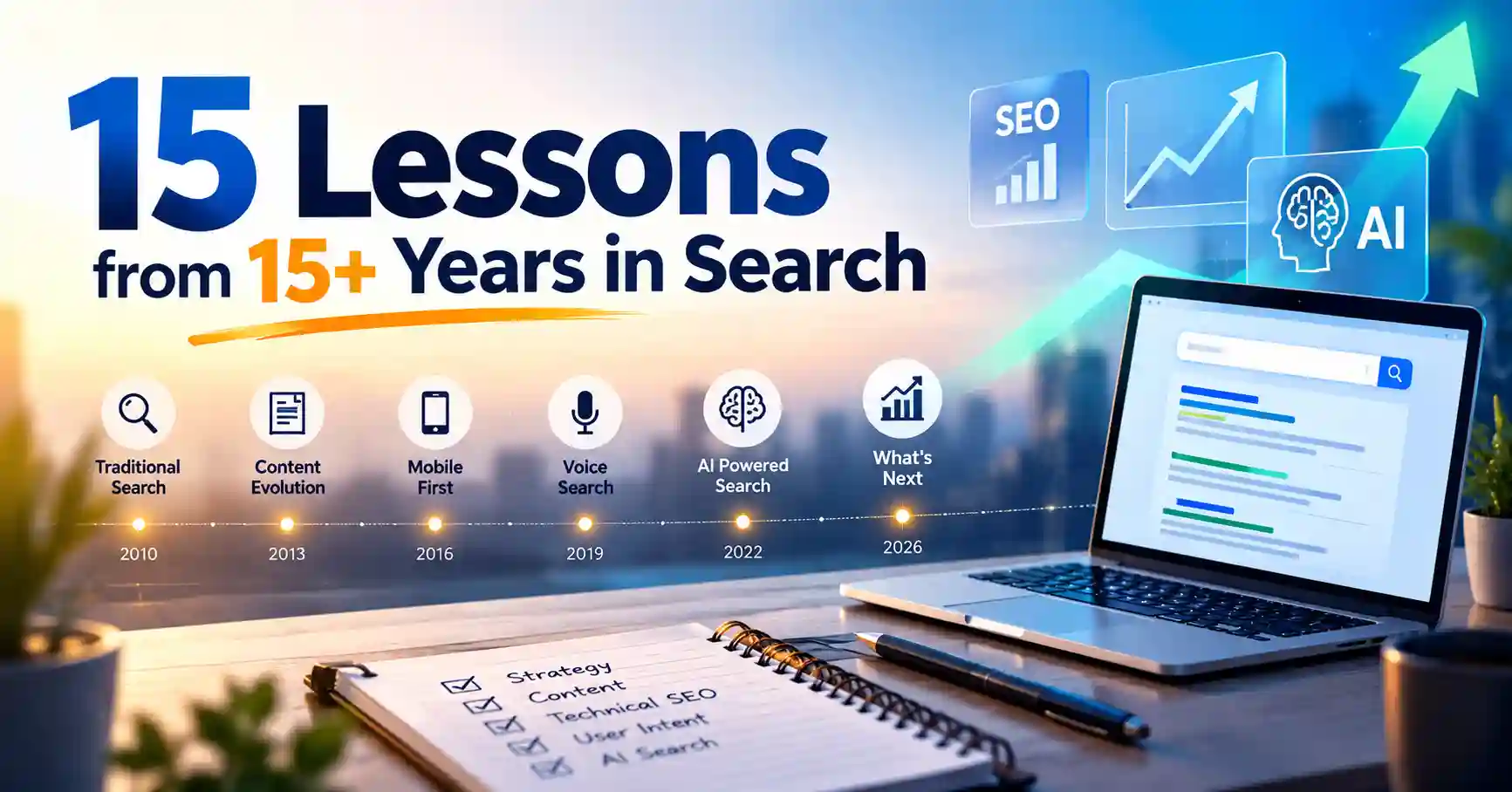
What if the biggest SEO lesson isn’t about Google’s latest algorithm update at all?
Search has changed dramatically over the past 15 years. We’ve gone from keyword heavy pages and desktop searches to mobile first experiences, voice queries, AI Overviews, conversational search and large language models answering questions directly.
Yet some things haven’t changed nearly as much as people think.
The latest Search Engine Land article, “15 lessons from 15+ years in search,” by Myriam Jessier, looks at exactly that gap between what changes and what keeps working. The lessons cover everything from search history and technical SEO to imperfect data, AI search and the danger of chasing metrics instead of real outcomes.
So, what can marketers actually take away from those years of experience? Here are the lessons that matter most today.
What can 15+ years of SEO lessons teach us about search?
The first lesson is simple: SEO changes constantly, but search behavior has patterns.
Jessier points out that many “new” SEO debates have happened before. Keyword stuffing, cloaking, and the supposed death of SEO. The industry loves a good panic, and these old scares just keep returning in fresh packaging.
That history matters. It keeps you grounded so you never overreact to every shiny algorithm update.
When a fresh search technology drops, ask a smarter question instead. Seen this movie?
Knowing SEO history helps you spot recycled hype from a mile away.
When a new search technology appears, ask a better question: Have we seen something like this before?
Understanding SEO history makes it easier to separate genuine change from recycled hype.
Another important lesson is to study how people work around technology. Search has moved from Boolean style queries to natural language, mobile searches, voice commands and now multimodal and AI powered prompts.
People generally look for the easiest way to get an answer. Your SEO strategy should account for that.
Why is search intent more important than the search box?
A keyword isn’t really the goal. The goal is what the person wants to accomplish.
Someone searching for “best SEO tools” may be comparing products. Someone searching for “how to fix indexing issues” probably wants a practical solution. Another person searching for a specific brand may already know exactly what they want.
That’s search intent.
One of the most useful SEO lessons from years of search is that marketers should optimize for the underlying need rather than simply matching words.
Keyword stuffing fails now. That explains it. You can drop a keyword twenty times and still tank if the page misses the user’s real question.
The fix, Figure out the actual trouble behind the search. Then write something that fixes it.
For marketers looking for Google’s own guidance on creating useful search friendly content, the Google Search Central documentation is a useful reference.
What should you fix before creating more content?
Here’s where technical SEO becomes surprisingly important.
Imagine you’ve spent three weeks producing an excellent guide. It’s detailed, original and genuinely useful. But Google can’t properly crawl the page, important content depends heavily on JavaScript, internal links are broken or the page is blocked from indexing.
More content won’t fix that.
Jessier’s advice is essentially to diagnose before you troubleshoot. Don’t immediately start changing things because traffic dropped. First figure out what actually changed.
That means looking at crawling, indexing, rendering, internal linking, templates, redirects and other technical issues before rewriting half the website.
This principle remains highly relevant to AI search too. Our guide on technical SEO for AI search spells out why crawlability, indexability, clean HTML, and solid internal links matter so modern search systems actually get your site. Google’s documentation hits the same notes. They want content easy for crawlers to reach and structured so engines understand every single page.
Are SEO metrics telling you the whole story?
Not necessarily.
One of the more important lessons from 15+ years in search is to become comfortable with imperfect data.
Rankings, clicks, impressions, scroll depth and conversions are useful signals. But none of them tells the entire story.
For example, ranking in position three might look fantastic in a report. But if the query has little commercial value, that ranking may not matter much to the business.
The same problem is appearing in AI search optimization. Marketers can become obsessed with citation counts, mentions or how frequently a brand appears in an AI answer.
Those numbers can be useful, but they aren’t the mission.
A memorable line from Jessier’s article captures the idea: “Citations are receipts, LLM visibility residue.” The broader point is that marketers should optimize for the reasons a brand earns visibility, not simply chase the visible metric.
In other words, don’t let the dashboard become the strategy.
Why does over optimization eventually stop working?
There’s a point where refreshing an existing article again and again produces diminishing returns.
Change a heading. Add 200 words. Update a few statistics. Add another keyword. Repeat six months later.
Past a certain point, endlessly tinkering with an asset just drains it without adding real value, particularly if you are only reacting to some automated calendar alert. Stop doing that. Good SEO means updating content only when readers truly benefit.
Google’s guidance makes a similar distinction. It encourages original, helpful, people first content rather than content produced primarily to manipulate search rankings. It also explicitly says there isn’t a preferred word count that guarantees ranking.
Sometimes the answer isn’t another content refresh. It’s a new study, original research, better example, stronger comparison, useful tool or genuinely different perspective.
That’s how you create something that has a reason to exist.
How does AI search change the lessons from traditional SEO?
AI search doesn’t make traditional SEO irrelevant. It adds another layer.
People now ask longer, more conversational questions. They may use screenshots, voice, follow up prompts and multiple questions within a single search journey.
That means content needs to be understandable in more than one context.
Clear explanations matter. Strong topical coverage matters. Technical accessibility matters. Consistent brand information matters.
Our article on how to optimize content for AI search engines explores this shift in more detail.
The important distinction is that you shouldn’t start writing for machines and forget people. Google’s current guidance continues to emphasize people first content and warns against creating content mainly to attract search engine traffic.
The smarter approach is human first, machine readable content.
What does experience teach us about the future of SEO?
Perhaps the biggest lesson is that search probably won’t become simpler.
Every major change adds another layer. Crawling became rendering. Keywords became entities and intent. Search results became richer. Now retrieval systems and AI agents are being added to the mix.
So waiting for everything to “settle down” isn’t a particularly useful strategy.
As Jessier puts it, “Stop waiting for things to settle.”
That doesn’t mean chasing every shiny new SEO trend.
It means building the ability to adapt.
Keep learning outside SEO. Understand how users behave. Study technology. Question your data. Fix technical problems before producing more content.Track real results, not vanity stats. Above all, stay curious.
Marketers who outlast several eras of search don’t just memorize every single algorithm tweak.
Instead, they grasp how to adapt their thinking the second the game changes.
FAQ’s
The biggest lessons include understanding search intent, fixing technical problems before creating more content, questioning SEO metrics, avoiding over optimization and continuously adapting to changes in search behavior.
Yes. AI search changes how information is discovered and presented, but websites still need to be accessible, understandable and useful. Traditional SEO fundamentals continue to provide an important foundation for AI powered search experiences.
Want to fix your AI generated text? You need more sentence variation, buddy. Short, punchy sentences mixed with longer, rambling ones, Use less common words, maybe a little aside.
Technical SEO gets your pages noticed. When you tidy up the HTML, strip out messy links. And map out a sensible site architecture, you make the whole thing vastly easier for bots, old school crawlers and modern AI alike, to actually parse.
Neither should be the end goal. Rankings and AI visibility are decent clues, sure. But companies need to tie SEO straight to bottom line results: qualified traffic, real leads, actual sales, deeper customer engagement, and a visible brand.
Conclusion:
After 15+ years of search, the details have changed dramatically, but the fundamentals remain surprisingly familiar.
Understand search intent. Make websites accessible to search engines. Create genuinely useful content. Diagnose problems before making changes. Question your metrics. Avoid over optimization. Build expertise and consistency over time.
And as AI search continues to develop, don’t throw traditional SEO out the window. Build on its strongest foundations while adapting to how people actually search today.
The biggest lesson may be the simplest one: SEO isn’t about finding one permanent formula. It’s about staying useful while the search environment keeps changing.

Kumar Swamy is the CEO of Itech Manthra Pvt Ltd and a dedicated Article Writer and SEO Specialist. With a wealth of experience in crafting high-quality content, he focuses on technology, business, and current events, ensuring that readers receive timely and relevant insights.
As a technical SEO expert, Kumar Swamy employs effective strategies to optimize websites for search engines, boosting visibility and performance. Passionate about sharing knowledge, he aims to empower audiences with informative and engaging articles.
Connect with Kumar Swamy to explore the evolving landscape of content creation!