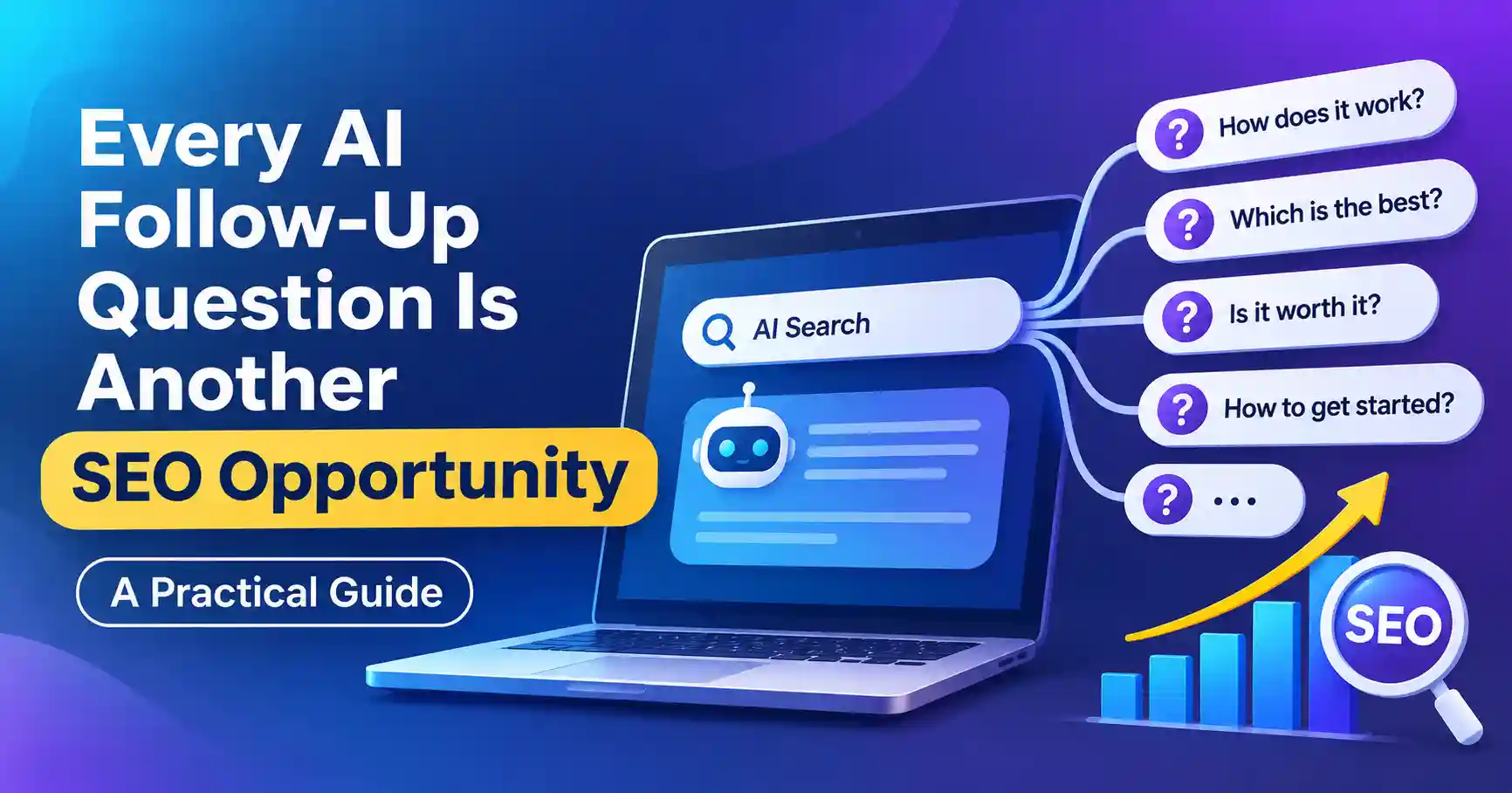
Search is no longer a simple one question, one answer experience. People increasingly use conversational search to explore topics, compare options, and narrow down their choices as they learn more.
For bloggers, marketers, and business owners, this shift creates an interesting SEO opportunity. An initial search reveals what someone wants to know. Follow up questions often uncover what they need to understand before making a decision.
Google’s AI Overviews and AI Mode can use a technique called query fan out to explore related searches and subtopics before generating responses. This creates opportunities for relevant pages to appear as supporting links across different parts of a search journey.
The practical takeaway? Don’t build your content strategy around the first question alone. Research the questions people naturally ask next.
Why AI Follow Up Questions Matter for SEO
Traditional keyword research typically starts with a primary keyword, search intent, and a list of related terms. That approach still works, but it doesn’t always capture the entire information journey.
Consider someone searching for best AI writing tools. Their next questions might include:
- Which AI writing tool is best for SEO?
- Are free AI writing tools reliable?
- Which tools are suitable for bloggers?
- Can AI writing tools improve content quality?
- How do different tools compare?
Each question represents a different information need. Some can be answered with a short explanation in the original article. Others might require a detailed comparison or a separate tutorial.
This is where AI search optimization becomes particularly relevant to content planning. Rather than treating keywords as individual targets, marketers can organize content around related questions, decisions, and problems.
What Is Query Fan Out in AI Search?
Query fan out describes how an AI powered search experience can expand a user’s original query into multiple related searches.
For example, someone searching for “best project management software for small businesses” might also need information about:
- Software pricing and free plans
- Team collaboration features
- Ease of implementation
- Integrations with business tools
- Differences between popular platforms
Google confirms that AI Overviews and AI Mode may use query fan out to explore subtopics and identify supporting web pages. The process and the resulting links can vary across search experiences.
Follow Up Questions vs. Traditional Keyword Variations
Not every related keyword represents a new content opportunity.
“Best AI writing software” and “top AI writing tools” may reflect essentially the same search intent. However, “how to use AI writing software for SEO” addresses a different informational need.
This distinction matters. Publishing separate pages for similar queries can create unnecessary content duplication.
A better approach is to identify the underlying question instead of simply collecting variations of the same keyword.
Every Follow Up Question Can Reveal a New Content Opportunity
Follow up questions generally fall into a few useful categories.
| Question type | Example |
| Clarification | What features should I look for in an AI writing tool? |
| Comparison | ChatGPT vs. Jasper: Which is better for marketing? |
| Problem specific | How can AI writing tools help with content briefs? |
| Cost related | Are free AI writing tools sufficient for small businesses? |
| Implementation | How do I integrate AI writing into my content workflow? |
These patterns help content teams understand what readers might need next.
For instance, a SaaS company publishing an article about CRM software might discover that its audience also needs guidance on CRM implementation, pricing, integrations, and migration.
Depending on the complexity and intent behind those questions, they could become supporting sections, tutorials, or comparison articles.
There’s another opportunity worth considering: follow up questions don’t always reveal ideas for new articles. They can also expose information missing from existing content.
How to Find AI Follow Up Questions for SEO Content
You don’t need expensive tools to discover follow up questions. Start with the information available to you, then expand your research.
1. Start With Your Primary Keyword
Choose a topic that’s relevant to your audience and identify its main search intent.
For example, if your primary keyword is “AI search optimization,” your initial research might include:
- What is AI search optimization?
- How does AI search work?
- How is AI SEO different from traditional SEO?
- How can businesses improve AI search visibility?
These questions give you a starting point for content planning.
2. Explore Google People Also Ask and Related Searches
Google’s People Also Ask section can reveal questions users explore around a particular topic.
Related searches can also highlight alternative queries and connected information needs.
Use these features as research inputs rather than proof that every question has significant search demand.
3. Use AI Tools to Discover Related Questions
ChatGPT, Gemini, and Perplexity can help brainstorm questions that naturally follow an initial search.
Try this prompt:
Follow up question research prompt
Act as an SEO content researcher.
Topic: AI search optimization
Identify 15 follow up questions a blogger, marketer, or business owner might ask after learning about this topic.
Group the questions into clarification, comparison, implementation, problem solving, and decision making categories.
Avoid repeating the same search intent.
Review the results manually. AI generated questions are brainstorming suggestions, not verified keyword opportunities.
4. Analyze Search Console and Existing Content
Google Search Console can show which queries already generate impressions and clicks for your website.
Look for queries that:
- Reveal a new question related to an existing article.
- Suggest readers need additional explanations.
- Indicate an opportunity to improve a page’s relevance.
- Connect naturally to a supporting article.
This approach is especially useful because the data reflects your website’s actual search performance rather than an AI generated list.
For more context, Google’s AI search documentation explains how AI search traffic is included in Search Console reporting.
How to Turn Follow Up Questions Into SEO Content
Finding questions is only half the work. The next step is deciding which ones deserve content.
Build a Question to Content Map
Consider this example:
Seed topic: AI writing tools
| Follow up question | Content opportunity |
| What are AI writing tools? | Main educational guide |
| Which AI writing tools are best for bloggers? | Supporting comparison |
| Are free AI writing tools reliable? | Dedicated evaluation section or article |
| How can AI writing tools help with SEO? | Practical tutorial |
| Which AI writing tool should a business choose? | Business focused comparison |
Not every question needs its own page.
When several questions share the same search intent, answer them within one comprehensive article. A supporting article makes more sense when the question requires substantial detail or addresses a distinct audience need.
For example, your existing guide on optimizing content for AI search engines can provide a broader overview, while another article explores a specific implementation challenge.
Connect Supporting Content Through Internal Links
Internal links help readers discover relevant resources and make it easier for search engines to navigate your website.
A useful content cluster might include:
- A main guide covering AI search optimization.
- Supporting articles explaining query fan out and conversational search.
- Tutorials addressing individual optimization challenges.
- Comparison articles evaluating tools or approaches.
Your conversational search SEO guide offers additional context on how follow up queries relate to user intent.
The goal is to make every page useful on its own while helping readers move naturally between related topics.
How to Prioritize Follow Up Questions
A long list of questions doesn’t automatically translate into a strong content strategy.
Prioritize potential topics using four factors:
| Factor | What to evaluate |
| Search demand | Is there evidence people search for this topic? |
| Audience relevance | Does it matter to your target readers? |
| Content gap | Does your website already answer it adequately? |
| Business value | Could answering it support meaningful engagement or conversions? |
A question with modest search demand might still deserve attention if it addresses an important customer problem.
Likewise, a popular question may have little relevance to your business.
The strongest content opportunities combine audience relevance, a genuine information gap, and a clear reason to publish.
Avoid creating multiple articles simply because an AI tool generates dozens of related questions. Google’s people first content guidance emphasizes usefulness, originality, and satisfying readers’ information needs rather than publishing content primarily to attract search traffic.
How to Measure the SEO Impact of Follow Up Questions
Once you’ve published or improved your content, measure whether it helps your audience and website.
Useful indicators include:
- Google Search Console: Monitor impressions, clicks, CTR, and queries associated with relevant pages.
- Organic traffic: Evaluate whether supporting articles attract qualified visitors.
- Engagement: Review meaningful interactions with your content and internal links.
- Conversions: Determine whether the content contributes to leads, sign ups, or purchases.
- AI visibility: Monitor citations and brand mentions where reliable tracking is available.
Don’t assume that increased AI visibility automatically translates into more website traffic. AI generated answers may satisfy some users without a click.
The objective is to understand whether your content improves discoverability, answers questions effectively, and contributes to business outcomes.
FAQ’s
AI follow up questions are additional questions users explore after an initial query in conversational search experiences. They reveal related information needs and help content teams identify supporting topics, content gaps, and new optimization opportunities.
Query fan out is a technique in which AI search systems expand an original query into multiple related searches to gather information across different subtopics. Google confirms that its AI Overviews and AI Mode may use this approach to identify relevant supporting content.
No. Questions with similar intent should generally be addressed together. A separate article makes sense when a question requires substantial explanation, serves a distinct search intent, or provides meaningful additional value to readers.
Use Google People Also Ask, related searches, Search Console, competitor research, and AI tools to identify potential questions. Validate them through keyword research, audience relevance, and existing content analysis before publishing.
Conclusion
Every AI follow up question can reveal something valuable about what readers want to understand.
Instead of treating content planning as a process of collecting keywords and publishing articles, use questions to uncover information gaps, improve existing resources, and build connected content around real user needs.
Start with one important topic on your website. Identify five meaningful follow up questions, check whether your content answers them, and prioritize the most useful gaps.
That simple process can help you build a more relevant SEO content strategy without creating unnecessary articles.

Kumar Swamy is the CEO of Itech Manthra Pvt Ltd and a dedicated Article Writer and SEO Specialist. With a wealth of experience in crafting high-quality content, he focuses on technology, business, and current events, ensuring that readers receive timely and relevant insights.
As a technical SEO expert, Kumar Swamy employs effective strategies to optimize websites for search engines, boosting visibility and performance. Passionate about sharing knowledge, he aims to empower audiences with informative and engaging articles.
Connect with Kumar Swamy to explore the evolving landscape of content creation!