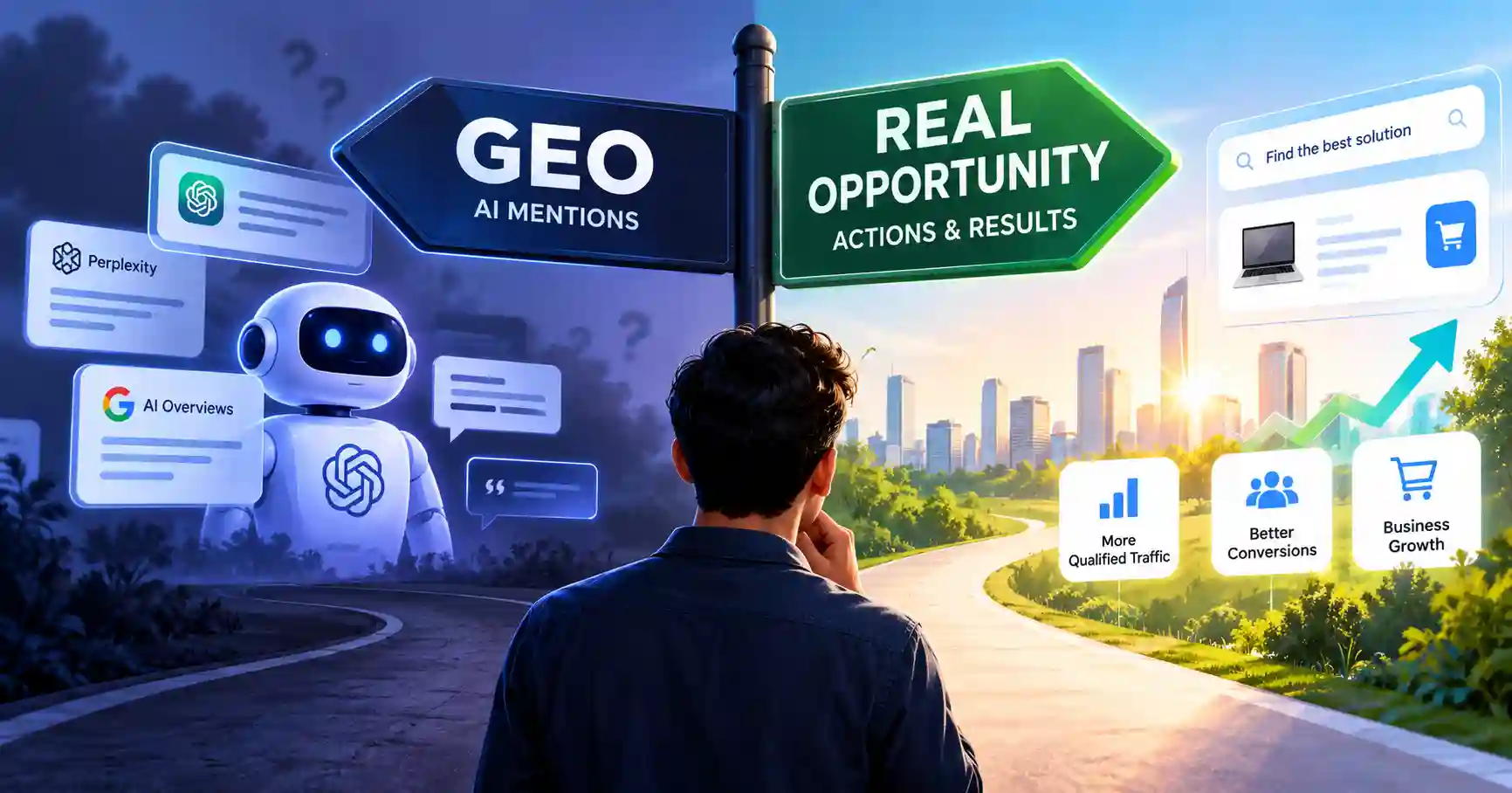
Generative engine optimization (GEO) has become a hot topic in digital marketing. Businesses want their brands to appear in ChatGPT responses, their content to be cited by AI search engines, and their products to show up in AI generated recommendations.
It’s easy to see why. Search behavior is evolving, and marketers need to understand how people use AI to find information. But there’s an important distinction to make: being mentioned by AI doesn’t automatically translate into business results.
A brand might earn AI citations without attracting qualified traffic, generating leads, or making sales. Focusing too heavily on GEO can also pull resources away from more valuable work, such as improving conversion paths, strengthening traditional SEO, and preparing websites for AI systems that help users complete tasks.
The goal isn’t to abandon GEO. It’s to look beyond visibility and build a search strategy that connects discovery with measurable business outcomes.
Why GEO Has Become Such a Big Conversation
Generative engine optimization aims to increase the likelihood that a brand, website, or piece of content appears in AI generated responses.
Traditional SEO focuses on improving a website’s visibility in search results. GEO expands that discussion to platforms such as ChatGPT and Perplexity, as well as Google’s AI powered search features.
For marketers, the potential is clear. Someone asking an AI assistant to recommend software, plan a trip, or solve a business problem might base their next decision on the answer. Appearing in that response can help a brand get noticed.
The challenge is measuring that visibility consistently. AI responses can change depending on the query, context, location, and product being discussed. A brand might appear in one answer but not another.
That’s why AI mentions shouldn’t be treated as a standalone measure of marketing performance.
For more context, read our guide to common misconceptions about AI search.
Where GEO Falls Short as a Standalone Strategy
Consider a SaaS company investing in content to appear in AI generated comparisons. Its brand starts showing up in answers about project management software, but website enquiries remain flat.
The increased visibility is encouraging, but it doesn’t tell the company whether the campaign is delivering business value.
To understand the impact, the team needs to look further. Are people clicking through to the website? Are they exploring product pages or booking demos? Is AI assisted discovery contributing to conversions later in the customer journey?
Without that information, the company risks optimizing for mentions instead of meaningful results.
GEO vs. SEO: What Should Businesses Prioritize?
The GEO vs. SEO debate can make these approaches sound like competing disciplines. In reality, they have considerable overlap.
According to Google’s official guidance on AI features in Search, established SEO fundamentals remain relevant to AI Overviews and AI Mode. There’s no separate set of special technical requirements that guarantees inclusion in these experiences.
That doesn’t mean every AI platform works the same way. Different systems may retrieve, interpret, and present information differently. The practical takeaway is to build on sound SEO practices rather than assume AI search requires an entirely separate optimization strategy.
The SEO fundamentals still matter
Focus on the work that helps people and search systems understand your website:
- Publish accurate, original content that answers genuine customer questions.
- Keep pages crawlable, internal links relevant, and site architecture clear.
- Demonstrate relevant expertise and support important claims with reliable sources.
- Ensure product details, pricing, and business information are accurate.
- Make important information easy to find and improve the overall page experience.
These practices support discoverability across traditional and AI powered search, although none guarantees an AI citation or recommendation.
Measure outcomes, not just visibility
Different metrics reveal different parts of the customer journey.
| Metric | What it tells you |
| Search impressions | How often pages appear in reported search results |
| Organic clicks | Whether people visit from search |
| AI citations or mentions | Whether a brand appears in sampled AI responses |
| Qualified leads | Whether enquiries come from the intended audience |
| Conversions and revenue | Whether marketing contributes to business results |
For example, an ecommerce store might receive fewer visits from one channel but generate more sales from those visitors. Looking at traffic alone would miss that difference.
Use visibility metrics to understand discovery and business metrics to evaluate performance. Both are useful, but they answer different questions.
The Real Opportunity: Search That Helps Users Take Action
The next opportunity isn’t just helping people find information. It’s making it easier for them to do something with it.
That’s where agentic search and agentic commerce come into the picture.
Agentic search describes experiences in which AI systems help users work through multi step tasks, compare options, and potentially take action. Agentic commerce applies similar ideas to shopping and transactions.
Imagine someone asking an AI assistant to find an accounting platform, compare subscription plans, check integrations, and shortlist suitable options. A vendor with accurate pricing, clear product information, useful comparison tools, and a straightforward demo process offers more than a website built around informational articles alone.
What UCP means for ecommerce businesses
Google’s Universal Commerce Protocol (UCP) is an open standard designed to support commerce experiences across Google’s AI surfaces, including shopping discovery and checkout capabilities. Available implementation options depend on the relevant integration and use case.
For ecommerce businesses, this makes a few fundamentals especially important:
- Keep product feeds, prices, availability, and descriptions accurate.
- Make shipping, returns, and payment policies easy to understand.
- Maintain a reliable checkout and order management process.
- Assess emerging integrations when they suit your platform and business model.
Not every store needs to adopt a new protocol immediately. A small retailer with inconsistent product data might gain more from fixing its Merchant Center feed than from investing in an advanced AI integration.
Don’t overlook useful website experiences
Practical tools and interactive content can also create value. A SaaS company might offer a pricing calculator, a marketing agency could build a website audit tool, or a publisher might develop an original benchmark report or interactive comparison.
These resources help visitors make decisions rather than simply read about a topic.
They can also give people a reason to visit the original website instead of relying entirely on a summary. While useful tools don’t guarantee AI citations, they provide direct value to users and create opportunities for deeper engagement.
A Practical 30/60/90 Day AI Search Action Plan
There’s no need to overhaul your entire marketing strategy at once. A phased plan helps you prioritize the work, control costs, and evaluate what actually makes a difference.
| Period | Priority | Actions |
| First 30 days | Fix the foundation | Audit technical SEO, Search Console performance, analytics, and conversion tracking. |
| Days 31–60 | Improve decision making content | Refresh important pages, add original examples, strengthen internal links, and clarify product or service information. |
| Days 61–90 | Test and evaluate | Build a useful interactive resource or test a relevant AI integration. Compare results with your baseline. |
Throughout the process, track the metrics that matter to your business: qualified enquiries, demo bookings, purchases, conversion rates, and revenue where attribution is reliable.
For a closer look at the relationship between traditional search and AI driven discovery, read our guide to how AI search traffic differs from organic traffic.
Common Mistakes to Avoid
As AI search develops, several mistakes can waste time and marketing budget.
- Chasing citations without a clear objective: Define what success means before investing in AI visibility tools.
- Abandoning traditional SEO: AI powered search doesn’t remove the need for crawlable, useful, well structured pages.
- Adopting every new technology: Evaluate whether a new protocol solves a genuine customer problem.
- Ignoring measurement limitations: AI assisted discovery may not appear as a clearly attributable referral. Correlation alone doesn’t establish causation.
- Publishing more content without adding value: Original research, practical tools, and specific expertise can offer more than another generic article covering familiar points.
FAQ’s
No. GEO focuses on improving visibility in generative AI responses, but many of its underlying practices overlap with SEO. Google confirms that established SEO fundamentals remain relevant to AI Overviews and AI Mode.
Track AI mentions and citations alongside organic traffic, qualified leads, conversions, and revenue. Use Search Console and analytics tools to establish a baseline, while recognizing that not every AI assisted interaction can be attributed reliably.
Agentic search involves AI experiences that help people work through tasks rather than simply retrieve information. It matters because businesses may need to make their product information, services, and transaction processes easier for these experiences to use.
Only when there’s a clear business reason. Start with technical SEO, useful content, accurate business information, and conversion tracking. Consider GEO monitoring tools when they help answer specific questions about visibility or marketing performance.
Conclusion
GEO isn’t the enemy of SEO. The real problem is letting a new acronym dictate your marketing priorities.
AI driven discovery is changing how people find information, compare businesses, and potentially complete transactions. But visibility alone doesn’t tell you whether those changes are helping your business grow.
Start with the fundamentals. Publish genuinely useful content, improve the website experience, measure conversions, and explore agentic search opportunities when they make sense for your audience and business model.
The strongest strategy isn’t about chasing every new AI trend. It’s about understanding what customers need, helping them find the right information, and making their next step easier.

Kumar Swamy is the CEO of Itech Manthra Pvt Ltd and a dedicated Article Writer and SEO Specialist. With a wealth of experience in crafting high-quality content, he focuses on technology, business, and current events, ensuring that readers receive timely and relevant insights.
As a technical SEO expert, Kumar Swamy employs effective strategies to optimize websites for search engines, boosting visibility and performance. Passionate about sharing knowledge, he aims to empower audiences with informative and engaging articles.
Connect with Kumar Swamy to explore the evolving landscape of content creation!