Your website might rank well in Google but still be absent from the AI generated answers your potential customers see. When someone asks ChatGPT, Google AI Mode, or another AI search tool to recommend a product or compare services, your brand may not make the list even if your website offers useful, relevant content.
This is why off page AI search visibility deserves attention alongside traditional SEO. Your website is only one part of your online presence. Industry publications, independent reviews, comparison websites, directories, and relevant online communities can all influence how people discover and evaluate your brand.
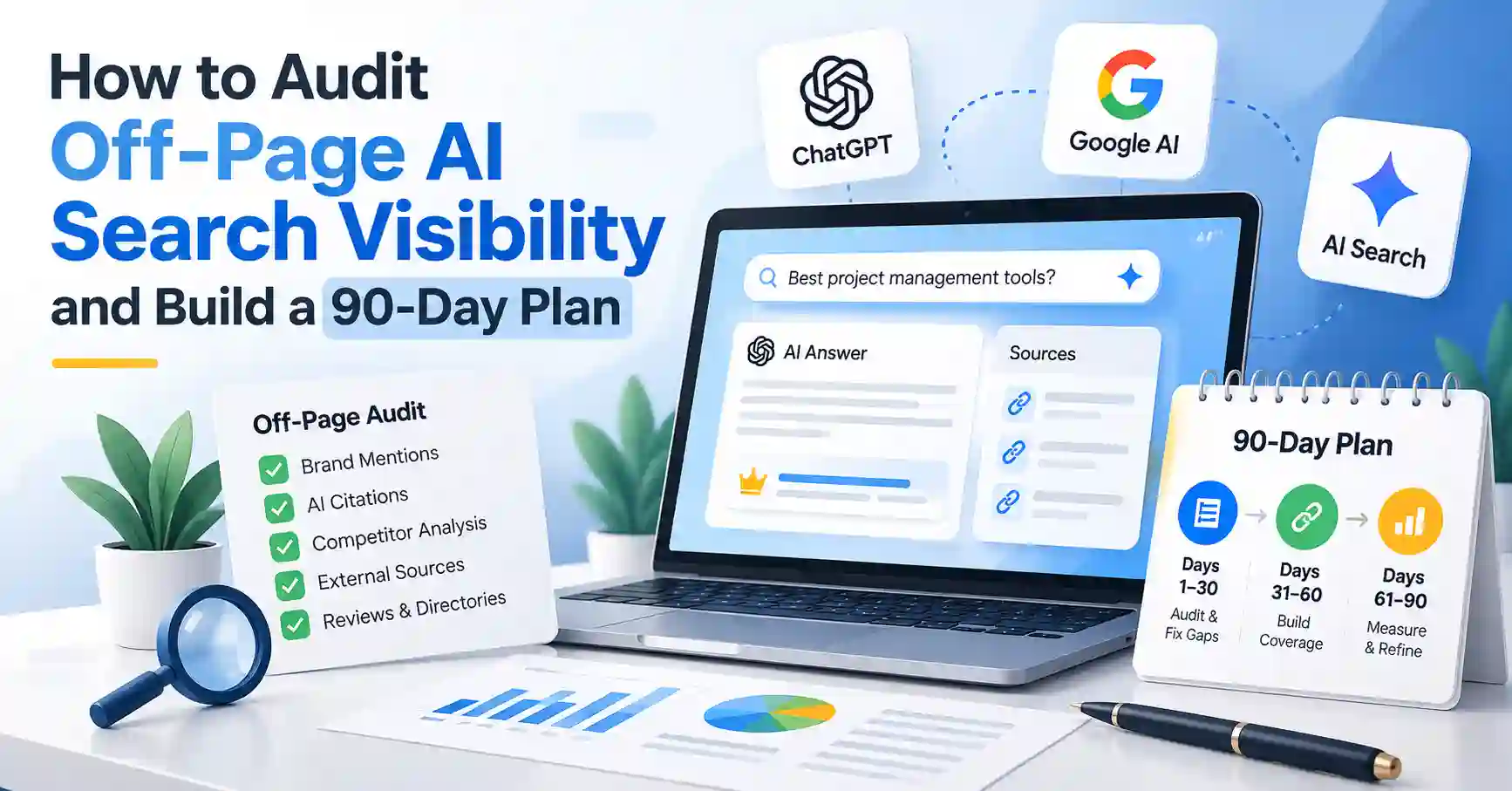
The challenge is figuring out which external sources matter, where competitors have an advantage, and how to close those gaps. Here’s how to audit your off page AI search visibility and turn the findings into a practical 90 day plan.
What Is Off Page AI Search Visibility?
Off page AI search visibility describes how often your brand appears in AI generated answers and how information about your business is represented across the wider web, particularly on websites you don’t control.
Consider a SaaS company that offers project management software. Its website covers features, pricing, and integrations in detail, but independent comparison articles focus on three competing products.
When someone asks an AI tool to compare project management platforms, those external sources may contribute to the information available to the system. Even a well optimized website can miss opportunities if relevant third party coverage is limited.
Brand mentions, citations, and backlinks serve different purposes
These terms are related, but they don’t mean the same thing.
- Brand mentions: Your company appears in an article, review, discussion, or AI generated answer.
- AI citations: An AI search experience links to a source that supports its response. That source could be your website or an external publication.
- Backlinks: Other websites link to your pages. Relevant backlinks can support traditional SEO, but their value depends on factors beyond sheer quantity.
- Third party reputation: Reviews, independent comparisons, editorial coverage, and accurate business information help potential customers assess your brand.
Google’s official guidance confirms that established SEO best practices remain relevant to its AI search features. There are no separate technical optimization requirements specifically for appearing in Google AI Overviews or AI Mode. Read Google’s guidance on AI features for more detail.
The goal isn’t to replace traditional SEO with a new discipline. It’s to understand how your external presence complements the work you’re already doing on your website.
How to Audit Off Page AI Search Visibility
A useful audit should help you answer three questions: Where does your brand appear? Which external sources are associated with those appearances? And where are competitors getting attention that you’re missing?
Step 1: Choose your topics, prompts, and competitors
Start with five to ten topics closely tied to your business goals. Focus on questions people ask when researching a product or deciding which solution to buy.
For an AI writing tool, your prompts might include:
- What are the best AI writing tools for bloggers?
- Which AI writing tools help improve readability?
- Compare AI writing tools for small marketing teams.
- What should I consider when choosing an AI content assistant?
Next, identify three to five direct competitors that target the same audience. Save your prompts and use them consistently during future audits.
This step is easy to overlook, but it matters. If you change the questions every time you test, you won’t know whether differences in the answers reflect actual visibility changes or simply different prompts.
Step 2: Check brand mentions across AI platforms
Run your selected prompts across relevant platforms, including ChatGPT and Google AI search experiences. Note whether your brand appears, how it’s described, and whether the response includes citations.
A spreadsheet is enough to get started. Track the following information:
| Field | What to record |
| Prompt | The exact question asked |
| Platform and date | Where and when you ran the test |
| Brand mention | Present, absent, or inaccurate |
| Citation URL | The linked source, if available |
| Competitors | Which competing brands appeared |
| Next action | The follow up task to investigate |
Don’t expect identical answers every time. AI responses can differ by platform, prompt, and date. Your findings should be treated as a consistent sample of visibility, not a complete picture of every answer an AI system might generate.
Step 3: Find the third party sources that keep appearing
Your own website is only one place to investigate. Look for external pages that repeatedly appear in answers related to your target topics.
Useful sources may include:
- Industry publications and expert roundups
- Product comparison and review websites
- Professional directories and industry associations
- Credible customer reviews
- Relevant forums and community discussions
Prioritize sources based on credibility, relevance, and audience fit. A detailed comparison on a respected industry website may be more useful than dozens of unrelated directory listings.
Step 4: Identify competitor citation gaps
Compare the sources associated with your brand with those associated with competitors.
Imagine that an AI platform repeatedly cites three independent articles when recommending email marketing software. Two discuss your competitors, while the third covers the category without mentioning your product.
That gives you a concrete research opportunity. Check whether your product meets the article’s criteria, whether the information is outdated, and whether the publisher accepts factual updates or editorial suggestions.
The objective isn’t to secure a link at any cost. It’s to improve accurate, relevant coverage that helps readers understand their options. A new backlink alone won’t guarantee that an AI generated answer changes.
Step 5: Review backlinks, reviews, and brand consistency
Check whether your company name, product description, website URL, and other important details are consistent across reputable external sources.
Look for outdated pricing, incorrect product descriptions, duplicate directory listings, and recurring customer concerns in reviews. Review your backlink profile for relevant editorial links and suspicious patterns, but don’t use link volume as a substitute for assessing quality.
If you discover inaccurate information, contact the publisher and provide the correct details along with supporting evidence. Resolving an existing problem can be a better starting point than launching a broad outreach campaign without a clear objective.
How to Build a 90 Day AI Search Visibility Action Plan
An audit is only useful if it informs your next steps. Divide the work into three phases, with a clear focus and deliverables for each.
Days 1–30: Establish your baseline and fix obvious gaps
Review your audit spreadsheet and identify missing brand mentions, recurring competitor citations, inaccurate business information, and promising external sources.
Start with improvements you can make directly. Update outdated directory profiles, correct factual errors, and prepare a concise brand information sheet covering your products, audience, differentiators, and supporting evidence.
Deliverables: A baseline audit, a prioritized list of visibility gaps, and a shortlist of outreach opportunities.
Days 31–60: Build relevant external coverage
Begin contacting publishers, industry websites, and relevant communities identified during the audit.
Rather than sending generic promotional pitches, offer something useful: original research, expert commentary, a practical resource, a product update, or evidence that corrects outdated information. Participate in discussions where you can genuinely help people instead of forcing promotional mentions into the conversation.
This is where digital PR and AI search optimization overlap. The priority is earning relevant coverage without compromising editorial quality.
For practical guidance on prospect research and link evaluation, see iTechManthra’s article on AI powered link building.
Deliverables: A documented outreach pipeline, publisher conversations, and verified coverage where opportunities materialize.
Days 61–90: Reassess and refine your approach
Return to your original prompts and run them across the same platforms. Compare brand mentions, citations, competitor appearances, and the sources associated with each response.
Review which outreach activities led to useful coverage, whether external information is more accurate, and whether referral traffic or branded search activity has changed.
For additional measurement guidance, read iTechManthra’s article on AI search visibility tracking.
Deliverables: A baseline versus day 90 report, an updated list of opportunities, and priorities for the next quarter.
| Period | Primary focus | Success indicator |
| Days 1–30 | Audit and prioritize | Baseline completed and major gaps documented |
| Days 31–60 | Outreach and coverage | Outreach tracked responses and placements recorded |
| Days 61–90 | Reassessment | Results compared and next steps identified |
These milestones help measure progress and execution, not guaranteed improvements in AI visibility. Some editorial placements take longer than 90 days to secure, and AI responses don’t necessarily change on a predictable schedule.
How to Measure Progress After 90 Days
Avoid judging your entire strategy by a single metric. Track visibility separately from the business outcomes it may contribute to.
Focus on five measures:
- Brand mention frequency: How often your brand appears in your selected AI responses.
- Citation frequency: How often your website or relevant third party pages appear as linked sources.
- Competitor visibility: How often competitors appear in the same set of prompts.
- Referral visits: Visits from identifiable AI platforms or relevant external publications.
- Business outcomes: Qualified leads, enquiries, conversions, and changes in branded search activity.
Google explains that traffic from AI Overviews and AI Mode is included in the overall Web search reporting in Search Console. This makes Search Console useful for evaluating Google search performance, but it doesn’t provide a complete record of every time your brand is mentioned across third party AI platforms.
For a fair comparison, keep your prompts and testing method consistent. Record the date and platform, and note any changes that might affect the results.
If brand mentions increase but qualified traffic doesn’t, investigate the quality of that exposure before committing more resources. Visibility is useful, but reaching the right audience matters more than collecting mentions for their own sake.
Common Off Page AI Search Visibility Mistakes
A few common mistakes can undermine an otherwise sensible strategy:
- Chasing backlinks alone: A relevant editorial mention can be useful even without a link. Consider the source’s credibility and audience.
- Changing prompts between audits: Inconsistent tests make it harder to compare results.
- Prioritizing quantity over credibility: More mentions don’t automatically translate into stronger brand visibility.
- Ignoring inaccurate information: Conflicting product descriptions and outdated listings can undermine customer confidence.
- Expecting guaranteed results in 90 days: Use the period to establish a baseline, test improvements, and identify activities worth continuing.
FAQ’s
Create a list of questions relevant to your customers and run them across selected AI platforms. Record brand mentions, citations, competitor appearances, and test dates. Repeat the process periodically to identify patterns.
Backlinks can support traditional SEO and help people discover your content. However, no individual backlink guarantees inclusion in AI generated answers. Focus on relevant, credible references that provide genuine value to your audience.
Start with relevant industry publications, trusted comparison websites, credible review platforms, and communities where your audience seeks advice. Prioritize sources based on relevance and editorial credibility rather than domain metrics alone.
There isn’t a universal timeline. Outreach, editorial acceptance, indexing, and AI response patterns operate on different schedules. A 90 day plan provides a practical period for testing and evaluation, not a guarantee of improved visibility.
Conclusion
Auditing off page AI search visibility means understanding where your brand appears across the wider web, which sources contribute to its reputation, and where competitors receive attention that you’re missing.
Start with a consistent set of customer questions. Track mentions and citations, investigate credible third party sources, and prioritize opportunities based on relevance and effort. Over the next 90 days, focus on correcting information gaps, building useful external relationships, and measuring the results.
Keep the process grounded in evidence. AI search visibility is still evolving, so a sensible strategy combines established SEO practices with repeatable testing and meaningful business metrics.

Kumar Swamy is the CEO of Itech Manthra Pvt Ltd and a dedicated Article Writer and SEO Specialist. With a wealth of experience in crafting high-quality content, he focuses on technology, business, and current events, ensuring that readers receive timely and relevant insights.
As a technical SEO expert, Kumar Swamy employs effective strategies to optimize websites for search engines, boosting visibility and performance. Passionate about sharing knowledge, he aims to empower audiences with informative and engaging articles.
Connect with Kumar Swamy to explore the evolving landscape of content creation!