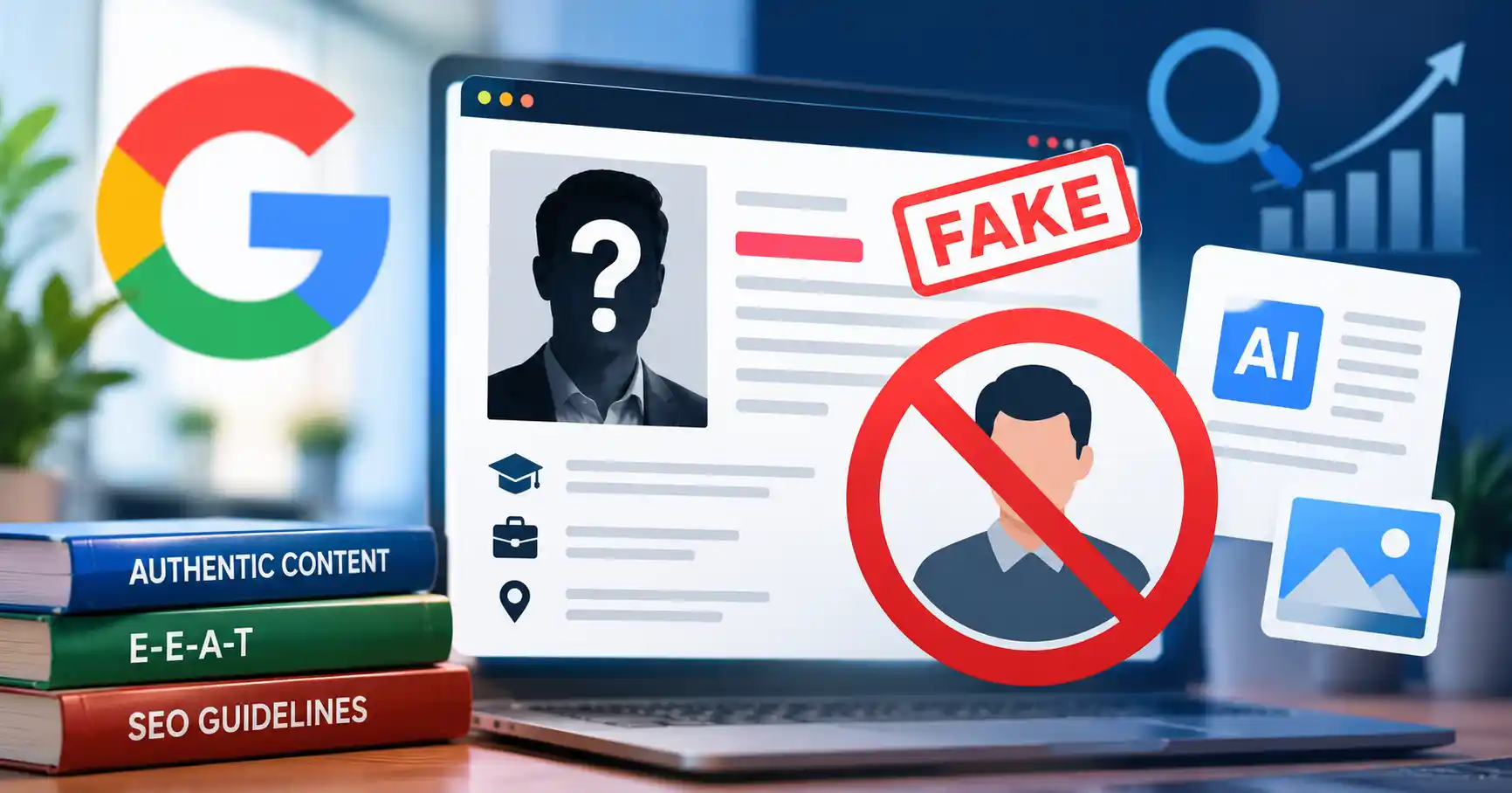
Have you ever landed on an article, seen an impressive looking author photo and bio, and assumed, “This person must really know their stuff”?
Now ask a slightly uncomfortable question: what if that author doesn’t actually exist?
Google has made its position much clearer.Google just dropped an update to its people first content guidance, and it warns hard against fake author profiles. Think AI generated headshots, completely made up names, and phony credentials meant to fake human expertise. Google calls this deceptive authorship a massive trust problem, it screams low quality.
Does this mean anonymous pieces are dead? Absolutely not. And it definitely does not mean AI assisted text is automatically junk, either. The core issue boils down to intent. Is a publisher intentionally faking expertise where none actually exists?
For SEOs, publishers, and content teams, that difference matters.
What exactly did Google change about fake author information?
The change appeared in Google’s “Creating helpful, reliable, people first content” guidance. The platform previously pushed publishers to show who made their stuff, slap on real bylines, and strip out fluff. But this new warning goes further. Google targets fake author profiles directly. Think AI generated headshots, completely fabricated names, or bogus credentials meant to fake human expertise. Google argues this trickery makes a page look sketchy to actual readers and its own automated filters. Cut it out.
That’s a pretty direct message.
The important part, though, is what Google isn’t saying. It isn’t saying every article needs a celebrity expert attached to it. It isn’t saying writers can’t use pen names in every circumstance. And it isn’t saying an author must have a long list of qualifications before their article can rank.
The problem is misrepresentation.
If a website creates “Dr. Michael Carter,” gives him a fake medical looking photograph, invents 20 years of experience and then publishes dozens of articles under that identity, that’s very different from using a legitimate editorial byline.
Google’s broader people first guidance also asks publishers to think about the “Who, How and Why” behind their content.
For more context on how this fits into broader SEO quality signals, see our guide to SEO best practices and why they can become SEO dogma.
Why does fake author information matter for E E A T SEO?
This is where the update gets interesting for SEO pros.
E E A T covers Experience, Expertise, Authoritativeness, and Trustworthiness. Google keeps saying it’s not a direct ranking factor. Fair enough. Yet their systems lean on tons of signals to sniff out genuinely helpful, reliable content.
And trust is the big one.
A fake author bio is essentially trying to manufacture one of those trust signals.
Imagine two articles reviewing the same accounting software.
The first says it was written by a real software consultant who has spent five years working with SaaS finance teams. The author has a genuine profile, previous articles, professional experience and a clear connection to the subject.
The second article uses a polished stock style AI portrait and claims to have been written by a “leading SaaS technology analyst” who doesn’t exist.
The words might look equally professional.
The underlying credibility isn’t.
Author bio SEO goes past a simple checkbox. Tossing up a headshot, an impressive title, and polished fluff fails to manufacture genuine authority. The underlying credentials must be bulletproof. Directly tethered to the actual creator. Google explicitly stresses that transparency here helps audiences properly evaluate expertise, demanding actual substance. Window dressing simply will not cut it anymore.
Does Google consider AI generated author profiles deceptive?
Yes, absolutely, especially when they fake human expertise, the distinction matters right now. Why? Because AI can crank out just about everything required to fake a convincing author persona from scratch.
A tool can create a realistic portrait.
Another tool can invent a professional biography.
A content system can generate 100 articles under that name.
A publishing platform can automatically display the same profile across hundreds of pages.
On the surface, everything looks legitimate.
But the identity isn’t.
Google’s warning specifically mentions AI generated headshots, made up names and false credentials in this context.
There is a broader lesson here for publishers messing with AI.
The tech itself isn’t the enemy. Google actually allows for automation when you use it properly. Their main rule is simple: content has to be useful, accurate, and made for actual human beings, not just to game search rankings.
So using AI to map out an outline, organize research, or tighten a rough draft is totally different from inventing a fake expert who never existed.
That difference matters.
If you’re using AI in your publishing workflow, our guide on Google’s human fact check requirements for AI generated content is also worth reading.
What should publishers do if they already use author personas?
Don’t panic. Audit them.
The easiest approach is to go through your site’s existing author pages and ask some uncomfortable but useful questions.
Does this person actually exist?
If the answer is no, replace the profile with a legitimate author, editorial team or appropriately disclosed house byline.
Are the credentials real?
Don’t claim that someone is a certified consultant, engineer, doctor, lawyer or industry specialist unless you can verify it.
Is the author genuinely connected to the subject?
A real person can still be a poor author match. Someone who writes about smartphones doesn’t automatically have the expertise to provide medical advice.
Does the author page provide useful context?
A good author page doesn’t need to be enormous. A short biography, relevant experience, previous work and professional profile can be enough.
Does the article demonstrate actual expertise?
This is probably the most important question.
A genuine author doesn’t rescue weak content.
Google wants real effort, Their guidance rewards original facts, actual skill, and deep analysis in your main content.
The takeaway? Skip spending two hours on a flashy author bio and five minutes actually making the article useful.
How can you create trustworthy author profiles without overdoing SEO?
Keep it boringly honest.
That’s actually a good thing.
Use the writer’s real name when appropriate. Use a real photograph if you’re going to use a photograph. Describe the person’s actual experience rather than filling the bio with impressive sounding marketing language.
For example:
Weak:
“John is a world renowned digital marketing visionary with decades of experience transforming global enterprises.”
Better:
“John writes about SEO and digital marketing. He has worked on content strategy, technical SEO and search visibility projects for SaaS and technology businesses.”
The second version isn’t flashy.
It’s believable.
You can also connect author information across your website.An author page connects readers to past work, professional networks, and personal history. Google suggests linking these profiles through sameAs markup so algorithms can verify who actually wrote the piece. Just remember one rule. Structured data has to reflect reality. Do not invent a fictional expert purely for show. Guidelines require tagging creators with accurate Person or Organization details, plus valid URLs.
Does the fake author warning change how AI content should be published?
It should change the workflow, not necessarily eliminate AI.
A sensible process looks something like this:
Research → AI assistance → human expertise → fact checking → editorial review → publish
Not:
AI → fake expert → auto publish → repeat
That’s the bigger SEO lesson.
AI can make content production dramatically faster. But speed doesn’t create experience. A language model can produce a convincing paragraph about a subject it has never personally experienced. It can also create a convincing biography for someone who doesn’t exist.
That makes human review even more important.
Google’s current people first guidance asks whether content demonstrates first hand expertise and depth of knowledge, whether it provides original value and whether readers leave satisfied rather than needing to search again.
This is also becoming relevant beyond traditional Google rankings.
AI search tools demand solid data to summarize. Real authorship, constant proof of expertise, and actual evidence build a distinct portrait of publishers and their craft today.
Our broader guide on SEO priorities for AI search and visibility explores why expertise and trust are becoming increasingly important as search becomes more AI driven.
What is the safest SEO strategy after Google’s fake author warning?
Don’t try to look more authoritative than you actually are.
That sounds obvious, but the SEO industry has spent years creating signals that look authoritative.
Author boxes.
Credentials.
Badges.
Expert roundups.
Schema.
Headshots.
Those things can be useful when they’re genuine. They become a problem when they’re being used as decoration to disguise weak or misleading content.
The better strategy is simpler.
Use real authors. Make credentials accurate. Explain who contributed to the article. Add first hand knowledge where it genuinely exists. Fact check important claims. Publish original information instead of rewriting the same five search results.
Google’s updated guidance isn’t really asking publishers to make their websites look more trustworthy.
It’s asking them to be trustworthy.
And there’s a big difference.
FAQ’s
Not automatically, no. The problem comes down to fake authorship. You can’t use a pen name to lie about your expertise, your credentials, or who you really are.
Google’s pretty clear: they don’t auto penalize AI made stuff. Nope. What really matters is if your content is useful, accurate, and original. It needs to be for people, not just a trick for Search rankings.
Rarely. Yet Google demands we spell out exactly who built the thing, and that creator info better be spot on.
AI can help write author bios, sure. But facts matter, Never let an AI invent qualifications, jobs, expertise, or awards. Keep it completely honest.
E E A T isn’t a single Google ranking factor. However, Google’s systems use various signals associated with experience, expertise, authority and trust to help identify high quality content. Trust is especially important
.
Conclusion
The biggest takeaway isn’t that author bios suddenly became a ranking factor.
It’s that Google is becoming increasingly explicit about deceptive attempts to manufacture credibility.
If your website has genuine writers and experts, this update shouldn’t be scary.
If your material leans on fabricated authorities, forged qualifications, or AI personas, a serious reckoning is in order. And if AI’s assisting your content creation, don’t mistake rapid output for genuine acumen.
A top tier content strategy? It’s rather straightforward: construct value, verify your data, clearly identify your contributors. Crucially, furnish your audience with compelling grounds for trust. In a search landscape increasingly shaped by algorithms, this candor could prove far more valuable than a polished, yet fabricated, author profile.

Kumar Swamy is the CEO of Itech Manthra Pvt Ltd and a dedicated Article Writer and SEO Specialist. With a wealth of experience in crafting high-quality content, he focuses on technology, business, and current events, ensuring that readers receive timely and relevant insights.
As a technical SEO expert, Kumar Swamy employs effective strategies to optimize websites for search engines, boosting visibility and performance. Passionate about sharing knowledge, he aims to empower audiences with informative and engaging articles.
Connect with Kumar Swamy to explore the evolving landscape of content creation!