Have you ever spent hours messing with bids, studying those reports, and still thinking, why is this ad campaign not going the way it should?
Yeah, you’re not alone.
Running digital ad campaigns has gotten way more complex lately. People in marketing now have to balance audience targeting with budget decisions, creative experiments, performance breakdowns, and continual campaign refinement all at the same time, and then react to shifting market conditions as they happen in real time.
That’s probably why Google’s newest announcement is getting so much attention.
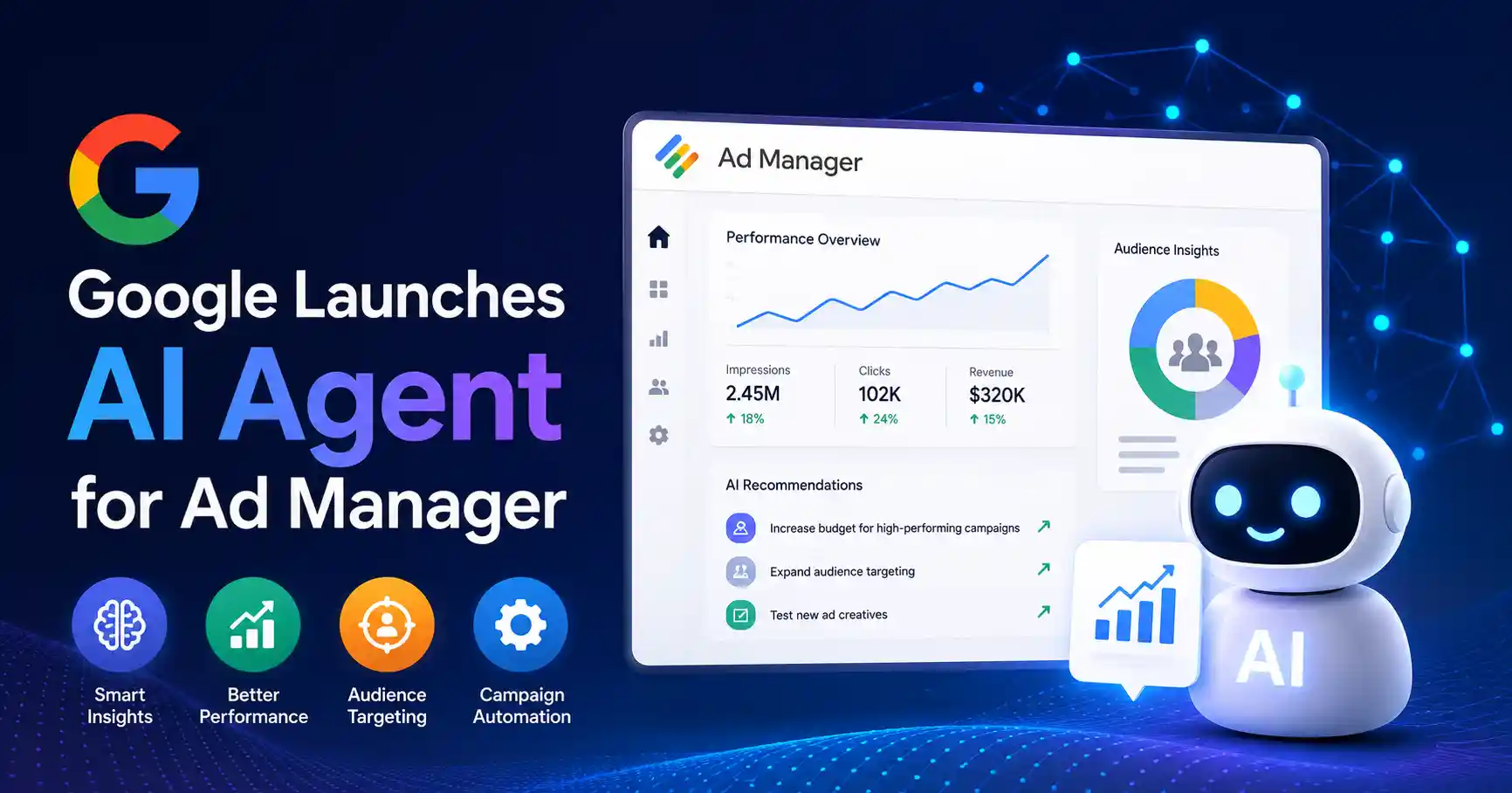
Google has rolled out an AI agent for Ad Manager, bringing in another automation layer meant to help advertisers make better choices, gain efficiency, and keep campaign management less of a headache.
Sure, AI has been showing up in advertising for years. But this announcement feels bigger than the usual tweaks. Google is steadily moving from AI assisted features to AI agents that can play a more direct role in how campaigns are actually run.
For advertisers, agencies and brands this could kinda reshape how digital marketing works in the next few years, for real, you know?
What is Google’s AI agent for Ad Manager and why does it matter?
At its core, Google’s new AI agent for Ad Manager is meant to help advertisers manage campaigns more efficiently, in a way that feels almost constant.
Unlike the usual automation tools that work through fixed rules, these AI agents can read the information , then make suggestions, spot chances, and also help with tuning tasks.
Think of it like a digital advertising assistant that’s on standby all hours, every day.
The AI agent can help marketers:
- Understand campaign performance
- Identify optimization opportunities
- Analyze audience behavior
- Improve campaign efficiency
- Reduce manual workload
This is important, because the advertising platforms generate really huge chunks of data. Many marketers have trouble turning all that information into something actionable, maybe not instantly, though.
The AI agent tries to bridge that gap, connecting the scattered signals into decisions.
As digital marketing strategist Nina Lopez explains:
“The future of advertising isn’t more dashboards. It’s smarter systems that help marketers make faster decisions.”
Google’s latest development appears to move in exactly that direction.
How does the AI agent improve campaign optimization?
One of the biggest challenges in advertising is campaign optimization.
Successful campaigns require constant adjustments.
Advertisers regularly monitor:
- Click-through rates
- Conversion rates
- Audience engagement
- Budget performance
- Creative effectiveness
The new AI agent helps simplify these processes.
Marketers don’t have to manually re view every metric, they can get recommendations based on performance trends and what the campaign objectives are really aiming for.
Potential benefits include:
Faster decision making
The AI can identify opportunities that might otherwise be overlooked.
Improved efficiency
Routine analysis tasks become easier to manage.
Better performance insights
Marketers gain clearer visibility into what’s working and what isn’t.
Reduced operational workload
Teams can spend less time doing the same repetitive stuff again and again, and more time on strategy, which is honestly the point.
That mirrors a wider industry shift toward AI powered advertising where smart systems help with campaign operations, not just giving summaries of data.
Why is AI becoming increasingly important in digital advertising?
The advertising landscape is changing rapidly.
Consumers interact with brands across:
- Search engines
- Social media
- Video platforms
- Mobile apps
- AI-powered discovery systems
Managing these touchpoints manually is becoming increasingly difficult.
That’s why digital advertising automation is gaining momentum.
AI can process large volumes of information far faster than humans.
This allows marketers to:
- Respond to performance changes more quickly
- Optimize budgets efficiently
- Discover audience opportunities
- Improve campaign targeting
Businesses already adapting to AI-driven marketing should also understand how OpenAI conversion focused ads are changing advertising strategies across digital platforms.
The advertising ecosystem is becoming more automated, and AI agents represent the next stage of that evolution.
What does this mean for advertisers and marketing teams?
A common concern whenever AI enters a workflow is whether it will replace human expertise.
The reality is usually more nuanced.
AI excels at:
- Data analysis
- Pattern recognition
- Process automation
- Recommendation generation
Humans remain better at:
- Strategy
- Creativity
- Brand positioning
- Customer understanding
The most effective approach combines both.
That AI agent can assist marketers in moving faster, while human specialists keep doing strategic call making. This matches the wider push toward marketing automation, where the platform does the repetitive chores and people concentrate on the higher-value things. Barry Adams , a well regarded digital marketing consultant, has often pointed out that tools should sharpen expertise not substitute for it.
That principle applies perfectly here.
Could AI agents change the future of audience targeting?
Audience targeting remains one of the most important elements of advertising success.
The right message shown to the wrong audience rarely performs well.
AI agents have the potential to improve audience targeting by helping advertisers:
- Analyze behavioral patterns
- Identify audience segments
- Optimize campaign delivery
- Improve personalization
As machine learning models become more sophisticated, targeting recommendations may become increasingly accurate.
This could lead to:
- Better engagement
- Higher conversion rates
- Improved return on ad spend
- More relevant user experiences
Businesses following recent advertising developments may also find value in understanding how Microsoft Ads expands LinkedIn targeting with job seniority filters as audience targeting capabilities continue evolving.
Together, these developments highlight how AI and data are transforming advertising precision.
What challenges should marketers consider before relying on AI agents?
While the benefits are significant, AI agents are not perfect.
Marketers should remain aware of several considerations.
Transparency
Understanding why an AI makes certain recommendations remains important.
Data quality
AI systems depend on accurate and reliable data.
Human oversight
Strategic decisions should still involve human review.
Brand alignment
Automated recommendations should match the business priorities and brand principles, even when it feels a bit rigid at first. The best organizations tend to view AI agents as partners not stand-ins, they collaborate in practice. With proper supervision in place, the automation stays useful for the intended outcomes and it supports the business goals the right way, continuously.
For advertisers interested in learning more about Google’s AI initiatives, Google Ads AI Essentials provides useful guidance on AI-powered advertising capabilities.
What does the future look like for AI powered advertising?
Google’s AI agent is unlikely to be the last major AI innovation in advertising.
Over the next few years, we can expect AI systems to play larger roles in:
- Campaign planning
- Audience analysis
- Budget optimization
- Creative testing
- Performance forecasting
Advertising platforms are going more toward smarter systems that help marketers deal with growing complexity, day by day, kind of.
The companies that manage to stitch together AI capabilities together with human expertise might end up with a serious competitive edge.
Advertising itself in the future won’t be entirely automated, no, it stays more guided.
The whole thing is intelligently assisted.
Final Thoughts
Google’s AI agent for Ad Manager is yet another big step toward adverting that is driven by AI.
It seems to assist marketers with performance reviews, spotting openings, and tuning campaigns in a faster way, which could raise productivity and also make results better.
Still, the top advertisers will keep mixing AI powered insights with human imagination, direction, and know how.
This isn’t about swapping out marketers, no. It’s about helping them do the work smarter.
What do you think about AI agents handling parts of advertising campaigns? Would you trust AI recommendations for your marketing plan? Drop your thoughts in the comments below.
FAQs
What is Google’s AI agent for Ad Manager?
It is an AI-powered assistant designed to help advertisers analyze data, identify opportunities, and optimize campaigns more efficiently.
Will AI agents replace advertising professionals?
No. AI agents are designed to assist marketers rather than replace strategic decision-making and creativity.
How can AI improve campaign optimization?
AI can analyze large datasets, identify trends, and provide recommendations faster than manual processes.
What are the benefits of AI powered advertising?
Benefits include improved efficiency, better targeting, faster optimization, and enhanced performance insights.
Should businesses fully rely on AI agents?
No. Human oversight remains essential to ensure recommendations align with business goals and brand strategy.

Kumar Swamy is the CEO of Itech Manthra Pvt Ltd and a dedicated Article Writer and SEO Specialist. With a wealth of experience in crafting high-quality content, he focuses on technology, business, and current events, ensuring that readers receive timely and relevant insights.
As a technical SEO expert, Kumar Swamy employs effective strategies to optimize websites for search engines, boosting visibility and performance. Passionate about sharing knowledge, he aims to empower audiences with informative and engaging articles.
Connect with Kumar Swamy to explore the evolving landscape of content creation!