Google rarely makes changes to Discover unless there is a reason, a real one.
Over the years, Google Discover has evolved from a plain content recommendation feed into one of the most effective traffic drivers for publishers, creators, and brands. Now, Google is testing another interesting feature, Search Profiles inside Google Discover.
At first glance, it might seem small. Still, when you zoom out and think about the way people find content these days, especially through AI powered recommendations, customized timelines, and interest based browsing, it may have a larger effect than many marketers expect.
This move with Search Profiles shows Google is still trying to make discovery more clear, more creator oriented. It also brings fresh chances for publishers, SEO specialists, and brands that depend on organic exposure.
So what are Search Profiles exactly, and why should marketers pay attention?
What Are Google Search Profiles in Google Discover?
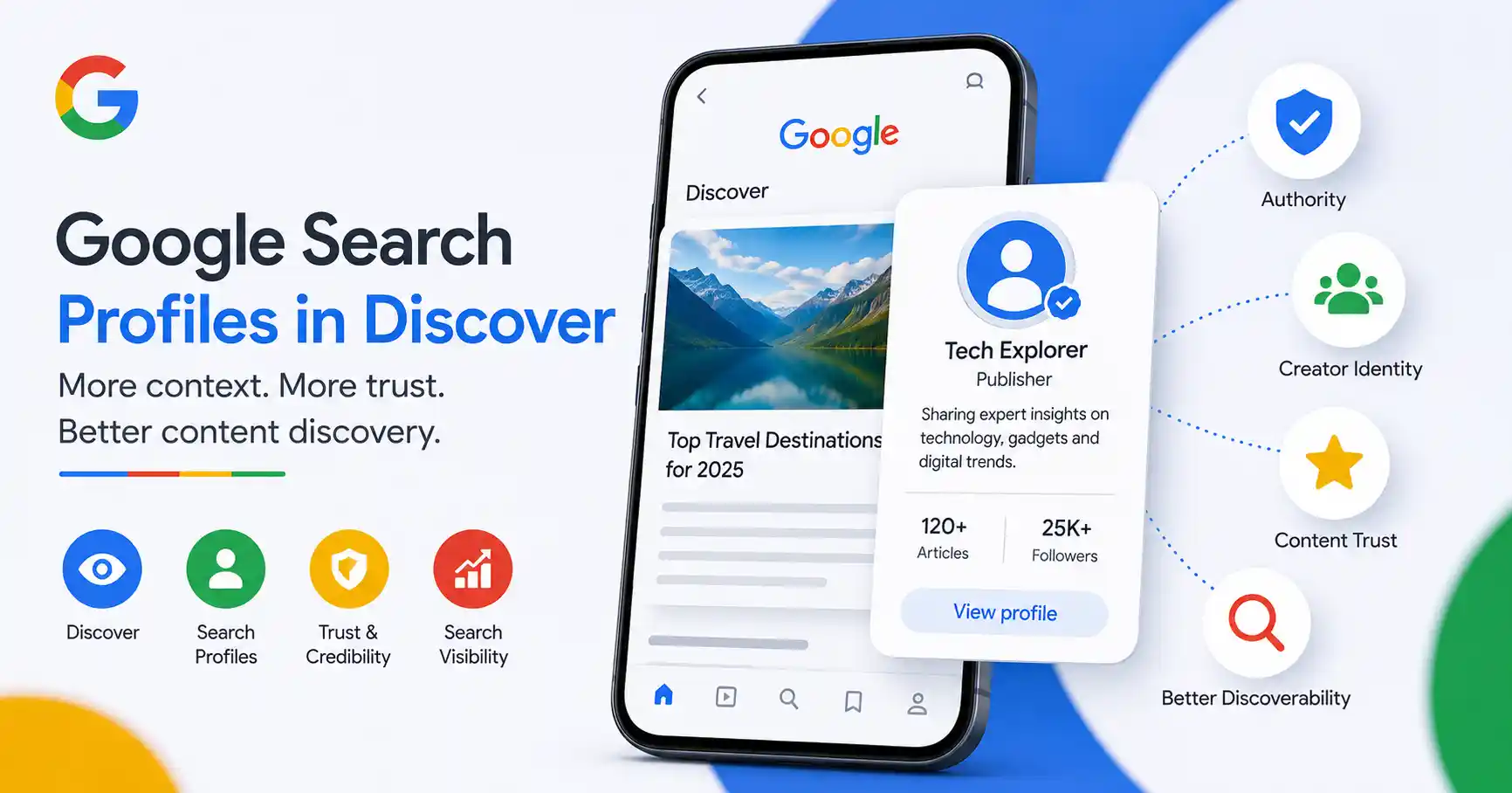
Google Search Profiles are like profile pages ,that let people dig a bit deeper on content creators, publishers ,and sources right from Discover recommendations.
So when users land on something in Google Discover, they might start noticing extra profile info that comes attached to the publisher or the creator behind that piece.
Instead of only showing an article suggestion, Google is now putting in more background about who made the content.
This change also fits with Googles bigger direction toward openness, credibility, and content trust, even if the details stay somewhat quiet at first, or maybe they just take their time.
For years, Google has been stressing E-E-A-T (Experience, Expertise, Authoritativeness, and Trustworthiness) and these Search Profiles seem to back that idea, by letting users understand the origin more clearly of what they end up reading.
In a few ways, Google is turning Discover a bit more into a social style discovery experience, while still keeping the whole search first base underneath.
Why Is Google Introducing Search Profiles in Discover?
The answer really seems to come down to trust.
Users are exposed to thousands of content suggestions every single day. Whether the content shows up through Search, Discover, AI Overviews, or social feed streams, people increasingly want to know, well who is behind the information.
Google understands this challenge.
By surfacing profile details right next to content suggestions, Google can help people judge how credible publishers are before clicking on anything, even when they are moving fast and missing the smaller bits of info.
This is especially important in industries such as:
- Health
- Finance
- Technology
- News
- Education
Where source credibility can significantly influence user decisions.
As AI-powered search experiences keep evolving , Google is also placing more emphasis on spotting dependable content creators. Understanding how Google evaluates trustworthy sources is becoming increasingly important , because the criteria keep shifting. Our guide on Google AI Overviews Preferred Sources outlines a lot of those authority signals that impact modern search visibility..
How Could Search Profiles Affect SEO and Organic Traffic?
This is where things get interesting.
Traditionally, SEO focused heavily on webpages.
Rank the page.
Earn the click.
Get the traffic.
Search Profiles suggest Google may increasingly consider the identity behind the content, not just the content itself.
That doesn’t mean profiles will become a ranking factor overnight. However, stronger creator signals, publisher reputation, and brand authority could become more visible across Google’s ecosystem.
Many SEO professionals already focus on:
- Author pages
- About pages
- Structured data
- Publisher information
- Entity optimization
Search Profiles may increase the importance of these elements.
“Google isn’t just evaluating content anymore. It’s evaluating who consistently creates valuable content.”
For publishers and brands, this means investing in credibility and expertise becomes even more important.
Could Search Profiles Help Publishers Build Brand Recognition?
Absolutely.
One challenge many publishers face is that users often remember the article but forget the source.
Search Profiles may help solve that problem.
If users repeatedly encounter content from a trusted creator or publisher, they become more familiar with that brand over time.
This could lead to:
- Increased brand awareness
- More returning visitors
- Greater trust
- Higher engagement
- Stronger content loyalty
Think about how social platforms work.
Users often follow creators rather than individual pieces of content.
Google appears to be exploring similar concepts within its own ecosystem.
This shift might be super useful for publishers that are fighting in busy sectors, where knowing the brand can nudge click-through numbers, and it also helps with steadier audience growth over time , which is why it matters.
What Does This Mean for AI Search and Content Discovery?
The timing of this update is not accidental.
Google keeps rolling out more AI powered search experiences, with AI Overviews, plus personalized recommender systems that feel more and more targeted.
Since content discovery now gets guided by algorithms more often, it becomes more important to figure out who actually made the content in the first place .
Users today discover content through:
- Google Search
- Google Discover
- AI Overviews
- AI Mode
- ChatGPT recommendations
- Social platforms
The journey is no longer linear.
This is why businesses need to grasp how AI-driven discovery acts different from traditional search behavior, because users are moving through results in a new way. In our article on AI Search vs Organic Traffic, we dig into how user journeys are evolving across modern search experiences too, and why it matters for teams that track performance and intent..
Search Profiles may ultimately help bridge the gap between content recommendations and creator credibility.
By providing more information about publishers, Google can strengthen user confidence while improving content discovery quality.
How Can Publishers Prepare for Search Profiles?
The good news is that most of the preparation aligns with SEO best practices already recommended by Google.
Publishers should focus on:
Strengthening Author Profiles
Detailed author bios help establish expertise and trust.
Improving About Pages
Clear information about your organization builds credibility.
Using Structured Data
Schema markup helps Google better understand content creators and publishers.
Building Brand Authority
Consistent publishing, quality content, and industry recognition strengthen your online presence.
Demonstrating Expertise
I’m looking at this and i don’t want some glossy paragraph that sounds like it came from a template. The real point is that the text should show lived experience, specific know-how, and actual subject matter context, not just generic talking points.
Per Google’s Helpful Content guidance, pages that demonstrate expertise, and that give tangible value for the reader, are more likely to do well across Google’s systems.
“The websites that win in modern search are often the ones users trust before they even click.”
Is This the Beginning of a More Creator-Centric Google?
It’s certainly possible.
Over the past few years, Google has invested heavily in understanding entities, authors, organizations, and publishers.
Search Profiles feel like another step in that direction.
Instead of judging the content by itself, Google seems to care more and more about the folks, and the orgs, standing behind what gets published.
That pattern also matches what is happening in the wider world of AI search, recommendation engines, and those personalized content experiences.
For publishers, marketers, and SEO practitioners, the takeaway is starting to feel pretty direct, like the message is getting louder :
Authority matters.
Trust matters.
Identity matters.
And those signals are likely to become even more important moving forward.
FAQs
What are Google Search Profiles in Discover?
Search Profiles provide additional information about content creators and publishers within Google Discover, helping users better understand who is behind the content they see.
Are Search Profiles a ranking factor?
Google has not confirmed Search Profiles as a direct ranking factor, but they may strengthen visibility and trust signals associated with publishers and creators.
Who can benefit from Search Profiles?
Publishers, bloggers, news organizations, content creators, and brands that regularly publish high-quality content may benefit from increased visibility and credibility.
How do Search Profiles support E-E-A-T?
Search Profiles help users identify content creators and publishers, supporting Google’s focus on Experience, Expertise, Authoritativeness, and Trustworthiness.
Should publishers update author pages now?
Yes. Strengthening author profiles, organization pages, and structured data is a smart long-term strategy regardless of whether Search Profiles become widely available.
Final Thoughts
Google Search Profiles in Discover might look like a small update, but it kind of points to a bigger shift in how search works. Like, users are not only seeing the content anymore, theyre also being shown who is behind it.
That means Google is pushing people to understand more than “what” they are consuming, they should also get a sense of “who” created it. It’s not just about the topic, it’s about the authorial presence and credibility.
For publishers and brands, this is a reminder that authority and trust cannot be treated like optional extras. It is getting closer to being required for search visibility, especially long term.
And as Google keeps folding in AI, personalization, and creator signals into the overall ecosystem, orgs that keep investing in real expertise and clear transparency will likely be the ones that hold up best.
So, what do you think about Google Search Profiles? Could they turn into a major visibility driver down the road? Drop your thoughts and join the discussion.

Kumar Swamy is the CEO of Itech Manthra Pvt Ltd and a dedicated Article Writer and SEO Specialist. With a wealth of experience in crafting high-quality content, he focuses on technology, business, and current events, ensuring that readers receive timely and relevant insights.
As a technical SEO expert, Kumar Swamy employs effective strategies to optimize websites for search engines, boosting visibility and performance. Passionate about sharing knowledge, he aims to empower audiences with informative and engaging articles.
Connect with Kumar Swamy to explore the evolving landscape of content creation!