
Introduction
- Google seems to be heading toward a future where Search, AI agents, and productivity tools feel like one unified experience not separate items in a lineup.
- The largest marketing change might not be “from search to AI” at all it is more like moving from clicks to finished actions, where results matter more than taps.
- Companies that grow authority, build trust, and publish well structured information are likely to win, especially as AI agents start steering purchase choices.
Picture a small business owner looking for a CRM in 2027. Instead of jumping through ten browser tabs, re reading feedback, scanning pricing pages, and setting up demos by hand, they just ask an AI assistant to surface the best options. In a few minutes the assistant researches vendors, lines up features, checks reviews, verifies cost details, schedules meetings, and then shares a clear recommendation.
This does sound a bit futuristic, and yet, according to Google CEO Sundar Pichai, it is closer than many marketers assume.
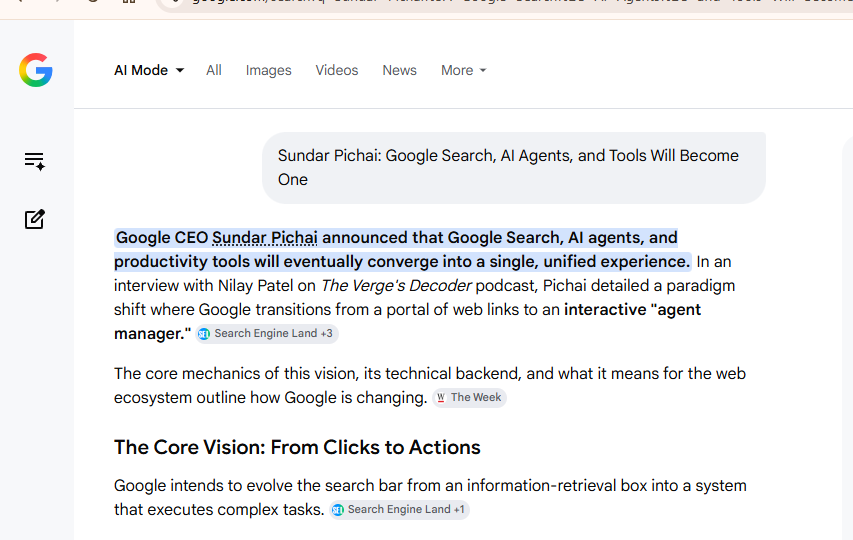
In a recent talk about what comes next for Google’s products, Pichai said Google Search, AI agents, and the growing bundle of AI powered tools will, in time, feel like one unified thing. At first glance it can look like yet another product roadmap note. But honestly it hints at a bigger change in the way people find what they need, weigh choices, and deal with companies while they’re online.
For marketers, SEO professionals, and business owners this is not just “another AI announcement.” It could shift the economics behind online visibility.
What Does Sundar Pichai Mean When He Says Search?
Google’s longer term plan seems to be a single AI layer that can search, reason, generate, and then take actions in the users name, not just point at results.
Today, users bounce around between multiple Google products. They search on Google, talk with Gemini, navigate using Maps, work inside Workspace, and browse in Chrome too. In Google’s future vision, all those experiences become stitched together in a single flow.
So instead of Search being a place where people just grab links, it turns into somewhere users actually get things done.
Like, when someone searches for “best project management software for a remote marketing team” they may get way more than a plain list of links. An AI agent could dig through options, compare pricing, check customer reactions, build a short list of the most relevant solutions, and then even line up product demonstrations.
This difference really matters, because classic search engines usually deliver information. AI agents deliver results.
It signals a move away from information retrieval, and toward task completion.
For years, marketers did content so it could answer questions, like step by step, over and over. Now the next phase of search might push businesses to optimize for systems that actually handle the task before a person even lands on your website.
Key Insight: Search is shifting from an answer engine into an action engine.
Why Should Marketers and Small Businesses Care About This?
Because AI agents may increasingly shape what customers decide, before they ever meet your brand face to face.
The old digital marketing funnel has mostly felt like this:
Search → Click → Website → Conversion
But in Google’s AI-driven future, that path could get really compressed and quick:
Search → AI Recommendation → Conversion
That change matters a lot, for two reasons.
For the past two decades, businesses mostly focused on pulling in traffic. Rankings led to clicks, clicks led to visits, and visits then created chances to turn prospects into paying customers.
In an agent driven environment, visibility might not be as much about pulling in clicks and it could be more about being picked by AI systems, when they decide what to do and what to show.
Traditional Search vs AI Agent Search
| Factor | Traditional Search | AI Overviews | AI Agent Future |
|---|---|---|---|
| Main Purpose | Find information | Summarize information | Complete tasks |
| User Behavior | Click links, then read | Read summaries | Delegate actions |
| Website Traffic | Essential | Reduced | Potentially optional |
| SEO Focus | Rankings | Citations | Trust and selection |
| Conversion Journey | Multiple steps | Shorter path | Direct execution |
| Competitive Advantage | Visibility | Authority | Machine confidence |
Takeaway: The eventual winner may not be the company that gets the most traffic. It might be the company that AI systems trust and choose again and again.
Also, this change can open doors for smaller businesses.
Big brands used to gain a lot from authority, backlinks and marketing budgets. AI agents, however, lean strongly on organized details, visible pricing, reviews, signals that demonstrate expertise, and business information that stays consistent.
Many small businesses end up doing better in these areas, because they communicate more clearly and they move with less organizational complexity.
A local accounting firm that has strong reviews, clear service boundaries, and real detailed expertise pages could become very competitive once AI systems start reviewing recommendations and ranking.
Key Insight: Trust signals may matter more than the old traditional authority signals.
Is SEO Becoming Less Important?
No. SEO is becoming more important, but the rules are not staying put.
With every major Google update, there are always new predictions about SEO “dying”.
The same pattern showed up with featured snippets.
Then voice search.
Then AI Overviews.
Still, companies keep chasing visibility, because visibility turns into revenue.
What is changing is the way visibility is earned.
In the past, SEO leaned hard on keywords, backlinks, and rankings. Those things still count, but AI-powered search adds more questions to handle.
Businesses today have to communicate in ways that work for both people and machine processes, not just one side.
AI systems read and score content differently compared to how a human user will feel it. They tend to search for clarity, credibility, organization, internal consistency, and supporting evidence, sometimes even when the writing seems “fine” on the surface.
A marketing page that is fuzzy, and loaded with common slogans might win over a few human visitors. But an AI agent is more inclined to believe what it can verify, so content with specific details, clear signals of expertise, real customer proof, and structured formatting usually performs better.
The New SEO Playbook for AI Search
- Go after topical influence in a tightly defined niche.
- Share original research and genuinely distinct perspectives.
- Add structured data whenever it makes sense.
- Keep business details uniform across every platform you use.
- Grow brand mentions beyond only your own site.
- Write material that supports the whole customer journey, not only the first question.
- Prioritize trust and credibility instead of chasing keyword density.
One straightforward example comes from HubSpot.
HubSpot didnt end up as some dominant marketing brand just by chasing keywords. The company grew real authority with teaching content, original research, templates, tools, and a lot of well earned know-how.
As AI systems keep deciding which sources get recommended, that whole kind of authority feels even more valuable.
Key Insight: SEO is moving into AI discoverability and recommendation optimization mode.
What Is the Biggest Risk of Google’s Unified AI Future?
The biggest risk is that AI becomes the destination, not the opening.
For a while now, Google acted like a bridge between people and sites.
People searched. Then Google pointed them. Then websites got exposure.
In the AI era, a real snag could appear.
If AI can answer questions, compare products, condense research, and finish transactions without pulling users to external websites, what does that do to the wider web ecosystem?
Publishers, bloggers, affiliate marketers, and content creators are already asking this kind of question.
A lot of online business models depend on traffic, because traffic creates a chain of events.
Traffic brings advertising revenue.
That advertising revenue ends up funding content creation.
So if less people click through, or they simply don’t end up on websites, content creators could have a harder time keeping those models alive.
And this concern is not only for publishers.
Small businesses that lean hard on organic traffic might run into problems too, especially if AI systems increasingly keep users inside Google’s ecosystem.
Here is where the debate gets interesting, maybe more than people expect.
Google says its AI helps users find information with more efficiency.
Critics answer that AI could weaken the incentive to create the very material those systems depend upon.
The real situation is probably between both sides.
Companies that rely only on search traffic may see mounting pressure.
Meanwhile, businesses with strong brands, loyal audiences, and several ways to acquire customers will likely adapt better.
Key Insight: The biggest challenge isn’t building AI agents. It’s keeping a good, living content ecosystem around them.
How Can Businesses Prepare for an AI-Agent-First World?
The strongest approach is to become the most trusted source in your category, consistently.
A lot of marketers are asking how to rank in AI generated search experiences.
A different question is more useful:
Why should an AI agent recommend your business?
AI agents are made to cut down uncertainty.
When they make suggestions, they’re looking for certainty.
That certainty comes from signals.
Organizations that show clearer trust signals are more likely to get recommended, in the end.
Practical Action Plan for the Next 12 Months
| Priority | Action | Expected Impact |
|---|---|---|
| High | Build topical authority | Stronger AI trust signals |
| High | Improve structured data | Better machine understanding |
| High | Publish expert content | Greater recommendation potential |
| Medium | Increase customer reviews | Improved credibility |
| Medium | Create comparison content | Better visibility in evaluation queries |
| Medium | Standardize product data | Easier AI interpretation |
| Long-Term | Develop proprietary research | Unique authority advantage |
Takeaway: AI agents tend to favor organizations that cut uncertainty through credibility, clear explanations and proven expertise.
Think about the software world.
When teams compare CRM platforms, project management tools, or email marketing solutions, they usually run into dozens of choices that look pretty close.
Now an AI agent judging those options will usually lean toward vendors that show clear pricing, strong reviews, documented know-how, transparent policies, and information that stays consistent.
And those are exactly the spots where companies can improve right now.
The firms that win in the next generation of search won’t necessarily be the ones posting the most content.
It may be that they are posting the most trustworthy content instead.
Key Insight: Future visibility will rely less on being discovered and more on being selected.
The Real Meaning Behind Google’s Strategy
Google’s plan is not just about slapping AI into Search. It’s more like reshaping Search into an intelligent decision making arena, where the user actually moves forward.
That line in the sand matters.
A lot of marketers still see AI as an add on, a feature. But Google seems to look at AI more like the interface, the place where everything gets handled.
In this setup people don’t go separately search, dig in, weigh options, and then act. Those steps blend together into one ongoing flow, guided by AI.
For businesses this has real weight.
Ranking fights start looking less like “earn spots” and more like “get recommended.”
Click battles turn into trust battles.
Instead of grabbing attention, the emphasis turns toward gaining confidence.
Now, this does not mean websites just disappear.
It does not mean SEO dies away.
It does not mean content marketing becomes irrelevant.
It does mean the metrics that truly matter are shifting.
And if a company keeps treating search like a mere traffic conveyor, it may run into trouble.
On the other hand, businesses that treat search as a trust building channel could see a big advantage.
Sundar Pichai’s statement about Search, AI agents, and tools becoming one product may sound like a technology announcement. In real life though, it reads more like a preview of a new digital marketplace where AI keeps mediating how consumers find, appraise, and select businesses.
The people in marketing who catch that change early won’t just adjust to the future of search.
They’ll help shape it too.

Kumar Swamy is the CEO of Itech Manthra Pvt Ltd and a dedicated Article Writer and SEO Specialist. With a wealth of experience in crafting high-quality content, he focuses on technology, business, and current events, ensuring that readers receive timely and relevant insights.
As a technical SEO expert, Kumar Swamy employs effective strategies to optimize websites for search engines, boosting visibility and performance. Passionate about sharing knowledge, he aims to empower audiences with informative and engaging articles.
Connect with Kumar Swamy to explore the evolving landscape of content creation!