
A Page ranking #1 on Google can generate thousands of visits each month, and still end up with almost zero traffic from ChatGPT, Perplexity, Claude, or Google’s AI-generated answers.
That seems wrong, if you’ve spent the last decade treating SEO like the universal visibility plan.
But new numbers from 10 websites and 150,000 indexed pages show it pretty clearly. Nearly half of the best organic pages got zero AI-driven traffic, no matter what. At the same time , pages with original research, proprietary data, and niche tools kept earning AI citations even though their normal organic visibility was much lower.
So this isnt SEO dying.
It’s something more interesting, search is splitting into two separate discovery systems. One leans on rankings. The other leans on usefulness. And the distance between the two keeps widening.
Introduction
- AI search traffic follows different content rhythms than traditional organic traffic and often prefers data-heavy, answer-first material.
- Service pages, calculators, assessments, and proprietary research are doing better than generic learning content inside AI-driven discovery.
- If a brand optimizes only for Google placement, it can fade out inside AI-generated answers, even while its organic results stay strong.
Why do highly ranked SEO pages still stumble in AI search?
Short answer: AI systems do not truly need generic educational content because they can generate that themselves. They need input that actually brings something distinct.
Traditional SEO liked thorough coverage.
Back then, if someone searched “What is customer retention?” a 3,000-word guide could keep winning the spotlight for years.
AI search shifts the value economics of information.
When a person asks ChatGPT, Gemini, or Perplexity about customer retention , the model can already describe the idea without referencing anyone. What it has a harder time building is
- Original data
- Industry research
- Proprietary frameworks
- Real-world benchmarks
- Interactive tools
- Fresh observations
That’s pretty much what the Search Engine Land study turned up. When trend analysis content showed up, it got LLM citations 78% of the time, but educational how-to pieces pulled in citations only 12% of the time.
The uncomfortable truth is that a lot of SEO content calendars are crammed with topics AI can reproduce fast, like immediately.
Then a 2026 GEO research paper ended up saying something similar, basically noting that AI search engines lean hard toward authoritative, earned-media sources when they build answers.
The new rule feels straightforward: if AI can generate your article without citing you, it will most likely not deliver traffic.
SEO vs GEO: what actually changes?
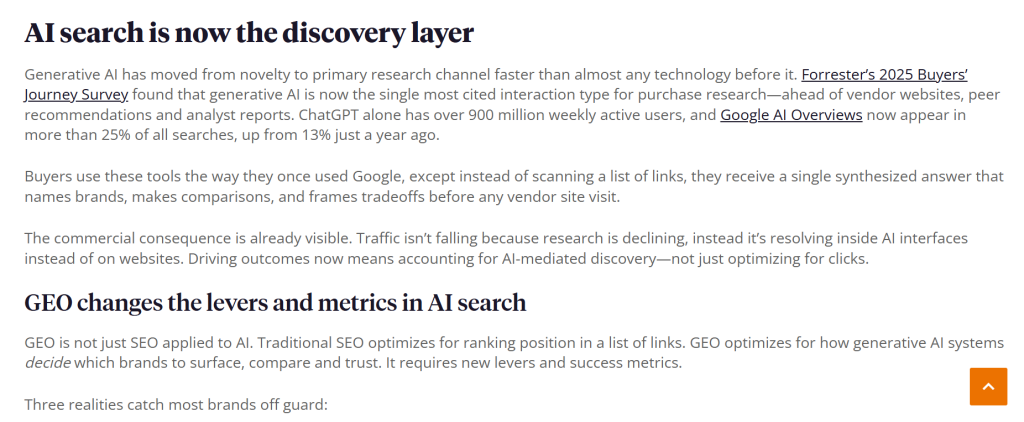
Short answer: SEO chases rankings and clicks, GEO chases citations and inclusion inside AI-generated answers.
The biggest mistake marketers make is assuming GEO is only SEO, with a new acronym.
The goals overlap, but the optimization targets are different, a bit like theyre chasing the same prize, yet from another hallway.
| Factor | Traditional SEO | GEO (AI Search Optimization) |
|---|---|---|
| Primary Goal | Rank on SERPs | Get cited in AI answers |
| Success Metric | Clicks and rankings | Mentions and citation share |
| Best Content Type | Comprehensive guides | Original insights and data |
| User Journey | Browse multiple pages | Seek one direct answer |
| Competitive Advantage | Authority and backlinks | Authority plus uniqueness |
| Traffic Behavior | Exploration | Intent-driven action |
Table placement note: 6 rows, 5 columns. Ideal directly after this section for featured snippet opportunities, so it reads cleanly.
Key takeaway: SEO wins visibility, GEO wins recommendation. The future needs both, not only one.
Many marketers are framing GEO as a replacement for SEO.
That misses it completely.
Organic search still drives massively larger traffic volumes. GEO just adds a second discovery layer where the rules arent identical, and you have to adjust.
Think of SEO as getting invited to the conference.
Think of GEO as being quoted on stage.
What content seems to win in AI search?
Quick answer: Original research, practical tools, proprietary datasets, specialist interpretations, and pages built to answer first tend to beat general lessons.
The “best” sites in AI search are not always the ones putting out the biggest pile of content.
More often, it is the places publishing the most relevant stuff.
In the study, they noted a handful of content styles that keep pulling AI referrals again and again, like;
- Original investigation
- Industry benchmark reports
- Yearly summary studies with real numbers
- Interactive calculators
- Evaluations and quizzes
- Product comparison utilities
- Service pages that answer one clear question
One extra example, not from the study, comes from Ahrefs.
They reported that AI traffic was only around 0.5% of visitors but it drove over 12% of signups. The reason, largely, was that AI users landed on tool pages and product focused sections rather than drifting through educational content.
That’s a strong clue.
Fewer visits.
More intention.
Higher conversion potential, honestly.
Many small businesses can benefit from this shift in a very real way.
A local accounting firm may never fully out rank the giant publishers for “small business tax tips”, that’s common.
Still, it can publish things that are more relevant and tangible, like
- A local tax deadline calculator
- State-specific compliance reports
- Regional business benchmarks
- Industry tax trend analyses
Those types of assets are much harder for AI systems to generate independently, even if the model understands the topic.
AI search increasingly rewards differentiated knowledge rather than content volume, more and more.
Are AI visitors better than organic visitors?
Short answer: often yes, but only for certain page types.
The traffic quality discussion is where it gets interesting in practice.
The Search Engine Land dataset found that AI users spent noticeably more time on tools, homepages, and service pages than organic visitors did.
Articles showed the opposite pattern.
Here’s the reason, in plain terms.
Organic search users are often exploring and comparing options.
AI users frequently arrive after receiving a recommendation, already primed.
The gap resembles :
Google:
“Here are 10 possible solutions.”
AI:
“This is probably the solution you need.”
That leads to really different intent.
Research from Ahrefs backs the same rhythm. AI visitors usually view fewer pages, yet they often convert at much higher rates, because they reach you with sharper purchase intent.
Still, there’s a important counterpoint.
- Higher conversion rates now might be partially bloated by low volume.
- When AI search becomes mainstream, visitor habits could level out.
- We should avoid declaring AI traffic permanently superior from early-stage numbers.
- Even so, the signals indicate AI visitors often show up nearer to a decision than traditional organic users.
- AI search may not actually be delivering more traffic, it’s more likely delivering better fit people.
How should small businesses adjust their content plan ?
Stop trying to out-publish bigger competitors and instead start making assets they can’t really copy.
This is where the GEO talk turns practical.
Most small businesses can’t realistically match enterprise publishers on sheer content quantity.
That’s becoming less of the whole thing though.
Lean into assets only your business can generate, not the same recycled stuff everyone else already has.
Step 1: Find your unique input
Look for stuff like
- Customer trends
- Internal benchmarks
- Industry observations
- Survey results
- Usage statistics
Step 2: Build pages that answer first
Put a direct answer right at the start of every important page.
The study found that brief answer capsules line up tightly with AI citations.
Step 3: Create one genuinely useful tool
You don’t need a huge engineering team for this.
Examples include
- ROI calculators
- Pricing estimators
- Compliance checkers
- Readiness assessments
- Industry scorecards
Step 4: Tighten up the service pages
Many brands treat service pages like a brochure. But AI systems often read them like actual recommendations, which means your wording and structure matter a lot more.
Explain, what you do, and for who its for, and what outcomes you expect, plus your differentiators, also include supporting evidence.
Step 5: Measure GEO separately
One of the biggest mistakes is mixing AI performance and organic performance into one single reporting bucket, not great.
The study found that many pages that were successful in organic search generated zero AI traffic, or at least none showed up in the reporting window.
Those are really separate channels.
Track them separately.
Small businesses do not need more content, they need more proprietary content, with real angles not just rephrased pages.
Is GEO overhyped?
Short answer, some GEO claims are too high, but ignoring AI discovery is riskier than trying it in controlled tests.
The GEO industry is filling up with consultants promising guaranteed AI visibility, and that part is where things get slippery.
That can be dangerous. Even big AI platforms give limited transparency about how citations are chosen and ranked. Business Insider recently called GEO a growing field where practitioners are still learning the rules as they go, almost day by day. There are also measurement problems, which makes the whole conversation harder than it should be.
AI referrals frequently lose attribution data, and it feels like it happens more often than we want to notice. Some AI driven visits show up as direct traffic, which makes it confusing to even understand what happened in the first place. Visibility can vary dramatically depending on the prompt wording. And we shouldnt ignore the downside, because that part is real too.
A recent academic study estimated that AI generated search summaries cut traffic to certain informational pages by about 15%, especially in content categories where quick answers satisfy user intent, without needing the visit. That means publishers have a real challenge on their hands.
AI can do this strange two way thing: it can increase visibility while also reducing clicks. So the winners wont be the sites chasing every GEO trend, chasing every small signal and moving too fast. They will be the brands building assets that are valuable enough that users still choose to visit the original source. The future isnt SEO versus GEO. It is about building content so useful that both human readers and AI systems keep referencing it, again and again.
Conclusion
The biggest takeaway from the SEO-GEO gap isnt just that AI search behaves differently. It is that AI search highlights a weakness many content strategies already had, even if teams did not fully name it.
For years marketers made content mainly because keywords existed, and well, that was enough.
Now AI systems are asking a tougher question, like, “what unique value does this page bring.”
If a page is built on generic explanations, it tends to wobble when it tries to answer that clearly.
But pages that lean on proof, real know how, practical tools, and original perspective hit the target right away.
That is why the brands pulling in AI visibility are not always posting more content.
Theyre posting things nobody else can reasonably match, and it shows.
:::

Kumar Swamy is the CEO of Itech Manthra Pvt Ltd and a dedicated Article Writer and SEO Specialist. With a wealth of experience in crafting high-quality content, he focuses on technology, business, and current events, ensuring that readers receive timely and relevant insights.
As a technical SEO expert, Kumar Swamy employs effective strategies to optimize websites for search engines, boosting visibility and performance. Passionate about sharing knowledge, he aims to empower audiences with informative and engaging articles.
Connect with Kumar Swamy to explore the evolving landscape of content creation!