
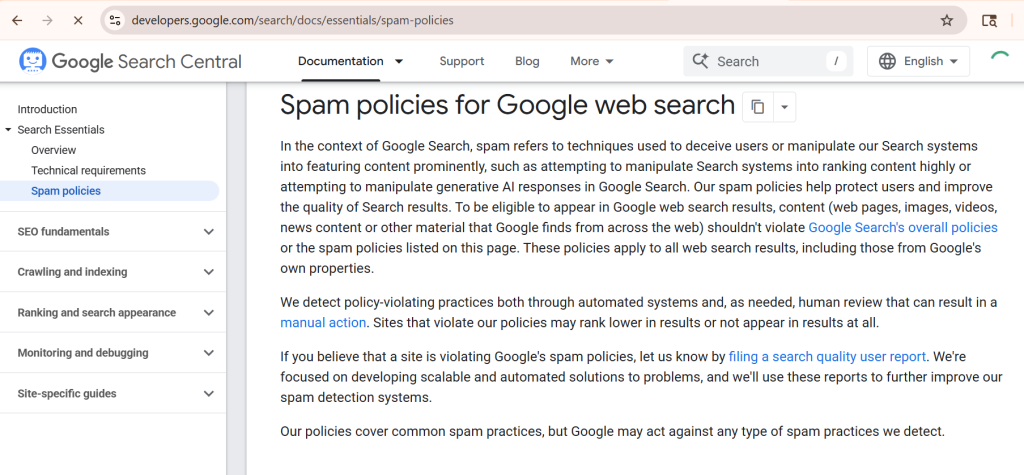
Google’s newest spam policy note looks small on paper. It is not. The company explained that its existing spam rules cover AI-generated material and generative AI answers, not just classic webpages. This matters because for the past couple of years the SEO world mostly treated AI text as a loophole, or a time-saving productivity trick, depending on who you asked.
Now Google is pushing a stricter boundary. The issue is not “AI content” by itself. The issue is the bulk, low-value, manipulative output, whether a person produces it or an LLM produces it. For digital marketers, this changes the actual operating environment more than most people notice at first.
Key points:
• Google is signaling that AI-produced content is evaluated using the same quality and spam expectations as content written by humans.
• Small businesses using AI for mass SEO output face higher risk now, especially when the material lacks expertise, originality, or real usefulness.
• The winning strategy is no longer “AI content at scale.” It’s “human insight amplified by AI efficiency” kind of.
The interesting part isn’t the policy language itself. It’s what Google is preparing for next: a search ecosystem flooded with synthetic content, AI summaries, and automated publishing pipelines. That changes how we should think about SEO entirely.
What Did Google Actually Change?
Google clarified that its spam policies apply to content generated through generative AI systems, including AI-generated responses designed to manipulate rankings.
The key distinction is that Google still does not ban AI-written content outright. It targets content created primarily to game search visibility rather than help users, or at least be actually useful.
This sounds obvious until you look at how the market evolved after ChatGPT launched. Thousands of agencies and affiliate marketers built content engines around prompts like:
• “Generate 500 location pages”
• “Rewrite rival articles”
• “Build SEO blogs around long-tail keywords”
• “Ship 50 posts per day”
For a while, those tactics did work. Mostly. The trouble for Google isn’t the use of AI. It’s the scaling up of low-value publishing, like a factory mood. That’s the real update here.
Why the wording matters
Google historically tried to avoid making too direct statements about AI-generated content, because it didn’t want to scare off legitimate workflows.
Now it’s staring at a different kind of problem:
• AI Overviews give answers directly inside search.
• Publishers lean on AI to mass-produce articles.
• Search quality could collapse if synthetic repetition gets everywhere.
Google needed wording that’s broad enough to cover future models of misuse, without banning AI-assisted practices that are genuinely useful. And that’s exactly what this change does.
Quotable summary: Google is no longer asking “Was this written by AI?” It’s asking “Was this made to support users, or to nudge search results?”
Is AI Content Still Safe for SEO?
Yes, but only if AI supports genuine expertise, not replacing it.
Most marketers are framing this discussion in a wonky way. The real issue isn’t “Can Google detect AI content?” it’s more like, “Does this page show original usefulness?”
Google has repeatedly boosted material that includes:
• First-hand experience
• Actual data
• Analytical interpretation
• Distinctive takeaways
• Intent alignment with the audience
AI-only writing often misses those signals because LLMs are forecasting tools, not authorities. They can sound confident, but they don’t automatically carry lived context or proven results.
Here is where many brands end up getting in trouble
A local business owner using ChatGPT to spin up 200 “best plumber in [city]” pages might believe they are accelerating SEO.
Google may read it as:
• Light differentiation
• Cookie-cutter layout
• Shallow expertise
• No original signals
• Scaled game-like manipulation patterns
That approach is increasingly risky right now.
On the other hand, a cybersecurity consultancy using AI to speed up drafting while adding:
• Internal breach data
• Analyst commentary
• Proprietary frameworks
• Real screenshots
• Customer lessons
…is probably fine, yes. The distinction is strategic intent.
Example: HubSpot compared to AI niche sites
Over the last year, a bunch of AI-heavy niche sites lost major organic visibility after Google quality updates, while brands like HubSpot kept growing even while using AI-assisted workflows internally. Why? Because authoritative brands still bring in:
• Editorial oversight
• Subject matter expertise
• Distribution trust
• Brand searches
• Original research
AI did not replace those advantages. It amplified them.
Comparison Table: High-Risk vs Sustainable AI SEO
| Strategy | Short-Term Traffic Potential | Long-Term Risk | Human Expertise Level |
|---|---|---|---|
| Mass AI blog publishing | High | Very High | Low |
| AI-assisted expert articles | Moderate | Low | High |
| Programmatic SEO with unique data | High | Medium | Medium-High |
| AI paraphrasing competitor content | Medium | Very High | Very Low |
| Human-led research accelerated with AI | High | Low | High |
| AI-generated affiliate sites | Medium | High | Low |
Takeaway: AI becomes dangerous for SEO when it replaces expertise, not when it accelerates it.
Quotable summary: The future of SEO belongs to companies with real knowledge, not the ones generating the most words.
Why Small Businesses Should Pay Attention
Small businesses, honestly, are more vulnerable to this shift than large publishers.
A major brand can survive temporary ranking volatility because it has:
• Direct traffic
• Email lists
• Brand recognition
• Partnerships
• Repeat customers
A small business depending on local SEO often has none of those buffers, period. If your organic visibility drops, revenue drops immediately.
The hidden danger: AI sameness, uniform output everywhere
Most small businesses using AI tools are unknowingly building near-identical content.
Think about this workflow:
- Open ChatGPT
- Ask for a service page
- Mention the city name
- Publish with minimal edits
Now multiply that by thousands of businesses using the same prompts. The result:
• Similar structure
• Similar phrasing
• Similar headings
• Similar examples
• Similar conclusions
Google’s systems are getting trained more and more to spot this pattern. And AI Overviews make it worse since generic content is easier for Google to summarize, meaning users might never actually click through to your site.
What local businesses should do instead
The benefit small businesses still have is proximity to real experience, not theory.
A local HVAC company could publish, for example:
• Photos from real installs
• Weather insights for the region
• A repair cost breakdown
• Before/after project data
• Common local problems
• Technician commentary
AI can help arrange and write up this info, but it cannot generate genuine operational experience convincingly at scale. That is your moat now.
A practical framework for small teams
Use AI for:
• Drafting
• Structuring
• Summarization
• Metadata
• Content briefs
Do not depend on AI alone for:
• Expertise
• Claims
• Analysis
• Unique positioning
• Industry interpretation
Quotable summary: Small businesses win with specificity, not the publishing volume.
What Does This Mean for AI Overviews, and Search Traffic?
Google is trying to fix a contradiction it made, by itself.
The company wants:
• AI-generated search experiences
• Faster answers
• Lower-friction discovery
But it also needs:
• High-quality publisher ecosystems
• Trustworthy sources
• Original reporting
• Expert websites
These incentives are starting to rub against each other, a bit.
The uncomfortable reality for publishers
AI Overviews can reduce clicks for informational queries. Multiple independent studies already hint that zero-click behavior increases when AI summaries address the user intent directly.
So it creates a rather weird dynamic:
• Google needs publishers to build quality content
• Publishers get fewer clicks from that same content, yeah
So why does this spam clarification matter? Because Google has to keep enough serious quality creation in motion, to feed its AI systems. If search becomes crowded with AI-produced echoes, the training and retrieval layers start to degrade, quietly. Google is basically guarding its own future data supply.
Now the pushback nobody seems to discuss
Some marketers claim Google is enforcing standards on independent publishers that it doesn’t fully apply internally.
After all:
• Google AI Overviews produce synthetic summaries
• Those summaries, occasionally, include inaccuracies
• Publishers lose traffic while Google keeps people inside search
That critique isn’t totally off base. But from Google’s point of view, the other option looks worse:
• AI spam floods the index
• Search quality slips
• User trust erodes
• Competitors take more market share
So this policy update is part quality control, part ecosystem defense, even if it feels a bit harsh.
What smart marketers should expect next
Over the next 12–24 months, expect Google to, more and more, reward branded searches, author reputation, first-party data, and real-world experience. Also community trust signals. And multi-format expertise: video, audio, forums, reviews. Generic blog SEO alone gets less defensible every quarter.
Quotable summary: Search visibility is shifting from keyword authority to experience authority.
How Should Content Teams Adapt Right Now?
The best content teams are moving from “content production” to “knowledge production,” which is confusingly similar until you actually try it.
Old SEO thinking: Publish more pages than competitors.
New SEO thinking: Publish better evidence than competitors.
A practical 6-step workflow
- Start with proprietary insight
Before using AI, identify internal data, customer patterns, industry observations, and operational expertise. This becomes the differentiator AI cannot really replicate. - Use AI for structure, not originality
AI is pretty good at outlines, formatting, summaries, and draft acceleration. Treat it like a junior assistant, not the strategist. - Add evidence layers
Include screenshots, metrics, case studies, quotes, examples, and contrarian analysis. That boosts perceived expertise, and makes the whole thing feel less generic. - Optimize for citation-worthy content
AI Overviews often grab concise definitions, clear answers, structured formatting, tables, and lists. Make sure sections can stand alone, contextually speaking. - Reduce commodity content
Stop pushing articles that hundreds of competitors can recreate in minutes. Examples:
• Generic “What is CRM?”
• Generic “Benefits of ERP”
• Generic “Top marketing trends”
Those topics are turning into AI summary territory.
- Build brand search demand
The safest SEO move right now is getting people to search for you specifically. That means putting time into, investing in:
• LinkedIn presence
• Video
• Communities
• Newsletters
• Podcasts
• Thought leadership
Brands survive when platforms shift, better than anonymous websites.
Comparison Table: Old SEO Playbook vs Emerging SEO Playbook
| Old SEO Model | Emerging SEO Model | Why It Matters |
|---|---|---|
| Publish at scale | Publish with proof | AI commoditized volume |
| Keyword targeting | Audience expertise targeting | Intent matters more |
| Generic informational blogs | Experience-driven content | Harder to replicate |
| Traffic-first strategy | Brand + trust strategy | Reduces dependency |
| AI-generated drafts | Human-guided AI workflows | Improves originality |
| SERP ranking focus | Multi-channel authority | Search is fragmenting |
Takeaway: SEO is getting less about content quantity and more about defensible expertise.
Quotable summary: AI lowered the cost of publishing, so Google is raising the value of originality.
The Bigger Shift Most Marketers Haven’t Fully Processed
Google’s spam clarification feels like more than a policy note; it’s a hint about what’s next in search.
We’re stepping into a market where:
• Content creation is cheap, fast
• Distribution is algorithm-driven, not human-routed
• Attention is limited, always competing
• Trust becomes the key differentiator
And yeah, that changes how digital marketing works, financially.
For a long time, SEO basically rewarded operational efficiency, meaning:
• More pages, more variations
• More keywords, more targeting
• More links, more backlinks
• More publishing, more output
AI pushed that model forward for a while; it supercharged the whole thing. Now Google is rebalancing toward credibility, like the center of gravity is shifting.
The irony is, AI may end up helping the businesses with genuine expertise more than anyone because they can produce strong, accurate content more quickly without having to surrender authenticity. Meanwhile, the companies that were built mainly on content arbitrage are facing a tougher reality.

Kumar Swamy is the CEO of Itech Manthra Pvt Ltd and a dedicated Article Writer and SEO Specialist. With a wealth of experience in crafting high-quality content, he focuses on technology, business, and current events, ensuring that readers receive timely and relevant insights.
As a technical SEO expert, Kumar Swamy employs effective strategies to optimize websites for search engines, boosting visibility and performance. Passionate about sharing knowledge, he aims to empower audiences with informative and engaging articles.
Connect with Kumar Swamy to explore the evolving landscape of content creation!