
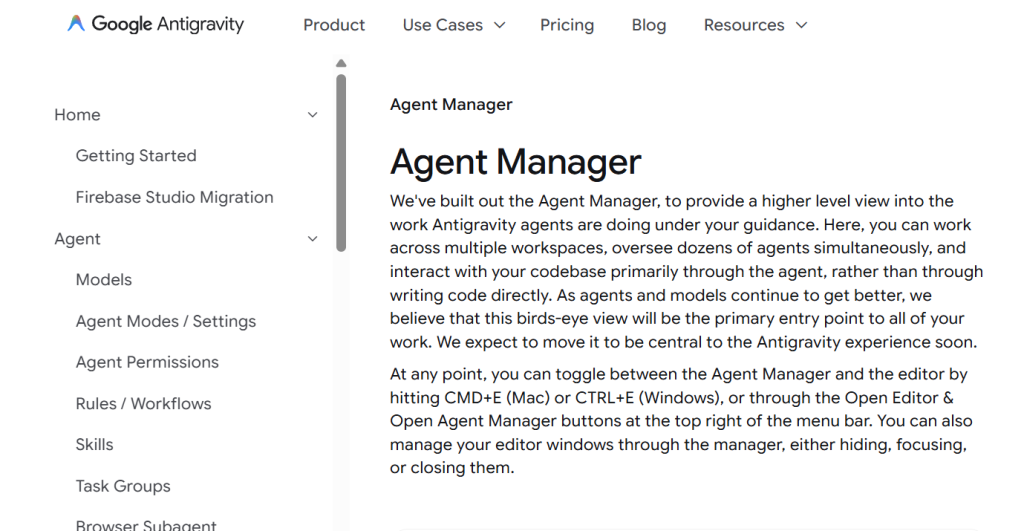
- Google advertises that they would be transitioning future searchs from a conventional search engine to “an agent manager”.
- This change will restructure the relationship with people and businesses, regarding where and how people are looking for answers, and in this new scenario, brands having to engage with serach engines.
- Also, to prepare for this shift, small businesses are supposed to embrace new AI tools and further optimize their digital strategies to meet the evolving needs of the users.
What Does Google’s ‘Agent Manager’ Vision Mean for the Future?
Google’s Sundar Pichai recently unveiled an ambitious vision: Google Search is transitioning into an ‘agent manager’. This suggests a future where search no longer just provides answers but acts as one’s online assistant and coordinates several agents (AI tools, applications, and others) to accomplish simple tasks. No longer will the search engine simply provide links or answers but will facilitate seamless multidevice, multiagent interaction.
Certainly, this transformation offers ample opportunities for someone who owns a small business. Digital strategies need to be rethought by people owning businesses. Search engine will face gradual transformation into a platform that is facilitating personal experience.
The Intent behind Making Google an ‘Agent Management’ Company
The core of Google’s transition shares concerns about making the search engine more efficient. Traditional search engines usually fetched results based on keywords entered by a user. It is now Google’s aim to smartly manage the search results through the multiple agents that will carry out tasks for the end users.
Instead of just bringing up a selection of recipes when someone looks up ‘dinner ideas’, Google could use one of these agents to draw in recipe data from various websites, matches the details with the requester’s personal preferences, dietary restrictions, past searches, or even order it right from the user’s usual shopping platform directly.
Thus, even small businesses are provided with opportunities to better engage with (potential) clients. If your business is online, it will be connected with customers through search terms in ways that boggled the mind.
How Will the Evolution of Google Search Affect Small Businesses?
The shift would significantly impact the way a small business might get seen, whereas Google Search now plays with AI and an agent for all this consumer lingo. Therefore, it will be more than recommended for businesses to make points with these factors, i.e. AI-driven content, structured data, and AI integrations.
So, if you are a small business and your site still isn’t optimized for AI interaction, now is the time to do it. This shows that, due to the agent-model change at Google, you could score high on traditional search but still go unnoticed; you have to have-your-content plug into the bigger Google ecosystem of agents so as to provide AI agents with necessary data for a truly seamless user experience.
Businesses are leading into AI entry and humanization for continued presence on Google’s changing plot of search.
How Will AI-Driven Search Change Content Creation?
In a world with agents being managed by the AI on Google Search, content creation will go beyond mere SEO basics. Businesses must start to develop content serving AI systems and not just human users. Here’s a fact: AI will need a well-structured content-rich with semantics along with the badly needed intelligent agents.
For instance, if you are managing a restaurant, having a menu on your website does not mean that you merely list the food items. It’s also about structuring the data in such a way that AI agents can reference it intelligently and therefore can derive insights and recommendations to the user. This might have implications such as integrating your menu with Google’s system, ensuring its availability across multiple platforms and voice-activated devices like Google Assistant.
Structured content is all about making sure that the back end of your website is optimized for AI-friendly access, speed, and richness in features that agents can bring up like your business hours, location, and pricing information.
Key Summary: Content must evolve to be AI-friendly, which means adding structure and providing data that agents can process.
Will Google’s Agent Manager Lead to More Competition?
While the ‘agent manager’ by Google may benefit businesses as it could make content discoverable in an easier way, it would also mean more competition. Google has adjusted the algorithms so much so skills in engaging with AI agents will be the primary criterion when picking a business. This will make it incredibly difficult for companies who have not begun to think in these terms.
Take e-commerce, for example: Once computer AI agents perform the search on their behalf, consumers can expect personalized clothes and accessories shopping lists brought up automatically based on their preferences. Small businesses have to shape their product listings so that they are favored by these AI agents and presented to online users.
Insight: Businesses slow in adjusting to Google’s new agent ecosystem may have major difficulties in standing out amidst search results.
Content Comparison: AI-Driven vs. Traditional Content Creation
In this section, let’s compare traditional content creation methods with the new AI-driven approach businesses will need to adopt.
| Aspect | Traditional Content | AI-Driven Content |
| Structure | Basic, often unstructured text and images | Structured data for AI agents to interpret |
| Optimization Focus | Keyword-driven SEO | AI-ready content with clear data points |
| User Personalization | Limited personalization based on past visits | Hyper-personalized recommendations based on behavior |
| Integration | Basic website presence | Integration with AI systems like Google Assistant and shopping tools |
| Content Delivery | Text and images in static formats | Dynamic, multi-agent interactions with content delivery |
Insights: Businesses need to shift from static content to structured, AI-friendly content to remain competitive in an evolving search ecosystem.
Frequently Asked Questions (FAQs)
Google and the ‘Agent Manager’ signify Google Search will act as a bearer providing several artificially intelligent agents to assist users in enhanced searches not just limited to providing search results.
To make their sites AI-friendly, small businesses should select, implement, and endorse structured data and AI-friendly content thus enabling increased accessibility to Google’s continued development of search algorithms.
Now, SEO strategies have to evolve from traditional keyword-based optimization to more toward structured data, personalized content, and AI-friendly strategies.
Yes, companies will have to invest in some of the efficient AI tools and be in sync with Google’s AI-driven ecosystem, which requires highly technical integrated AI, chatbots, and personalized recommendations that will work.
Definitely yes, the AI arrangement when utilized by agents that handle search functions, that means that if companies have not applied the same in some manner, there would be a struggle in lieu of visibility and pertinence in the search result.
Conclusion: Embracing the Future of Google Search
What Google provides in ‘search agent manager‘ can completely alter an orientation of business interaction to SEO spaces. Small businesses must grasp that being part of this new ecosystem calls for immersion in AI, altering greatly their offerings to matter to a specific anonymous user. Digital asset applications need to be onboard with the developing search platform. The future of search has come. The one who adapts early will outplay those who come later in the ever-increasing AI-driven context.
The Big Picture: Google’s new ‘virtual manager’ presents businesses with the chance to interact better with users but will benefit only the ones that embrace AI technology in their strategies for survival in this new digital space.

Kumar Swamy is the CEO of Itech Manthra Pvt Ltd and a dedicated Article Writer and SEO Specialist. With a wealth of experience in crafting high-quality content, he focuses on technology, business, and current events, ensuring that readers receive timely and relevant insights.
As a technical SEO expert, Kumar Swamy employs effective strategies to optimize websites for search engines, boosting visibility and performance. Passionate about sharing knowledge, he aims to empower audiences with informative and engaging articles.
Connect with Kumar Swamy to explore the evolving landscape of content creation!