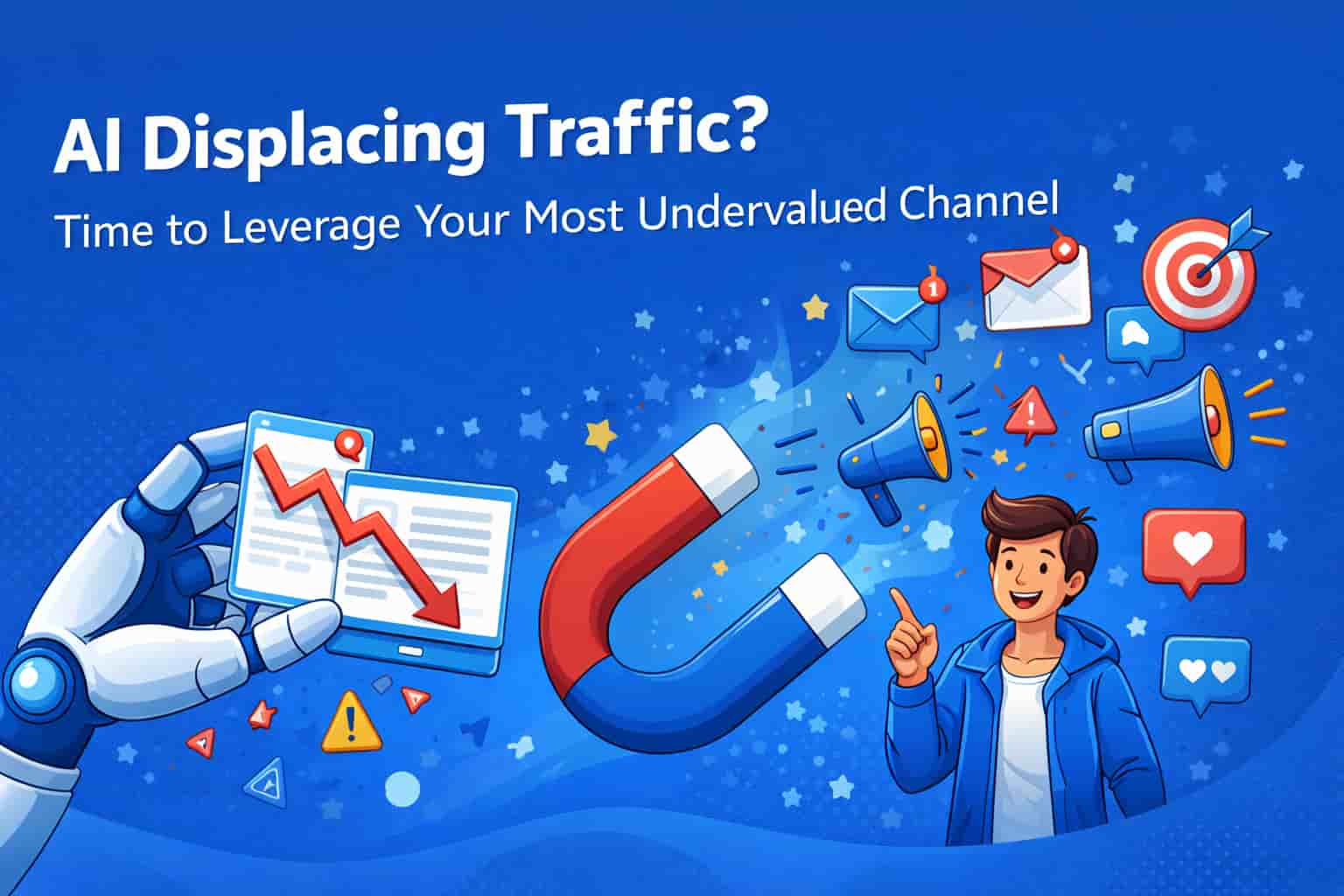
Introduction: Feeling the traffic drop already?
Have you ever looked at your analytics dashboard and wondered, “Hold on… Why is my organic traffic consistent when the positions are good?” You’re not deceiving yourself. AI-assisted search, previews, and conversational replies are gradually transforming user content discovery in a big way. And indeed, the impact of AI on traffic is unprecedented in that it has already started to happen in ways we haven’t thought of before.But here’s the good news: this shift doesn’t mean your growth story is over. It means it’s time to lean into your most undervalued channel the one many brands ignored while chasing Google clicks. Let’s break it down in simple terms and talk about what actually works now.
What does “AI displacing traffic” really mean?
AI displacing traffic doesn’t mean search engines are dead. It means fewer clicks are making it to websites because AI answers questions directly on the results page or inside chat interfaces. Users get summaries, comparisons, and recommendations without needing to click through.
Competitor analysis shows a common pattern: informational keywords are taking the biggest hit, while branded searches, community-driven content, and direct engagement channels are holding strong. This is where zero-click searches, AI search results, and SERP volatility come into play. If your strategy depends only on ranking for generic keywords, you’re exposed.
Why is organic search no longer enough on its own?
Organic search traffic is still valuable, but it’s no longer reliable as a single growth engine. AI-generated answers compress the funnel. Users trust the summary and move on.
As growth marketer Rahul Mehta puts it, “Search hasn’t disappeared, but attention has fragmented. Brands that rely on one channel are the first to feel the drop.”
This is why smart brands are diversifying into owned media channels, focusing on first-party data, and building direct relationships instead of renting attention from algorithms.
So, what is the most undervalued channel right now?
It’s your owned audience email lists, communities, subscribers, and returning users. Unlike social or search, this channel can’t be taken away by an algorithm update.
Email marketing, for example, is showing renewed strength because it bypasses AI search entirely. When someone opens your email, you already won the click. The same goes for WhatsApp updates, Slack groups, and niche communities. These are powerful examples of audience-first marketing in action.
If you’re already publishing helpful content, connecting it to your newsletter strategy (like we discuss in our guide on content distribution strategies) is one of the fastest wins right now.
How can brands adapt their content strategy in an AI-first world?
First, stop creating content just to rank. Start creating content people want to return to. AI can summarize facts, but it can’t replace lived experience, strong opinions, or trust built over time.
Second, double down on brand authority. Branded searches are less affected by AI displacement because users are actively looking for you.
Third, use AI as a support tool, not a replacement. As content strategist Nina Lopez says, “AI won’t replace content teams, but teams who ignore AI will fall behind.”
Finally, connect your content ecosystem. Blog posts should feed newsletters, social posts should point to owned channels, and every article should give readers a reason to come back. Our breakdown on future-ready SEO tactics covers this shift in more detail.
Is this the end of SEO or the start of something better?
It’s not the end of SEO. It’s the end of lazy SEO. Search engine optimization now overlaps with AI content discovery, brand trust, and engagement depth.
The brands winning today aren’t chasing traffic spikes. They’re building sustainable audiences, measuring success beyond pageviews, and treating AI as a new layer not a threat. One respected digital marketing publication recently highlighted how community-led growth is outperforming pure search-led models in AI-heavy SERPs. That insight alone should change how we think about “traffic” going forward.
FAQs
Is AI really taking traffic away from websites?
Yes, especially for informational queries. AI answers reduce the need for clicks, leading to more zero-click searches.
What would be the current the most secure marketing channel?
Marketing through owned channels such as email lists and communities is the least prone to fluctuations because the relationship is under your control.
Will you advise me to eliminate my investments in SEO?
Not at all, but rather SEO should be the supporting pillar for brand development and audience establishment or else it will be left alone in isolation.
What is the role of first-party data in an AI-powered web?
It provides the capability to analyze and communicate with your audience directly without the need for intermediaries from third-party platforms. N
Are small businesses able to play a role in this new battleground?
For sure. Lesser brands usually gain consumer trust and even build communities quicker than the larger ones.
Conclusion: Your move matters more than the algorithm
AI displacing traffic is real, but it’s also an opportunity. If you invest in your undervalued channels now email, community, and brand you’ll be less dependent on unpredictable platforms tomorrow.
Curious how this shift is affecting your niche? Drop a comment, ask a question, or share this article with someone still stressing over traffic drops.

Kumar Swamy is the CEO of Itech Manthra Pvt Ltd and a dedicated Article Writer and SEO Specialist. With a wealth of experience in crafting high-quality content, he focuses on technology, business, and current events, ensuring that readers receive timely and relevant insights.
As a technical SEO expert, Kumar Swamy employs effective strategies to optimize websites for search engines, boosting visibility and performance. Passionate about sharing knowledge, he aims to empower audiences with informative and engaging articles.
Connect with Kumar Swamy to explore the evolving landscape of content creation!