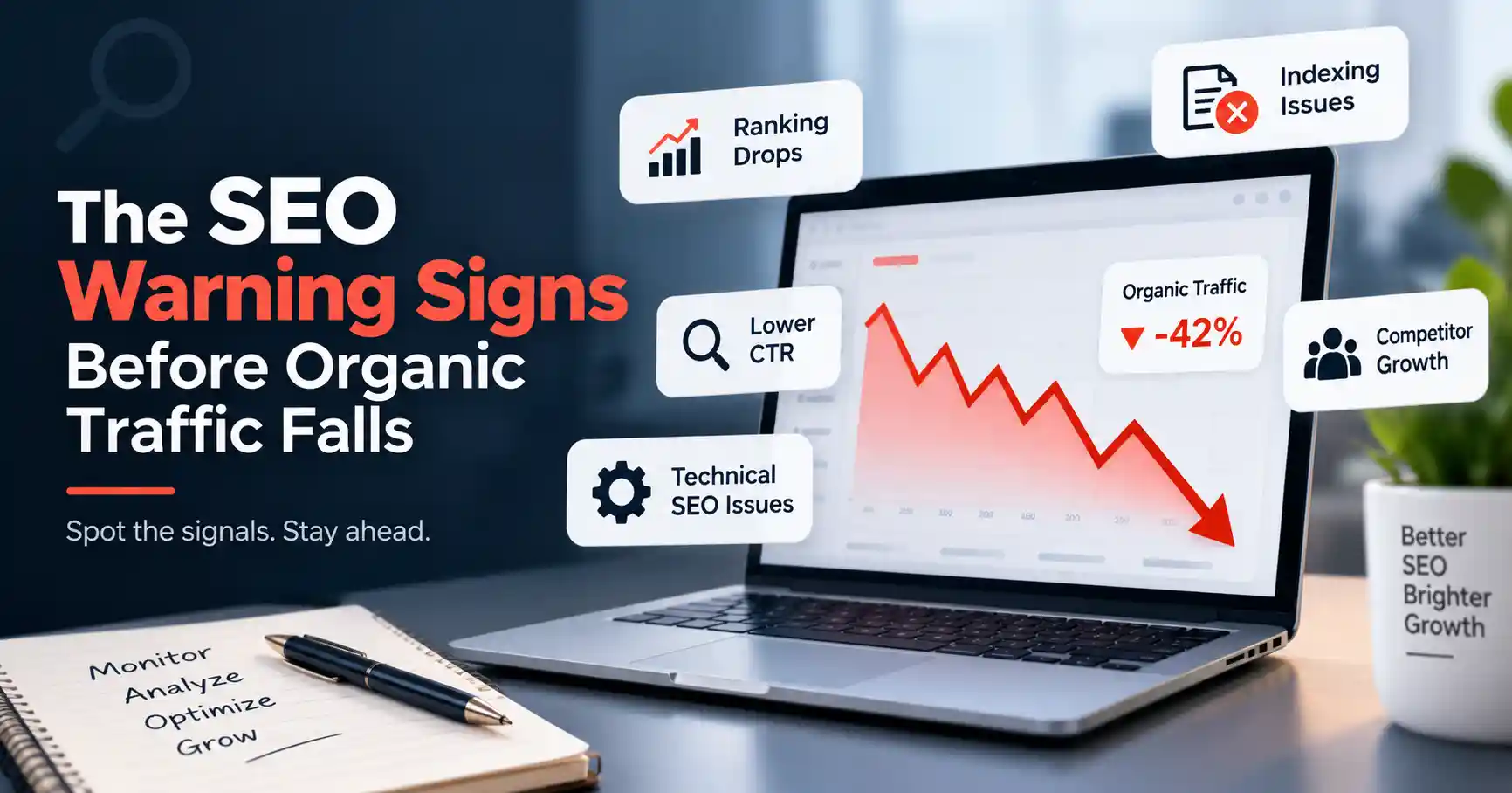
Have you ever opened your analytics dashboard and thought, “Wait… where did all that Google traffic go?”
The frustrating part is that organic traffic usually doesn’t disappear out of nowhere. In many cases, your website gives you small warning signs first. A valuable keyword starts slipping. Impressions rise but clicks don’t. Google begins showing a different page from your website for the same search. Or an important page quietly drops out of the index.
By the time the overall traffic graph looks scary, the real problem may have been developing for weeks.
That’s why understanding the SEO warning signs before organic traffic falls is much more useful than simply reacting to a traffic crash.
What are the early SEO warning signs before organic traffic falls?
The first warning sign is often not a dramatic traffic decline. It’s a change in the quality of your organic visibility.
For example, your website might still be receiving 50,000 monthly visits, but your pages that generate leads, sales or enquiries could be losing visibility.
That distinction matters.
Search performance should be monitored at the page, query and business intent level rather than relying only on total organic sessions.
Watch for these early changes:
- Important commercial keywords moving down
- Clicks falling while impressions remain stable
- High value landing pages losing visibility
- Google ranking different URLs for the same query
- Important pages becoming excluded from the index
- Competitors appearing more frequently for your keywords
- Organic conversions declining before traffic does
Google itself recommends looking at clicks, impressions, position, queries, pages and other patterns when investigating search traffic changes.
In other words, don’t wait for the traffic graph to scream at you.
Are keyword ranking drops a bigger warning than falling traffic?
Sometimes, yes.
A small keyword ranking drop can look harmless when you’re looking at hundreds or thousands of keywords. But losing five positions for a keyword that generates leads may be far more important than gaining hundreds of low value rankings.
Imagine a page ranks #2 for “B2B SEO services” and slowly moves to #6.
Your overall keyword count might still look healthy. Your impressions might even increase.
But the commercial impact can be significant.
Google also points out that small ranking movements can happen naturally because search results are constantly changing. A temporary move from position 2 to position 4 doesn’t automatically mean something is broken.
The warning comes when the decline is persistent.
Look at your most valuable keywords and ask:
“Are my important searches gradually becoming less visible?”
If the answer is yes, investigate before the decline spreads.
What does Google Search Console reveal before an organic traffic drop?
Google Search Console AI Performance Reports Are Now Global is one of the best places to catch SEO problems early because it shows what is happening in Google Search itself.
Don’t just look at the total clicks chart.
Compare:
- Clicks
- Impressions
- Average position
- Click through rate
- Top queries
- Top landing pages
- Device performance
- Country performance
One particularly useful pattern is impressions increasing while clicks remain flat or decline.
That can mean your pages are appearing more often but aren’t winning the click.
The reason might be a weaker title, changing search intent, stronger competitors, featured snippets, AI generated search results or another SERP feature taking attention away from traditional listings.
Google’s troubleshooting guidance specifically recommends examining patterns in clicks, impressions and position rather than treating every traffic decline as a ranking penalty.
Could technical SEO issues quietly destroy organic visibility?
Absolutely. And this is where things get uncomfortable because technical problems can hide in plain sight.
A page might look fine in your browser, even when Google can’t crawl it well. It may also fail at indexing or understanding what’s on the page.
Common technical SEO issues include:
- Accidental noindex tags
- Incorrect canonical URLs
- Robots.txt blocking important sections
- Broken redirects
- Server availability problems
- 404 and soft 404 issues
- Sitemap problems
- Incorrect internal links
- Pages disappearing from the index
A particularly nasty example is a website migration.
You change URLs, launch the new version and everything looks fine. A few days later, rankings start moving. Then impressions fall. Eventually, traffic follows.
Google notes that site moves and URL changes can cause ranking fluctuations while pages are recrawled and reindexed.
If you’re interested in the technical side, our guide on 10 Technical SEO Audit Mistakes That Turn Good Audits Into Bad Recommendations explains why fixing every warning isn’t necessarily the right approach.
And if indexing is your concern, How Soft 404s and Indexing Errors Can Wipe Out Traffic covers another common way valuable pages can disappear from search visibility.
Why can clicks fall even when search engine rankings stay stable?
This is one of the easiest warning signs to misunderstand.
Suppose your page remains at position #4.
You might assume everything is fine.
But your clicks fall by 20%.
What happened?
The search results page may have changed.
Users could now be seeing AI Overviews, featured snippets, videos, shopping results, maps, discussions or other search features before reaching traditional organic listings.
Google also explains that a decline in clicks without a corresponding fall in impressions can indicate that users are choosing other search results or that the search results page has changed.
This is why search engine rankings shouldn’t be your only SEO KPI.
A better question is:
“Are my rankings producing the visibility and clicks they used to?”
If not, study the actual SERP instead of staring at your ranking tracker.
Are competitors a warning sign before your organic traffic drops?
Yes, and this one is often overlooked.
Your rankings don’t exist in isolation.
If a competitor publishes a stronger page, updates an outdated guide, earns authoritative links or builds a better answer to the searcher’s question, your page can gradually lose ground.
You may not see a sudden penalty.
Instead, you’ll notice something more subtle:
Your competitors are appearing for more of the queries that matter to you.
Google’s guidance notes that rankings can decline when another site becomes more useful, relevant or authoritative for the search.
So every month, manually check a sample of your most important keywords.
Don’t just ask, “Where am I ranking?”
Ask:
“What are the pages above me doing better?”
Analyze originality, depth, and research quality. Examine user intent, page experience, and linking strategies, Does the rival actually answer better? That is a superior audit compared to counting words, Trust me.
Can seasonality or changing search demand look like an SEO problem?
Definitely.
Not every organic traffic drop is an SEO failure.
Search demand changes.
A product may become less popular. A seasonal topic may naturally decline. A news driven query may lose interest. Or users may simply change the way they search.
For example, a website selling holiday products could see organic traffic fall sharply after the holiday season even though its rankings haven’t changed.
That’s why comparing the same period year over year can be valuable.
Google recommends using Google Trends alongside Search Console when determining whether declining search demand is affecting your traffic.
So before rewriting 50 pages because traffic dropped, check whether people are actually searching for those topics at the same level.
Sometimes your SEO isn’t broken.
The market simply moved.
What should you do when you spot these SEO warning signs?
Fight the urge to panic rewrite immediately. Truly, it remains the absolute worst blunder possible. Instead, anchor yourself to a basic routine, perhaps auditing SEO health weekly. Zero in ruthlessly on top pages and crucial keywords. Compare clicks, impressions, CTR, and rankings against the previous cycle, alongside year over year figures whenever feasible.
Then check indexing.
After that, inspect your technical SEO, competitors and SERP changes.
A useful order is:
- Confirm the traffic decline is real.
- Identify which pages and queries changed.
- Compare clicks, impressions and rankings.
- Check Google Search Console for indexing problems.
- Look for technical SEO issues.
- Review competitors and search result changes.
- Check seasonality and search demand.
- Only then make significant content or SEO changes.
This approach prevents one of the biggest SEO mistakes: fixing something that wasn’t actually broken.
FAQ’s
Watch for a steady drop in clicks along with lower impressions. Also check if rankings slip or if conversions drop. Do the same for visibility on key pages. A single day that dips is not always a true issue.
Yes. Indexing problems, noindex tags, robots.txt restrictions, broken redirects and server issues can prevent Google from properly accessing or indexing important pages.
Not always. Google search results naturally fluctuate. A small temporary change isn’t necessarily concerning, but a persistent decline for high value keywords deserves investigation.
No. CTR can fall while rankings remain stable. Changes in SERP features, competitors, titles, snippets and AI generated search experiences can all affect clicks.
For high priority sites, scan the main pages and search terms once a week. If you need more detail, do a full SEO check every month. The point is to notice changes over time, not to chase every small daily shift.
Conclusion:
SEO disaster rarely arrives without warning. Look closer. It practically leaves breadcrumbs behind, whispering about the approaching trouble long before the algorithm drops the hammer.
A few declining commercial keywords. A CTR problem. A page slowly losing impressions. An indexing error. A competitor publishing better content. A changing SERP.
Individually, these may not look dramatic.
Together, they can tell you that your organic visibility is weakening.
Dismiss minor rank drops. Spotting genuine trends early matters most, because once those shifts become visible, real action can finally happen.

Kumar Swamy is the CEO of Itech Manthra Pvt Ltd and a dedicated Article Writer and SEO Specialist. With a wealth of experience in crafting high-quality content, he focuses on technology, business, and current events, ensuring that readers receive timely and relevant insights.
As a technical SEO expert, Kumar Swamy employs effective strategies to optimize websites for search engines, boosting visibility and performance. Passionate about sharing knowledge, he aims to empower audiences with informative and engaging articles.
Connect with Kumar Swamy to explore the evolving landscape of content creation!