
Introduction:
- The point is to drive processes in AI, and how Google’s engineers addressed the opaqueness associated with the decision tactics of AI models, and how this plays off.
- The opaqueness of AI models that becomes black-box models has considerable business implications in business planning, personalization, contents, business consumer reactions, customer trust, and providing search results too.
- For small businesses, AI’s advantages are outweighed by the disadvantages of its limitations such as a lack of transparency.
Black-Box Models in AI: What Does This Have to Do with Small Business?
A black-box model within the AI scenario is a machine learning system with invisible internal characteristics, even for its creators, who fail to understand it. Google engineers tried an insightful explanation, highlighting the fact that nearly all crucial operationalized Google Search decisions involved black-box AI models. For small businesses, the mystery almost entirely was how they actually implement their working in relation to defending their value online.
Concerning Search AI. It is important to openly know more about how it is working, adjusting marketing strategies, and maintaining a competitive position. However, treating AI models as “black boxes” raises a relevant question: to what extent can smaller businesses influence AI’s decisions on their behalf?
Summary: Small businesses often cannot predict or influence a search’s final outcomes since they cannot even understand how black-box AI models function and make decisions based on data.
Do Black-Box AI Models Influence Search Engine Results?
The main issue with a black-box model is that it offers no explanation behind the reason for some decisions. The use of black-box models by Google in search has been particularly controversial; they influence a site’s ranking based on impenetrable science.
Imagine Google’s RankBrain and BERT, capable of taking content analysis beyond the ability of mere mortals, in delivering context and the sense of normal human interaction instead of easy matches between keywords. This steeper learning curve is no less than a challenge for the SEO practices serving businesses that are intended to fancy up their existence in the digital arena. What used to be simple and easy strategies for SEO is entwined with AI’s exercise in judgment about what seems “relevant” or “valuable” to searchers.
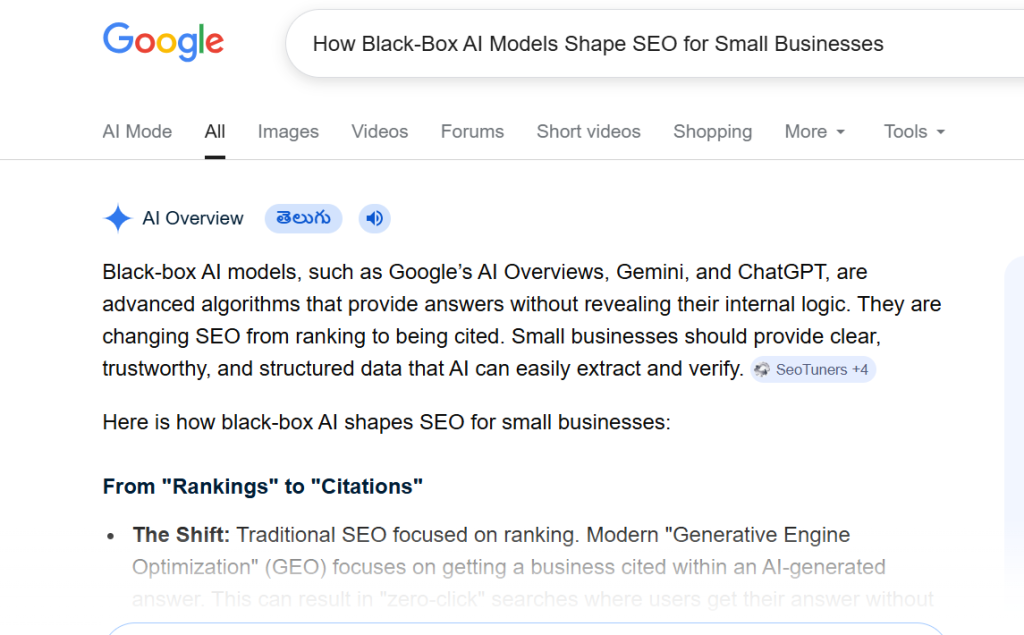
Insight: The orchestration of black-box AI algorithms would draw businesses toward creative skills in SEO rather than the result of completely opaque algorithmic maneuvering.
can anyone actually do something for a Black-Box AI model’s optimization?
On the plus side, aside from web design, the evolution of modern Web applications has opened up a phenomenal opportunity for the most recent wave in traditional search engine optimization (SEO) for which experience and empirical knowledge from the era of mainstream engines are entertainingly welcome both yesterday and today. Thank Goodness BERT is around to set the beat for humanlike AI.
In other words, more relevant and heterogeneous content is made available by Natural Language Understanding models, giving rise to good vibes for businesses selling it. Even here, good user/business content on avant-garde technology and models, making the natural use of text or data mining on an intrigue level, should find no further trouble as the majority of successful publishers avoid the traditional “two-d project”-looking outputs of restricted, modeling-minded products.
What is One Argument Against: Is the Blackbox a Real Problem?
Detractors argue that black-box AI models push in irrelevant complexity and never allow businesses to control optimizeable contents. However, the rebuttal is that black-box models epitomize the evolution of AI and encourage businesses to adapt in more creative ways, instead of concentrating on gameable tactics like SEO to achieve more of a user-value-attuned objective.
The black-box nature of AI pushes businesses into becoming better at meaningful engagement and enhancing user experiences. While the truth is transparency is an ideal piece, the point is to understand that AI is evolving quickly and will dominate and shape the future of the digital space in ways requiring quick adaptability in businesses.
Insight: The lack of transparency in black-box models forces businesses to innovate and adapt to new SEO and content marketing paradigms, which can be beneficial in the long run.
How can protect themselves from the consequences of black-box AI?
Since small businesses cannot afford the resources to understand the full extent of an AI algorithm, the goal should be about putting mechanisms in place that might help small businesses change and mitigate the risk consequence of employing black-box models.
- Create Quality Content: Any content that is engaging and user-centric is expected to do well. The models from Google usually like content that answers a lot of questions.
- Engage with Your Audience: AI models consider such user behavior signals as click-through rates and time spent on pages. Trying to develop a deep relationship over social platforms can make a huge difference.
- Embrace Experimentation: AI algorithms are always changing, which means that what works today brackets what might probably be tomorrow. Small businesses should be willing to test out ideas for content strategies and SEO tactics, and get ahead of the curve.
- Monitor Analytics: Alongside the use of Google Analytics and Search Console to monitor the traffic and rankings, it is significant that you need various answers to point to what or which other factors have caused the traffic and ranking fluctuations.
Summery: Black-box AI triggers can be minimized. Embrace adaptability, high-quality content, and continuous experimentation. Stay ahead of what next the algorithm change would bring.
Comparison Table: Traditional SEO vs AI-Optimized SEO
| Factor | Traditional SEO | AI-Optimized SEO |
|---|---|---|
| Focus | Keyword density, backlinks | Content relevance, user experience |
| Approach | Technical and structured | Holistic and user-centric |
| Algorithm Transparency | High predictability | Low transparency |
| Adaptability | Limited to updates (e.g., Penguin) | Requires ongoing adaptation to AI’s evolving nature |
| Outcome | Predictable results based on past performance | Results driven by engagement and content quality |
KeyInsight: AI-optimized SEO requires businesses to be more adaptive and focus on overall content quality, not just technical SEO factors.
Conclusion
In turn, black-box AI models are set to change the way search engines interact with businesses. Although they bring in complexity and uncertainty, they also offer incentive to businesses to innovate potentially in areas like content quality and customer engagement. Probably a sensible lesson for small businesses is that despite the fact no one will ever control all the factors in an AI model, they may still be able to focus on much more meaningful stuff, that is, using all of their energy to create content that is truly valuable and relevant to the audience.

Kumar Swamy is the CEO of Itech Manthra Pvt Ltd and a dedicated Article Writer and SEO Specialist. With a wealth of experience in crafting high-quality content, he focuses on technology, business, and current events, ensuring that readers receive timely and relevant insights.
As a technical SEO expert, Kumar Swamy employs effective strategies to optimize websites for search engines, boosting visibility and performance. Passionate about sharing knowledge, he aims to empower audiences with informative and engaging articles.
Connect with Kumar Swamy to explore the evolving landscape of content creation!