Have you ever clicked on an AMP article in Google Search and then found yourself thinking, were you actually going to the publisher site, or were you viewing some remembered, cached version?
For years that question mattered to publishers, marketers, and SEO pros. While Accelerated Mobile Pages (AMP) helped websites load fast on mobile devices, the path that people took to reach those pages often introduced confusion around who owns the content, how branding looks, and what analytics are really telling you.
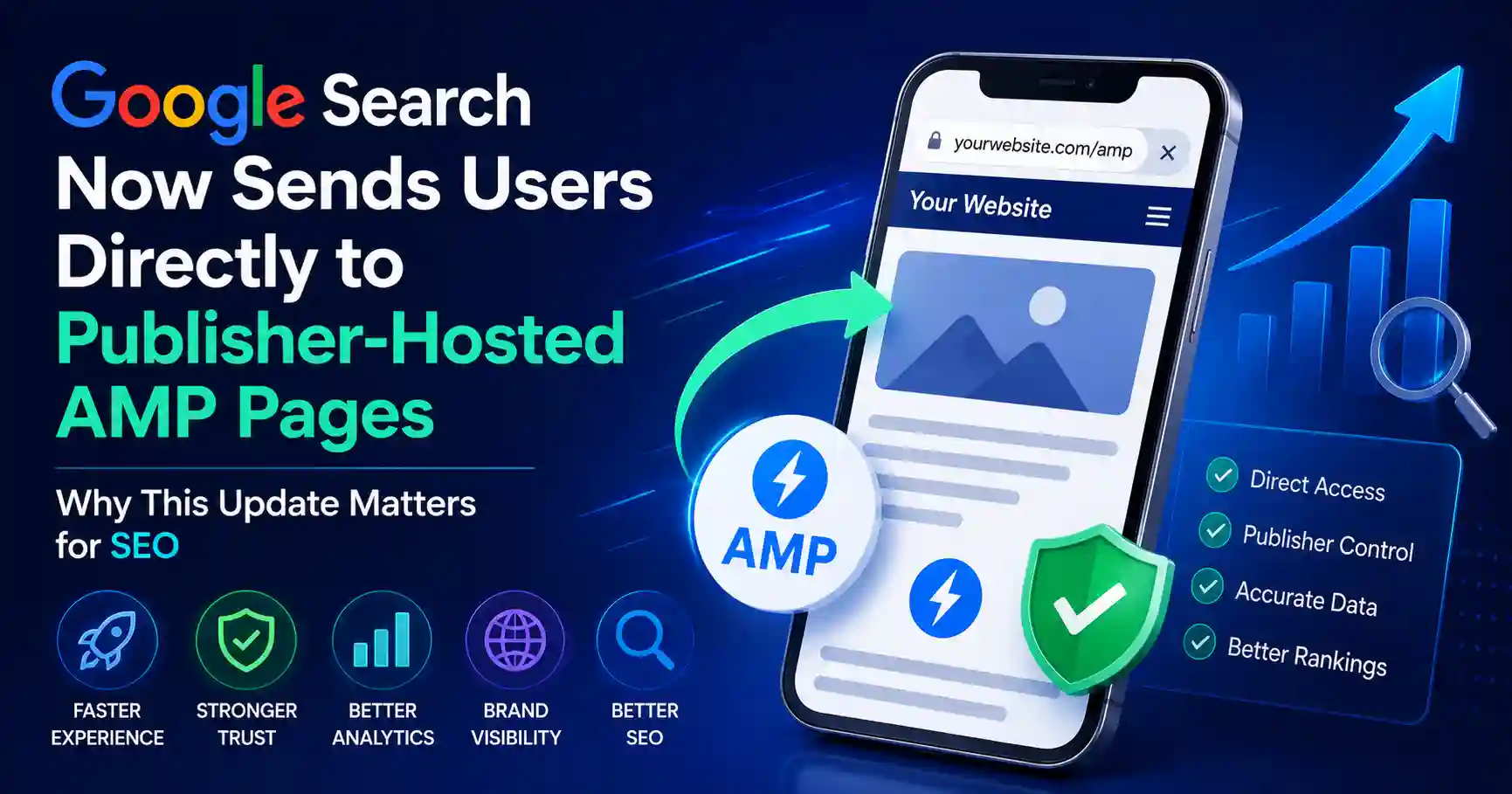
Google’s most recent update adjusts this by sending users directly to publisher-hosted AMP pages, instead of routing them through intermediary versions. It might feel like a small technical change, but the effect is real: it touches website owners, how much users trust what they see, the accuracy of analytics, and even search performance.
If you run a news site, blog, or other content platform, here’s what you should know.
Why is Google sending users directly to publisher-hosted AMP pages?
The internet has changed significantly since AMP was first introduced.
Modern websites have become much faster thanks to improvements in:
- Core Web Vitals
- Browser technology
- Faster hosting
- Image optimization
- Better caching
- Modern JavaScript frameworks
So, as a result, publishers are more and more pushing for visitors to land straight on their own sites, not on the intermediary copies.
This latest change supports that goal.
Visitors now interact a bit more directly with the publisher domain, creating that more consistent browsing experience and also reinforcing brand identity a lot. It feels less fragmented, more connected.
As digital strategist Nina Lopez puts it,
“Trust starts with transparency. When users clearly know whose website they are on, both publishers and readers gain, and it stays beneficial for everyone.”
What benefits does this update provide for publishers?
Sending visitors directly to publisher-hosted AMP pages offers several advantages.
Stronger brand visibility
Visitors remain on the publisher’s own domain throughout the experience.
Better analytics
Traffic measurement gets a bit more accurate, since people engage directly with the publisher website, not some middle system.
Improved user trust
Consistent URLs help users recognize trusted brands.
Greater control
Publishers end up with better handle over page changes, branding, and the overall user experience.
These upgrades can look a little subtle, yet they make it easier how publishers steer their digital presence, day to day.
Does this update affect SEO performance?
Not directly.
Google has repeatedly stated that AMP itself is not a ranking factor.
Instead, search performance depends on overall page quality, including:
- Helpful content
- Page experience
- Mobile usability
- Site speed
- Technical SEO
- User satisfaction
This update doesnt automatically improve rankings , but it does make the overall experience cleaner for users , and also for publishers.
Businesses focused on improving website performance should also read Why Proving Technical SEO ROI Is So Difficult, which explains how technical improvements contribute to long-term search growth.
Should publishers still use AMP in 2026?
The answer depends on your website.
Many modern websites achieve excellent performance without AMP by focusing on:
- Fast hosting
- Optimized images
- Efficient caching
- Responsive design
- Core Web Vitals optimization
However, publishers that already use AMP can still grab the advantage of rapid phone experiences while keeping those direct ties with visitors.
Instead of wondering if AMP is mandatory, publishers should ask whether their full mobile experience, meets what people expect.
What role does technical SEO play after this update?
Technical SEO remains essential.
Regardless of AMP, websites should prioritize:
Crawlability
Ensure search engines discover important pages.
Indexation
Help valuable content appear in search results.
Structured data
Provide clear information for search engines.
Internal linking
Strengthen relationships between related pages.
Mobile performance
Deliver fast, reliable experiences across devices.
Organizations modernizing their optimization strategy should also explore The New SEO Stack: What Replaces Your Old Toolset, which explains how technical SEO continues evolving alongside AI-powered search.
How should publishers prepare for the future?
Google’s latest update reinforces a broader trend.
Publishers should invest in:
- High-quality original content
- Fast websites
- Strong technical foundations
- Consistent branding
- Helpful user experiences
- Reliable analytics
Instead of relying on individual technologies, long-term success depends on building websites users trust and search engines understand.
For official guidance on creating search-friendly websites, Google Search Central Documentation remains one of the most valuable resources available.
Final Thoughts
Google sending users straight to publisher-hosted AMP pages might look like a minor technical shift but in practice it is a real move toward something more open, and yes more publisher friendly in search.
For publishers, the priority still needs to be delivering fast helpful and trustworthy information, while also keeping solid technical SEO basics in place.
Regardless if your site uses AMP or not, the rules for strong search results stay the same: produce meaningful content, improve the user experience, and reinforce long term credibility with your readers.
So how are you getting your website ready for the future of mobile search? Drop your thoughts in the comments below.
FAQs
What are publisher-hosted AMP pages?
They are AMP pages served right from a publisher’s own website, not from some intermediary version. This gives publishers more control over branding, and also over analytics, in a way that feels more direct.
Does this update improve SEO rankings?
No. The update itself is not a ranking factor, but it can improve user experience and data accuracy.
Is AMP still required for Google Search?
No. Google no longer requires AMP for most search features. Fast, mobile-friendly pages remain the priority.
Should publishers remove AMP?
Not necessarily. If AMP continues providing a good experience and fits your technical strategy, it can still be useful.
What matters most for SEO today?
Helpful content, technical SEO, Core Web Vitals , mobile usability, structured data , and a strong user experience still remain the most important long-term factors, even when things change around.

Kumar Swamy is the CEO of Itech Manthra Pvt Ltd and a dedicated Article Writer and SEO Specialist. With a wealth of experience in crafting high-quality content, he focuses on technology, business, and current events, ensuring that readers receive timely and relevant insights.
As a technical SEO expert, Kumar Swamy employs effective strategies to optimize websites for search engines, boosting visibility and performance. Passionate about sharing knowledge, he aims to empower audiences with informative and engaging articles.
Connect with Kumar Swamy to explore the evolving landscape of content creation!