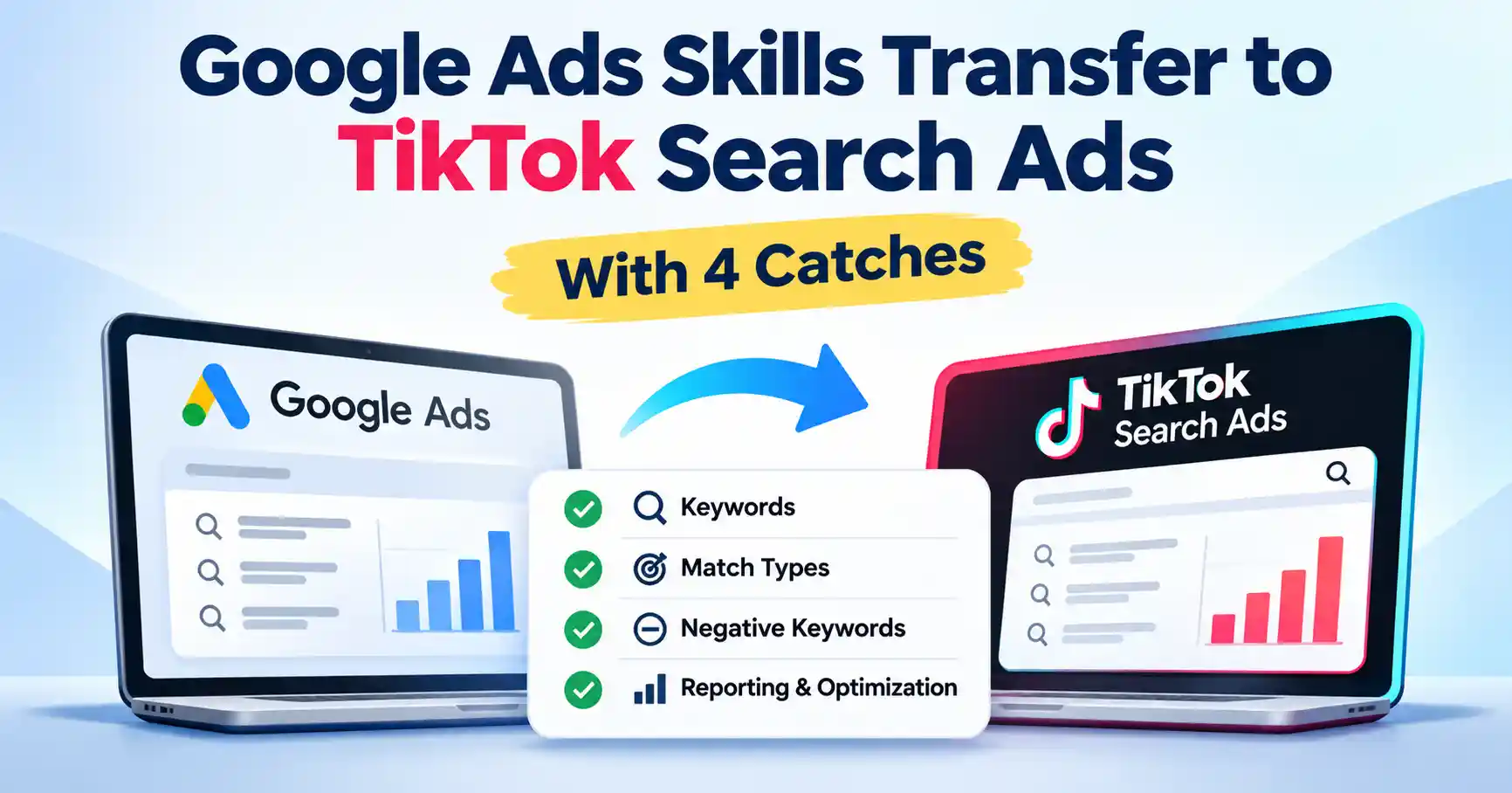
If you’ve managed Google Ads campaigns for years, TikTok Search Ads may feel familiar. The platform supports keywords, match types, negative keywords, search term reports, and even keyword level bidding in certain campaign setups.
But familiarity doesn’t guarantee success. Some features work differently on TikTok, others come with specific restrictions, and reporting limitations can affect how you evaluate campaign performance.
The upside? Experienced PPC marketers don’t have to start from scratch. They can bring their existing skills to TikTok Search Ads, provided they understand which controls transfer, where the differences lie, and how the platform changes the optimization process.
Can Google Ads Skills Transfer to TikTok Search Ads?
Yes. TikTok’s dedicated Search Ads Campaign product uses several concepts that Google Ads advertisers already know.
TikTok introduced its keyword based Search Ads Campaign product in the US in September 2024. Unlike Automatic Search Placement, which automatically matches ads to relevant search queries, Search Ads Campaign gives advertisers more direct control over keyword selection and targeting.
Understanding the difference between these two products is important. If you want greater control over which searches trigger your ads, you’ll need to work with the dedicated Search Ads Campaign setup.
Which Google Ads skills work on TikTok?
Several established PPC skills remain relevant:
- Keyword research and search intent analysis
- Broad, phrase, and exact match targeting
- Negative keyword management
- Search term report analysis
- Campaign optimization and budget management
- Ad relevance and conversion tracking
For example, a business promoting premium skincare products could use proven Google Ads keyword themes such as “best moisturizer for dry skin” and “sensitive skin skincare” as a starting point for TikTok Search Ads.
The key distinction is that these keywords are starting points, not guaranteed winners. Search behavior, creative relevance, and campaign performance still need to be tested on TikTok.
Which Google Ads Skills Transfer to TikTok Search Ads?
1. Keyword research and match types
Both platforms support broad, phrase, and exact match keywords. TikTok also recommends beginning with broader targeting and refining keyword selections as campaign performance becomes clearer.
Google Ads managers already understand how match types influence reach and targeting precision, so the underlying approach should feel familiar.
However, keyword performance doesn’t automatically translate between platforms. Someone searching Google for a product comparison may behave differently from someone discovering product related content through TikTok Search.
Practical tip: Start with keywords that have demonstrated commercial intent in Google Ads. Group them into closely related themes, then use TikTok’s Keyword Suggestion Tool to identify additional opportunities before launching.
2. Negative keywords and search term reviews
Negative keyword management is another skill that carries over.
TikTok supports broad, phrase, and exact negative keywords. Its Search Terms report also helps advertisers identify irrelevant queries and determine which searches should be excluded.
Consider a business advertising professional SEO software. Searches such as “free SEO tools,” “SEO jobs,” or “SEO course” may attract people who aren’t looking to purchase software.
Reviewing these queries and excluding unsuitable traffic is a familiar task for Google Ads managers.
There’s one important difference, though: TikTok negative keywords don’t automatically account for singulars, plurals, misspellings, or synonyms. Some variations may need to be added separately.
That makes it worth reviewing your existing negative keyword lists before importing them into TikTok.
3. Search term reporting and optimization
Google Ads managers are already familiar with examining search terms to understand which queries trigger their advertisements.
TikTok offers a Search Terms report for keyword based campaigns. Advertisers can use it to review matched queries, identify relevant searches, and find opportunities for keyword expansion or exclusion.
The optimization process is straightforward:
- Review search queries regularly.
- Identify relevant terms generating engagement.
- Add suitable terms to your targeting strategy.
- Exclude searches that don’t align with your campaign.
- Monitor performance after making changes.
The underlying skill transfers directly. The difference is that TikTok’s reporting interface and available data aren’t identical to Google Ads.
Google Ads vs TikTok Search Ads: Key Differences
The terminology may look familiar, but the two platforms aren’t interchangeable.
| Feature | Google Ads | TikTok Search Ads |
| Keyword targeting | Search keywords | Dedicated keyword based campaigns |
| Match types | Broad, phrase, exact | Broad, phrase, exact |
| Negative keywords | Broad, phrase, exact | Broad, phrase, exact |
| Keyword level bidding | Available in relevant Search setups | Traffic objective with Cost Cap |
| Automated targeting | Multiple AI driven options | Automated Keywords available |
| Search visibility | Impression Share metrics | Impression Share and Top 1 Impression Share |
| Creative | Text ads and other formats | Video and image carousel assets |
TikTok supports several campaign objectives, including Traffic, Sales, Lead Generation, and App Promotion. Feature availability, however, can vary by market and account.
The 4 Catches Google Ads Managers Should Know
The transferable skills give Google Ads advertisers a useful advantage. These four differences are where they need to be more careful.
Catch 1: Negative keywords don’t behave exactly the same
Google Ads advertisers often reuse existing negative keyword lists when launching campaigns on another platform. It’s a convenient way to get started, but it can leave gaps in TikTok targeting.
TikTok’s negative keywords don’t automatically cover plural forms, misspellings, or synonyms. If you’re excluding “free SEO tool,” you may also need to account for searches such as “free SEO tools” and relevant spelling variations.
What to do: Review imported negative keyword lists before launching. Add important variations manually and check the Search Terms report after your campaign starts running.
Catch 2: Keyword level bidding comes with restrictions
Advertisers accustomed to adjusting bids across different levels in Google Ads may expect similar flexibility on TikTok.
TikTok supports keyword level bidding only for Search Ads Campaigns using the Traffic objective and Cost Cap bidding. Keyword bids are applied within the ad group, and the feature isn’t available across every campaign objective.
For example, a SaaS advertiser might want to bid more aggressively on “CRM software pricing” than on “CRM software features.”
That strategy can work within TikTok’s supported Traffic setup. But if the campaign is optimized for Web Conversion, keyword level bidding shouldn’t be assumed to remain available.
What to do: Choose your campaign objective based on the business goal first. Treat keyword level bidding as a campaign specific control rather than a feature available everywhere on TikTok.
Catch 3: Automated Keywords can expand targeting
TikTok’s Automated Keywords feature can generate additional keywords based on ad creatives and product information. It’s designed to complement manually selected keywords rather than replace them.
Here’s a detail that’s easy to overlook: Automated Keywords are enabled by default for SMB accounts, while Key Accounts must enable the feature.
TikTok also states that advertisers aren’t notified whenever new automated keywords are added.
As a result, campaign targeting can expand beyond the keywords you originally selected.
What to do: Check the Automated Keywords setting during campaign setup. Review search terms regularly, monitor automated keyword performance, and add exclusions if the expansion starts attracting irrelevant traffic.
Catch 4: Reporting has visibility limitations
Google Ads managers are accustomed to examining campaign, keyword, and search term data in considerable detail.
TikTok provides reporting across campaign related levels, including ad groups, keywords, and search terms. However, several limitations affect how much information advertisers can access.
According to TikTok’s reporting documentation:
- Search Ads metrics have approximately eight hours of reporting latency.
- Low conversion keywords and search terms may not be individually disclosed.
- Conversion totals may therefore differ from the sum of visible keyword rows.
- Search terms and keywords can’t be broken down by individual creative in reporting.
These limitations become important when comparing TikTok with Google Ads.
If one platform provides more granular conversion information than the other, comparing keyword performance directly may lead to misleading conclusions.
What to do: Use consistent reporting windows and business KPIs when evaluating campaigns. Make campaign and ad group performance your primary reference points, and treat keyword reports as diagnostic data rather than complete accounting records.
TikTok also offers Impression Share and Top 1 Impression Share metrics for eligible Search Ads campaigns. These can help advertisers assess visibility, although availability varies by account and campaign.
How to Move Google Ads Keywords to TikTok Search Ads
The easiest way to get started is to use your existing Google Ads data without copying the entire campaign structure.
Step 1: Identify proven Google Ads keywords
Export keywords that have generated meaningful conversions or qualified traffic.
Focus on commercial and transactional searches rather than importing every keyword from your account.
For example:
- “best project management software”
- “project management software pricing”
- “project management software for teams”
These keywords offer a reasonable starting point for testing TikTok Search Ads.
Step 2: Group keywords by search intent
Organize your keywords into ad groups built around closely related themes.
Avoid putting unrelated keywords into a single ad group simply because they belong to the same product category. Your creative needs to address the reason someone searched in the first place.
TikTok recommends organizing keywords thematically and maintaining relevance between keywords and advertising creatives.
Step 3: Adapt creatives to TikTok searches
This is where Google Ads experience alone won’t be enough.
TikTok Search Ads support video and image carousel creatives. An advertiser targeting “best CRM for small business,” for instance, could create a short video demonstrating how a CRM solves a common business problem.
The creative should answer the searcher’s question quickly. Simply repeating the keyword in the ad isn’t enough to make it relevant.
Step 4: Set budgets, bids, and exclusions
Choose the campaign objective that aligns with your business goal, configure the appropriate bidding strategy, and review negative keywords before launching.
Start with a manageable budget and monitor delivery, search terms, clicks, and conversions.
Step 5: Review and optimize
Avoid judging campaign performance after just a handful of clicks.
TikTok’s optimization guidance recommends allowing campaigns time to calibrate and avoiding major changes during the initial learning period.
Use your Google Ads experience to establish a structured review process, but let TikTok’s own campaign data guide your optimization decisions.
Is TikTok Search Ads Worth Testing for Google Ads Advertisers?
For businesses whose audiences actively search for products, services, tutorials, or recommendations on TikTok, Search Ads can provide an additional acquisition channel.
That doesn’t mean TikTok should automatically replace Google Ads.
Google captures demand through its established search experience. TikTok combines search with content discovery, creating different opportunities for advertisers.
A practical approach is to test TikTok Search Ads alongside existing campaigns, evaluate traffic quality, and compare the cost of acquiring meaningful business outcomes.
For a broader perspective on changes in paid advertising, read iTechManthra’s guide to emerging PPC trends and advertising strategies.
FAQ’s
Yes. Google Ads keywords can provide a useful starting point for TikTok Search Ads. However, keyword performance, search behavior, and targeting need to be validated independently on TikTok.
Yes. TikTok’s dedicated Search Ads Campaign product supports broad, phrase, and exact match keywords. Advertisers can adjust match types as campaigns are optimized.
Yes. TikTok supports broad, phrase, and exact negative keywords. However, plural forms, misspellings, and synonyms may require separate exclusions.
Yes, but there are restrictions. Keyword level bidding is supported for TikTok Search Ads Campaigns using the Traffic objective and Cost Cap bidding.
Conclusion
Google Ads skills transfer to TikTok Search Ads more readily than many advertisers might expect.
Keyword research, search intent analysis, negative keyword management, and search term optimization remain valuable. Experienced PPC managers already know how to build campaigns around user intent and use search data to improve performance.
The challenge is understanding where familiar controls behave differently.
Negative keyword matching, keyword level bidding restrictions, Automated Keywords, and reporting limitations all deserve attention before launching a campaign.
If you’re planning to expand into TikTok Search Ads, start with proven Google Ads keywords, adapt your creatives to TikTok’s search experience, and evaluate results using realistic business KPIs.
Successful cross platform advertising isn’t about copying campaigns. It’s about transferring your expertise while adapting to how each platform works.

Kumar Swamy is the CEO of Itech Manthra Pvt Ltd and a dedicated Article Writer and SEO Specialist. With a wealth of experience in crafting high-quality content, he focuses on technology, business, and current events, ensuring that readers receive timely and relevant insights.
As a technical SEO expert, Kumar Swamy employs effective strategies to optimize websites for search engines, boosting visibility and performance. Passionate about sharing knowledge, he aims to empower audiences with informative and engaging articles.
Connect with Kumar Swamy to explore the evolving landscape of content creation!