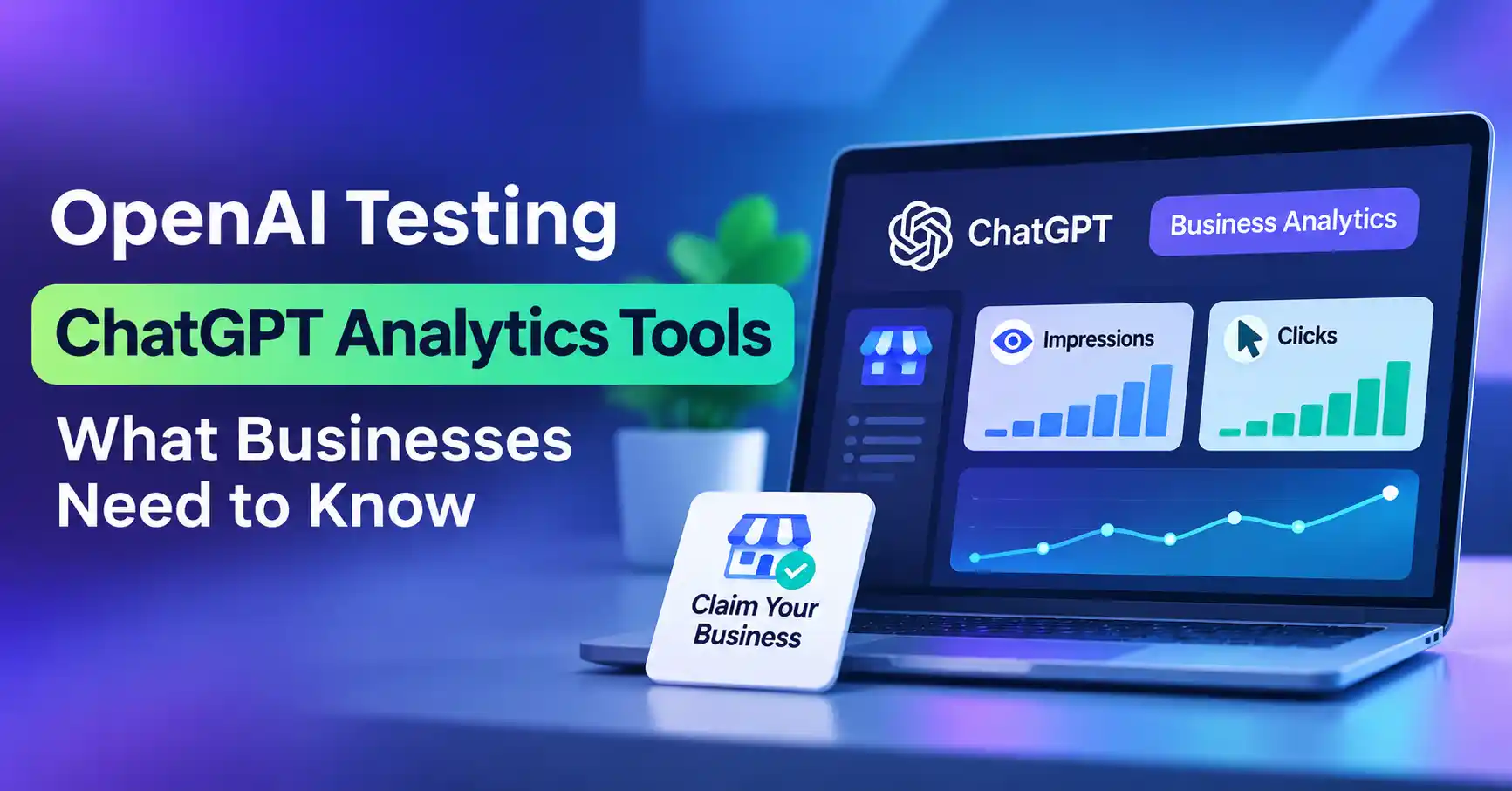
Businesses may soon have a clearer picture of how they appear in ChatGPT responses. OpenAI is reportedly testing business analytics tools that could help companies track brand appearances and the clicks those mentions generate.
This development could make AI visibility easier to measure. Currently, marketers often depend on manual prompt testing, third party tracking tools, and website referral data to understand whether ChatGPT is mentioning their brands.
According to Search Engine Land, the experimental feature could include daily impression and click metrics, along with options to claim business profiles and manage company information. OpenAI, however, has not officially announced a public launch.
Here’s what the reported ChatGPT analytics feature could mean for businesses, marketers, and SEO professionals.
What Is OpenAI Testing With Its New ChatGPT Business Tools?
OpenAI appears to be developing a business facing platform that could help companies manage their presence within ChatGPT.
The feature surfaced on November 6, 2026, when Marketplace Pulse founder Juozas Kaziukėnas shared a screenshot displaying a “Claim your business in ChatGPT” message. Search Engine Land and Search Engine Roundtable subsequently reported details about the experimental functionality.
The reported “Claim your business in ChatGPT” feature
The reported interface points to three potential capabilities:
- Track how a business appears in ChatGPT responses.
- Maintain product information and business details.
- Help customers make decisions through a business agent.
Businesses may need to verify ownership before accessing these features. Connecting a Shopify store was reportedly one example of a verification method.
These capabilities remain experimental and should not be mistaken for a fully launched business platform.
Why the feature matters
For marketers, the biggest opportunity is access to first party visibility data.
Rather than guessing whether ChatGPT is recommending a company, businesses could potentially examine impression and click metrics directly from the platform.
That would make AI visibility reporting more useful when evaluating content strategies, brand awareness, and website traffic.
What Could ChatGPT Analytics Show Businesses?
The reported ChatGPT business tools appear to focus on two primary performance metrics: impressions and clicks.
Track brand impressions within ChatGPT
Impressions would indicate how often a business appears in ChatGPT responses.
For example, a software company might appear when someone asks ChatGPT to recommend project management tools.
Tracking impressions could help the company understand whether its brand is appearing more frequently in AI generated answers.
However, an impression wouldn’t necessarily mean someone searched specifically for that brand. It could simply reflect the company appearing in a recommendation or response.
Measure clicks to business websites
The second reported metric involves clicks on links leading from ChatGPT to business websites. These figures would reportedly appear in daily charts.
This distinction matters because visibility and traffic aren’t the same thing.
A brand might appear frequently in ChatGPT responses without generating many website visits. Another business could receive fewer mentions but attract visitors who are genuinely interested in its products.
Tracking both metrics would help marketers understand the difference between exposure and actual traffic.
Update product information and business details
The reported business interface may also allow companies to maintain their product information and business details.
This could be particularly useful for ecommerce businesses.
Accurate product descriptions, pricing, availability, and company information can reduce inconsistencies across the information customers encounter.
However, updating a business profile wouldn’t automatically guarantee that ChatGPT recommends the company.
Use business agents to answer customer questions
Another reported capability involves business agents that can answer customer questions using information supplied by the company.
For instance, someone evaluating a SaaS product might ask about integrations, pricing options, or supported features.
A business agent could potentially respond using approved company information.
This also means businesses would need to keep their information accurate and useful rather than treating profile management as a one time task.
How ChatGPT Analytics Could Work for Businesses
Consider a SaaS company publishing comparison articles, integration guides, and product documentation.
Its marketing team wants to understand whether these resources are helping the brand appear in ChatGPT recommendations.
If the reported analytics tool becomes available, the company could potentially review daily impressions and clicks.
A simplified example:
| Metric | What it could indicate |
| Impressions increase | More appearances in ChatGPT responses |
| Clicks increase | More visits generated through ChatGPT links |
| Impressions rise, clicks remain flat | Visibility is growing without a similar increase in traffic |
| Clicks rise, conversions remain flat | Visitors may not be reaching relevant conversion opportunities |
These patterns can help identify areas worth investigating, but they don’t automatically explain performance changes.
Increasing impressions, for instance, could reflect changes in ChatGPT responses, demand for a particular topic, or broader exposure across relevant questions.
The dashboard alone may not reveal which explanation is responsible.
ChatGPT Analytics vs. Google Search Console
The reported development has similarities to Google Search Console, although the two platforms would measure different discovery environments.
| Capability | Google Search Console | Reported ChatGPT analytics |
| Search visibility | Search impressions | ChatGPT answer impressions |
| Website clicks | Search clicks | Clicks from ChatGPT |
| Performance trends | Available | Reportedly available |
| Page level insights | Available | Not confirmed |
| Query or prompt insights | Search queries in supported reports | Reportedly unavailable |
| Competitor benchmarks | Not a standard feature | Reportedly unavailable |
Google introduced AI Search performance insights in Search Console in 2026, including impressions and information about pages appearing in AI responses. These reports cover supported Google AI Search experiences, not ChatGPT.
For more details, read our guide to Google Search Console AI performance reports.
The practical takeaway is that Google Search Console and ChatGPT analytics would complement each other rather than replace one another.
How ChatGPT Analytics Could Change GEO and AI SEO
Generative Engine Optimization (GEO) focuses on improving how brands and content appear in AI generated responses.
Measuring GEO performance has traditionally been challenging. Marketers can test prompts manually, monitor citations, or use third party tools to track AI visibility. But these approaches don’t necessarily provide the same information as a platform’s own analytics.
The reported ChatGPT analytics feature could help address part of that gap.
Measuring brand visibility in AI generated answers
If OpenAI provides first party impression data, marketers could track how frequently their businesses appear in ChatGPT responses over time.
That could be useful when evaluating:
- Product comparison content
- Educational articles
- Brand positioning campaigns
- Product documentation
- Content targeting specific customer problems
For example, a company publishing a detailed guide to CRM integrations might want to understand whether its brand becomes more visible when users ask ChatGPT about integration solutions.
Understanding whether GEO campaigns generate clicks
Visibility is only one part of the picture.
A useful GEO measurement strategy should connect three stages:
- Visibility: Does the brand appear in relevant AI responses?
- Traffic: Do those appearances generate website visits?
- Business outcomes: Do visitors subscribe, purchase, or complete another meaningful action?
The third stage matters most when evaluating business impact.
More ChatGPT impressions might indicate greater exposure, but they don’t necessarily translate into leads or revenue.
Businesses should combine visibility information with analytics platforms such as Google Analytics and their CRM systems to understand what happens after visitors arrive.
For additional context, see our article on GEO and AI search visibility.
The limitations of AI visibility metrics
The reported analytics feature also has limitations.
According to information shared by Kaziukėnas, the dashboard doesn’t include prompt data, user information, competitor benchmarks, or rankings.
That means marketers might see an increase in impressions without knowing exactly which questions generated those appearances.
Performance metrics can show what happened, but they don’t always explain why.
How Businesses Can Prepare for ChatGPT Analytics
Businesses don’t need to wait for an analytics dashboard to improve their AI visibility measurement.
Several practical steps can help them prepare.
1. Improve business and product information accuracy
Start by reviewing the information customers can find about your company.
Make sure your website clearly explains:
- What your business offers
- Who your products are designed for
- Which problems your solutions address
- Pricing and product limitations
- Important features and integrations
For ecommerce businesses, product descriptions, availability, and specifications should remain consistent wherever they appear.
2. Strengthen website content and technical SEO
AI visibility shouldn’t become a reason to abandon traditional SEO.
Google Search Central explains that foundational SEO practices remain relevant to AI Search features. Websites should prioritize crawlability, helpful content, clear technical structure, and reliable information instead of chasing artificial optimization techniques.
Businesses should focus on:
- Original content that answers customer questions
- Clear product and service pages
- Useful comparison articles
- Accurate technical documentation
- Relevant internal linking
- Accessible, crawlable website content
These improvements support discoverability across multiple channels, not just ChatGPT.
3. Establish an AI visibility tracking baseline
Start monitoring how your brand appears in relevant AI responses.
A simple tracking sheet can include:
| Tracking area | What to record |
| Prompt | The customer question being tested |
| Brand appearance | Whether your business is mentioned |
| Competitors | Other companies appearing in the response |
| Sources | Websites or pages cited |
| Date | When the observation was recorded |
Use consistent prompts and repeat tests periodically.
Manual prompt testing, however, isn’t equivalent to representative first party analytics. Responses can change depending on wording, context, and the availability of information.
4. Connect AI visibility with website conversions
Track traffic arriving from ChatGPT using website analytics.
Review:
- Referral traffic
- Landing pages
- Engagement
- Lead submissions
- Purchases
- Conversion paths
This helps businesses determine whether AI generated recommendations are bringing visitors who actually matter to their business.
What ChatGPT Analytics May Not Tell You
Even if OpenAI launches the reported dashboard, businesses shouldn’t treat it as a complete GEO measurement solution.
Impressions and clicks alone won’t necessarily reveal:
- Which prompts generated a brand mention
- Why a competitor appeared instead
- Whether a particular content page influenced an answer
- How users evaluated competing products
- Whether visibility generated brand awareness without a click
Answering these questions may require additional monitoring tools, qualitative research, and website analytics.
The most useful approach is to combine first party metrics with independent analysis rather than relying on a single dashboard.
FAQ’s
OpenAI is reportedly testing business analytics features, but it hasn’t officially announced a public launch. The reported dashboard could provide impression and click information for verified businesses.
The experimental feature reportedly measures how often businesses appear in ChatGPT responses. However, detailed prompt level information and competitor rankings aren’t included in the reported functionality.
The concept is similar because both platforms help businesses understand visibility and website traffic. However, Google Search Console measures performance in Google Search, while the reported ChatGPT analytics would focus on appearances and clicks within ChatGPT.
Businesses can manually test relevant prompts, monitor AI generated citations, use third party AI visibility tracking tools, and analyze referral traffic through website analytics platforms.
These methods provide useful insights, although they aren’t equivalent to first party ChatGPT impression data.
Conclusion
OpenAI’s reported ChatGPT analytics development highlights an important shift in digital marketing: businesses increasingly want to understand how AI platforms influence brand discovery.
If the feature becomes available, first party impression and click data could make ChatGPT visibility easier to measure. Marketers would have a more direct way to connect AI generated recommendations with website traffic.
But analytics alone won’t improve visibility.
Businesses still need useful content, accurate product information, strong technical SEO, and a clear understanding of their customers’ questions.
The smartest approach is to treat ChatGPT analytics as another measurement channel, not a replacement for SEO or website analytics.

Kumar Swamy is the CEO of Itech Manthra Pvt Ltd and a dedicated Article Writer and SEO Specialist. With a wealth of experience in crafting high-quality content, he focuses on technology, business, and current events, ensuring that readers receive timely and relevant insights.
As a technical SEO expert, Kumar Swamy employs effective strategies to optimize websites for search engines, boosting visibility and performance. Passionate about sharing knowledge, he aims to empower audiences with informative and engaging articles.
Connect with Kumar Swamy to explore the evolving landscape of content creation!