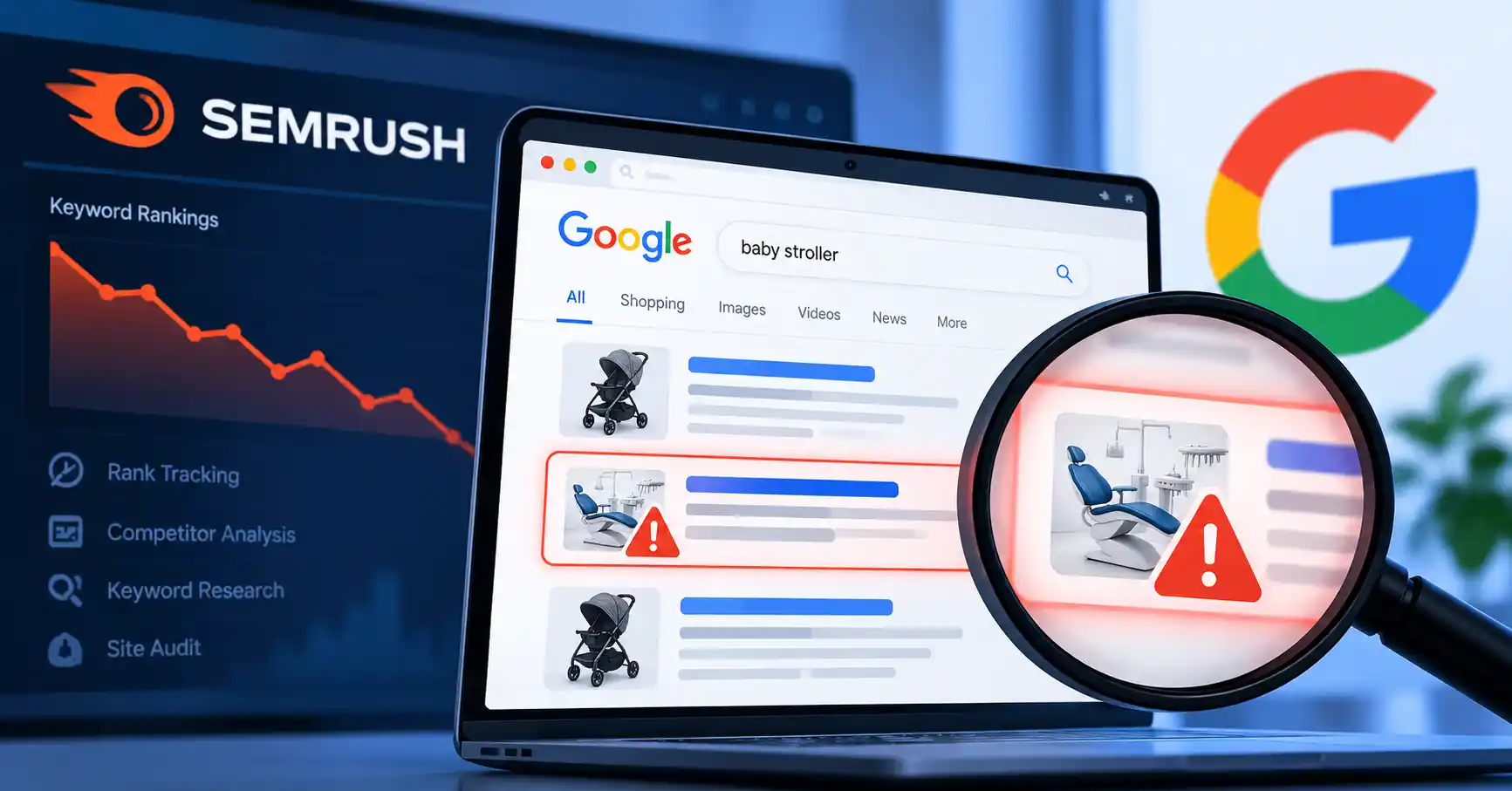
Google displays search engine results pages (SERPs) in response to user queries. SEO tools collect and analyze these results to track keyword positions, monitor competitors, and measure search visibility.
Semrush uses the term “poisoned SERPs” to describe cases where automated Google searches return results that differ from what typical users might see.
In its October 27, 2026, announcement, Semrush identified two types of questionable results:
- Clearly irrelevant results: Pages that have little or no connection to the search query.
- Partially misleading results: Results that initially look relevant but include loosely related or irrelevant listings further down the page.
Semrush illustrated the problem with a Brazilian search for a specific baby stroller model that returned a dental supply store’s equipment page. Both results shared the Portuguese word “carrinho,” which can mean a cart or trolley.
The example highlights a potential problem with keyword matching: a shared word doesn’t necessarily mean a result meets the searcher’s intent.
Why Are Automated SEO Tools Affected?
Rank trackers collect search results for particular keywords, locations, devices, and languages. They then use that information to estimate where websites appear in Google.
When the collected results are inaccurate, the resulting ranking reports can be misleading.
For example, a tool might report that a page has fallen from position four to position 18. If the change stems from a questionable results page, it may not reflect a genuine ranking loss.
However, poisoned SERPs aren’t the only possible explanation for ranking fluctuations. Algorithm updates, increased competition, location differences, and changes to search result features can also affect reported positions.
What Did Semrush Confirm About Poisoned SERPs?
In its October 27 update, Semrush described the problem as an industry wide issue affecting search data providers. The company said it identifies clearly invalid results, excludes them from its database, adjusts its data sources, and introduces additional validation checks to trigger new data collection when results appear suspicious.
Semrush also acknowledged that some questionable results may still slip through and encouraged customers to report unexpected ranking changes.
The announcement didn’t provide an overall percentage of affected keywords. It’s therefore too early to assume that every Semrush ranking or every SEO platform is affected to the same extent.
Read the official Semrush update on poisoned SERPs for the company’s explanation.
How Does This Compare With Other SEO Tools?
Semrush isn’t the only provider addressing the issue. An October 2026 report from Search Engine Roundtable documented responses from several rank tracking companies.
Ahrefs, for example, reported that the proportion of affected results varied by provider, citing a range of 5% to 20%. This is a reported observation from Ahrefs, not a universal estimate covering every platform or keyword.
The distinction is important because SEO providers use different data collection methods, validation systems, and datasets. Their reported figures may not be directly comparable.
Google hasn’t publicly confirmed the underlying explanation for the behavior described by Semrush. Some industry observers have suggested that restrictions on large scale automated data collection could be involved, but this remains an interpretation rather than a confirmed explanation from Google.
For more context, read Search Engine Roundtable’s report on third party Google rank tracking.
How Poisoned Google Results Can Affect SEO Reporting
Inaccurate search results can disrupt several parts of an SEO workflow.
Keyword tracking: Reports may show unexpected ranking drops or gains that don’t match the results users typically see.
Competitor analysis: Competitors may appear to gain visibility because the collected results have changed, rather than because their content has improved.
SEO performance reporting: Agencies may need to investigate unusual fluctuations or revise reports when the underlying data hasn’t been properly validated.
Content decisions: Teams might rewrite useful articles, change titles, or redirect pages because they believe their rankings have collapsed.
Consider a hypothetical scenario. An SEO manager sees a client’s product page fall from position six to position 20 for a commercial keyword. Before changing the page, the manager checks Google Search Console and finds that clicks and impressions remain broadly consistent with the previous period.
That discrepancy doesn’t automatically mean the rank tracker is wrong. Search Console measures performance differently, so the figures won’t necessarily match. Still, the conflicting signals give the manager a good reason to investigate before rewriting the page.
How to Verify Whether Your Google Rankings Have Actually Dropped
When ranking data looks suspicious, follow these steps before making significant SEO changes.
Step 1: Check Google Search Console
Open the Performance report and compare the affected period with a comparable previous period.
Focus on four metrics:
- Clicks: Has traffic from Google declined?
- Impressions: Is your website appearing less often in search results?
- Average position: Is the reported position showing a sustained change?
- Queries and pages: Are the changes concentrated around specific keywords or URLs?
Google recommends examining clicks, impressions, affected pages, and search type when investigating traffic declines. Its official guide to debugging Search traffic drops explains how to investigate further.
Keep in mind that average position is an aggregate metric. It doesn’t guarantee that your page will appear at the same position for every searcher.
Step 2: Look for Persistent Patterns
Avoid drawing conclusions from a single unusual report.
Check whether the change continues over several days or affects multiple keywords. Compare similar weekdays or reporting periods where possible, and consider recent content changes and seasonal demand.
One unexpected reading warrants investigation. A sustained decline supported by several signals calls for a more thorough SEO audit.
Step 3: Compare Independent Data Sources
If possible, check another rank tracker. Compare the same keyword, country, device, and approximate location to make the results as consistent as possible.
When tools disagree, investigate their collection methods and reporting dates. Agreement between providers can increase confidence, but it doesn’t guarantee accuracy, particularly when their data sources are similar.
Step 4: Inspect the Affected Pages
If Search Console also indicates a genuine decline, investigate the relevant pages for indexing problems, technical errors, outdated information, changing search intent, and stronger competitor content.
Our guide to Google’s top ranking factors offers additional context on relevance, content quality, authority, and technical SEO.
Step 5: Contact Your SEO Tool Provider
If the discrepancy remains unexplained, contact your provider with the affected keywords, URLs, dates, locations, and screenshots.
Providing specific examples gives the support team a clearer starting point for investigating potentially inaccurate data.
What Should Bloggers and Businesses Do Next?
The answer isn’t to abandon rank tracking. It’s to interpret ranking reports more carefully.
Start by avoiding major SEO changes based on a single ranking alert. Use first party data to assess your website’s search performance, while remembering that no single metric tells the entire story.
Keep a record of unusual fluctuations, including the dates, affected keywords, and changes in clicks or impressions. Over time, these notes can help you distinguish temporary anomalies from sustained performance changes.
Continue investing in content quality and technical SEO, too. If a page loses traffic and independent evidence points to a genuine problem, investigate the cause and address it.
You can also improve your reporting process with our guide on how to improve keyword rankings in Google Search.
Finally, understand the different roles of Search Console and rank trackers. Search Console reports how your verified website performs in Google Search, while third party tools estimate rankings and help compare competitors. Their numbers won’t always match, and that difference alone doesn’t prove either source is wrong.
FAQ’s
The term describes search results that Semrush says can be inaccurate when Google responds to certain automated search requests. Some results may be clearly irrelevant, while others may appear reasonable at first but contain loosely related listings further down the page.
No public confirmation of the underlying explanation has been established in the reporting discussed here. The suggestion that the behavior is connected to restrictions on large scale automated data collection remains an industry interpretation, not a confirmed explanation from Google.
Yes. Rank tracking remains useful for identifying trends and comparing competitors. However, unexpected changes should be validated, particularly when they conflict with other performance data. Semrush says it has introduced additional checks to identify and exclude questionable results.
Search Console provides first party performance data for your website, including clicks, impressions, queries, and average position. It can help you assess whether a reported ranking change corresponds with broader changes in search performance, although it doesn’t reproduce every individual search result.
Conclusion
Semrush’s announcement highlights an important SEO lesson: the usefulness of a report depends on the quality of the data behind it.
Poisoned Google results may explain some unusual rank tracking changes, but they shouldn’t become a catch all explanation for every ranking decline. Genuine losses can still result from increased competition, changing search intent, technical problems, or search algorithm updates.
For bloggers, marketers, and business owners, the practical approach is simple: validate unexpected changes, compare independent signals, and investigate sustained declines before making strategic decisions.

Kumar Swamy is the CEO of Itech Manthra Pvt Ltd and a dedicated Article Writer and SEO Specialist. With a wealth of experience in crafting high-quality content, he focuses on technology, business, and current events, ensuring that readers receive timely and relevant insights.
As a technical SEO expert, Kumar Swamy employs effective strategies to optimize websites for search engines, boosting visibility and performance. Passionate about sharing knowledge, he aims to empower audiences with informative and engaging articles.
Connect with Kumar Swamy to explore the evolving landscape of content creation!