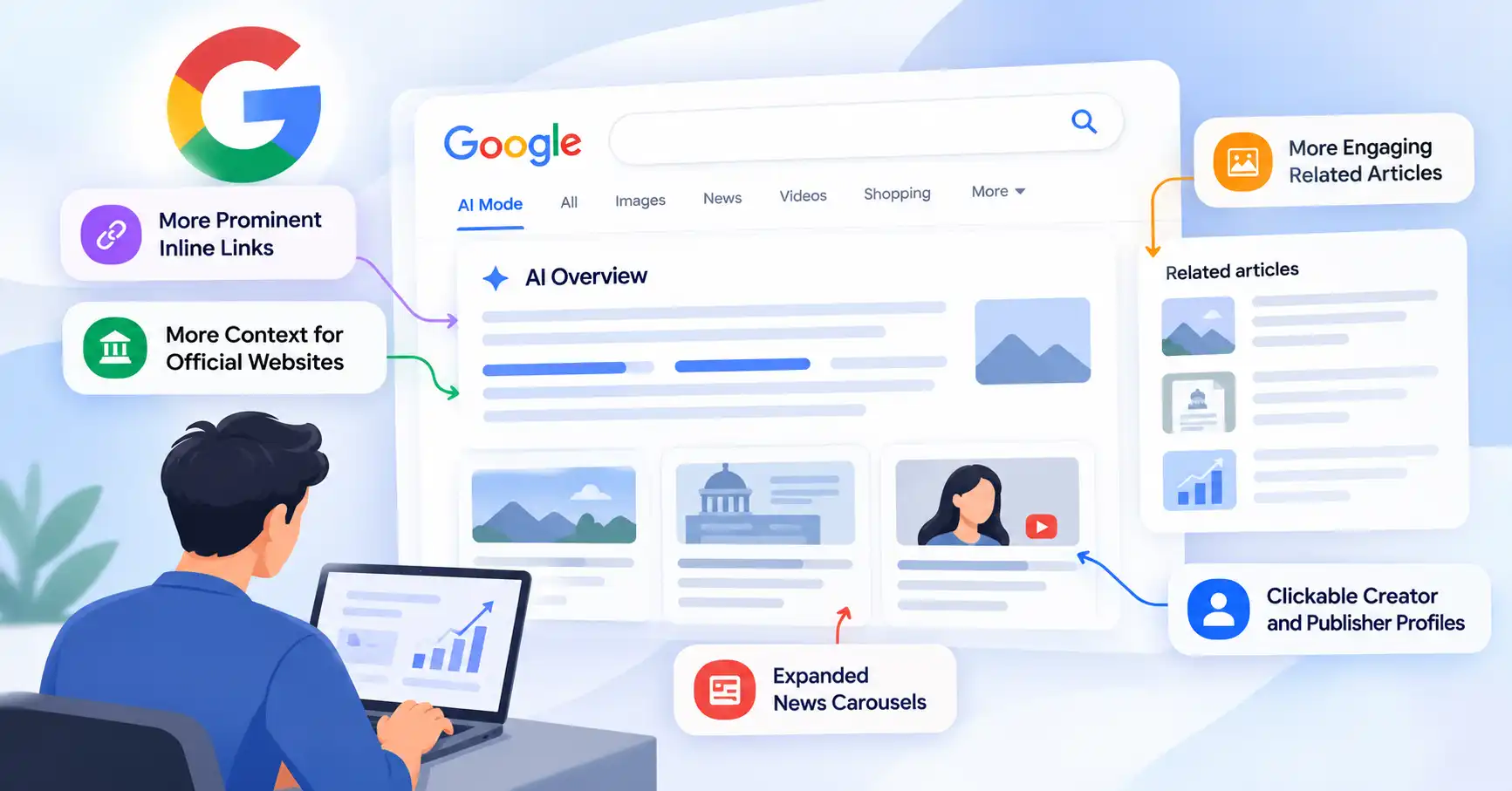
Google is changing how people find and explore websites through AI powered search. On October 15, 2026, the company announced updates to AI Mode and AI Overviews that make links easier to spot, add context to official website links, expand news carousels, improve related article links, and introduce clickable creator and publisher profiles.
For bloggers, content creators, marketers, and business owners, these changes could open up new ways to reach audiences through Google Search. But more prominent links don’t necessarily mean more clicks, leads, or sales.
The real challenge is understanding how these updates affect website visibility and adapting your SEO strategy without losing sight of the fundamentals.
What Has Google Changed in AI Mode and AI Overviews?
Google’s latest AI search updates aim to help people explore original sources instead of relying solely on AI generated answers. The announcement covers five key changes.
1. More Prominent Inline Links
Inline links appear within AI generated responses, giving readers a way to explore supporting information without leaving the context of the answer. Google is making these links appear higher in responses more often, helping users find relevant sources more easily.
For publishers, where a link appears can make a difference. A link placed alongside a useful explanation may attract more attention than one tucked away at the bottom of a lengthy response.
Consider a marketing blog that explains customer acquisition costs. Readers who want to understand the calculations or see practical examples may visit the original article. Whether that happens depends on whether Google surfaces the page and whether the reader wants to explore further.
2. More Context for Official Websites
Google is testing a dedicated section at the top of certain AI responses that highlights official websites and explains why each link is relevant.
This could be useful when people need to complete a task or find information from an authoritative source. They might be looking for a government service, official product documentation, or a company’s support portal.
Businesses should make sure their official pages clearly explain what they offer and make important information easy to find. Still, this update doesn’t guarantee that every business website will appear in these sections.
3. Expanded News Carousels and Preferred Sources
Google is expanding prominent carousels featuring timely articles to more locations and languages. These carousels can also highlight Preferred Sources, helping users find coverage from publishers they choose to follow.
For news publishers and websites covering current events, this creates another potential discovery opportunity.
The practical response is to prioritize accurate reporting, clear publication details, and timely updates when they’re relevant. Publishing more frequently, on its own, won’t guarantee a place in a carousel.
4. More Engaging Links to Related Articles
Google is making links displayed at the end of some AI responses more prominent, using image thumbnails and a more clickable design.
These links can give readers a reason to explore a topic beyond the initial answer.
For content marketers, this is a good reason to build a useful library of related resources. A detailed article about SaaS pricing, for example, could link naturally to separate guides covering usage based pricing, subscription billing, and pricing experiments.
When these resources are organized well, readers can move from a general question to the specific information they need.
5. Clickable Creator and Publisher Profiles
Google has started testing clickable creator and publisher names on video results in AI Mode. These links lead to Search profiles that provide additional context about creators and their work.
The change is particularly relevant to video publishers and creators who want audiences to recognize their work across multiple pieces of content.
Keep author information accurate, maintain consistent branding, and make editorial ownership clear on your website. Creators and publishers can consult Google’s Search profiles documentation for information about availability and setup requirements.
Why Google’s AI Search Updates Matter for SEO
These changes make it easier for users to discover sources within AI search experiences. However, their impact will depend on the industry, query type, content format, and what users are trying to accomplish.
More Links Create Opportunities, Not Guarantees
Prominent links could help websites attract visitors who want more detail than an AI generated answer provides. But some users will find the answer sufficient and leave without visiting another website.
That distinction matters. Publishers shouldn’t assume better link placement will automatically reverse declines in organic traffic.
Original Content Becomes More Important
When AI responses summarize information, articles that simply repeat widely available advice can struggle to stand out from similar resources.
Original research, expert commentary, practical demonstrations, useful comparisons, and firsthand product testing give readers a clearer reason to visit a source.
Google’s official guidance on optimizing websites for generative AI features reinforces the value of unique, useful, people first content alongside established SEO practices.
Visibility Is Only Part of the Picture
Appearing in an AI search experience doesn’t necessarily translate into meaningful business results. A handful of visitors who sign up for a product or request a consultation may be more valuable than a much larger group of unqualified visitors.
For marketers, the goal should be to understand not just whether content gets seen, but whether that visibility leads to relevant visits and conversions.
How Bloggers and Businesses Should Adapt
Google’s AI Mode SEO updates don’t call for an entirely new optimization strategy. Instead, they offer another reason to strengthen the foundations of a useful, discoverable website.
1. Publish Content That Offers Something Different
Before revising an article, ask a simple question: what will readers learn here that they won’t find in a dozen similar posts?
Consider adding original examples, clear explanations, relevant evidence, screenshots where they help, or comparisons built around transparent criteria.
For instance, a SaaS company comparing project management tools could explain how it evaluated each product, identify which use cases each tool suits, and acknowledge the limitations of its comparison.
That level of detail gives readers a practical reason to explore the full article rather than settle for a summary.
2. Strengthen Technical SEO
Your content needs to be accessible to Google’s systems to be eligible for inclusion in AI search experiences.
Check that important pages can be crawled and indexed, internal links help Google discover relevant content, and essential information is available as readable text rather than being confined to inaccessible visual elements.
Use Google Search Console’s URL Inspection tool to investigate indexing issues. Make sure structured data accurately reflects the content people can see on the page.
For a more detailed checklist, read our guide to technical SEO for AI search.
One point worth clarifying: Google says AI Overviews and AI Mode don’t have additional technical eligibility requirements beyond the relevant requirements for Google Search. Special AI markup or an llms.txt file isn’t required for eligibility.
3. Make Author and Publisher Information Clear
Readers should be able to identify who created your content and understand why the source is worth considering.
Use accurate author biographies, relevant credentials, clear editorial policies, and appropriate citations. Keep your brand identity consistent across your website and other publishing channels.
These steps improve transparency and help establish credibility. They aren’t guaranteed ranking signals, nor do they guarantee access to a creator profile.
4. Build Useful Internal Links
Internal links help readers discover related information and help search engines navigate your website.
Link to supporting articles when they answer a natural follow up question. Adding links simply to increase their number doesn’t improve the reader’s experience.
For example, an article about AI search visibility could point readers toward a detailed guide on measuring AI performance. The link should offer a useful next step, not distract from the main discussion.
5. Keep Content Accurate and Current
Update articles when facts, product details, regulations, or recommendations materially change. Changing publication dates or rewriting sections just to make a page look fresh isn’t a useful substitute for meaningful updates.
If you use generative AI for research or drafting, verify important claims and add genuine editorial value. Google’s guidance on generative AI content explains that producing large numbers of pages without adding value may violate its scaled content abuse policy.
How to Measure the Impact of Google’s AI Search Updates
A measurement plan helps you understand whether your website’s performance changes alongside developments in AI search.
Establish a Baseline
Record your current impressions, clicks, click through rate, and relevant landing page traffic before evaluating results. Compare equivalent periods and account for seasonality, content updates, and other factors that might affect performance.
Track AI Search Visibility
Google introduced dedicated Search Generative AI performance reports in Search Console in 2026. Where these reports are available, use them alongside the broader Performance report to examine visibility in AI search experiences.
See Google’s official announcement about Search Generative AI performance reports for further information.
Measure Business Outcomes
Use Google Analytics or your existing analytics platform to track referral sessions, engagement, sign ups, leads, and purchases.
A simple reporting framework can help you connect search performance with business results.
| Metric | What it tells you |
| AI search impressions | How often your content appears in reported AI experiences |
| Organic clicks | Whether search visibility translates into visits |
| Referral sessions | How visitors arrive at and interact with your website |
| Conversions | Whether visits contribute to business goals |
| Landing page engagement | Whether visitors engage with the content they find |
Look at these indicators over time rather than attributing every change to Google’s announcement. Search Console reporting has limitations, and not every AI appearance or click can necessarily be isolated.
FAQ’s
Google announced more prominent inline links, contextual links to official websites, expanded timely news carousels, improved related article links with thumbnails, and tests of clickable creator and publisher profiles.
They may create more opportunities for referral traffic by making sources easier to discover. Actual results depend on query relevance, link placement, user intent, and whether readers need additional information.
Focus on useful, original content, sound technical SEO, crawlability, relevant internal links, accurate information, and a good user experience. Google doesn’t require special AI specific markup for inclusion in AI Overviews or AI Mode.
Yes. Google continues to recommend established SEO fundamentals, including accessible content, compliance with Search policies, and reliable, people first resources.
Conclusion
Google’s updates to AI Mode and AI Overviews make links, related articles, timely reporting, and creator information more prominent. For bloggers and businesses, that creates new possibilities for discovery, but it doesn’t guarantee higher rankings or more website traffic.
The sensible approach is to publish content worth visiting, maintain strong technical SEO, build internal links that genuinely help readers, and measure whether search visibility leads to meaningful business outcomes.

Kumar Swamy is the CEO of Itech Manthra Pvt Ltd and a dedicated Article Writer and SEO Specialist. With a wealth of experience in crafting high-quality content, he focuses on technology, business, and current events, ensuring that readers receive timely and relevant insights.
As a technical SEO expert, Kumar Swamy employs effective strategies to optimize websites for search engines, boosting visibility and performance. Passionate about sharing knowledge, he aims to empower audiences with informative and engaging articles.
Connect with Kumar Swamy to explore the evolving landscape of content creation!