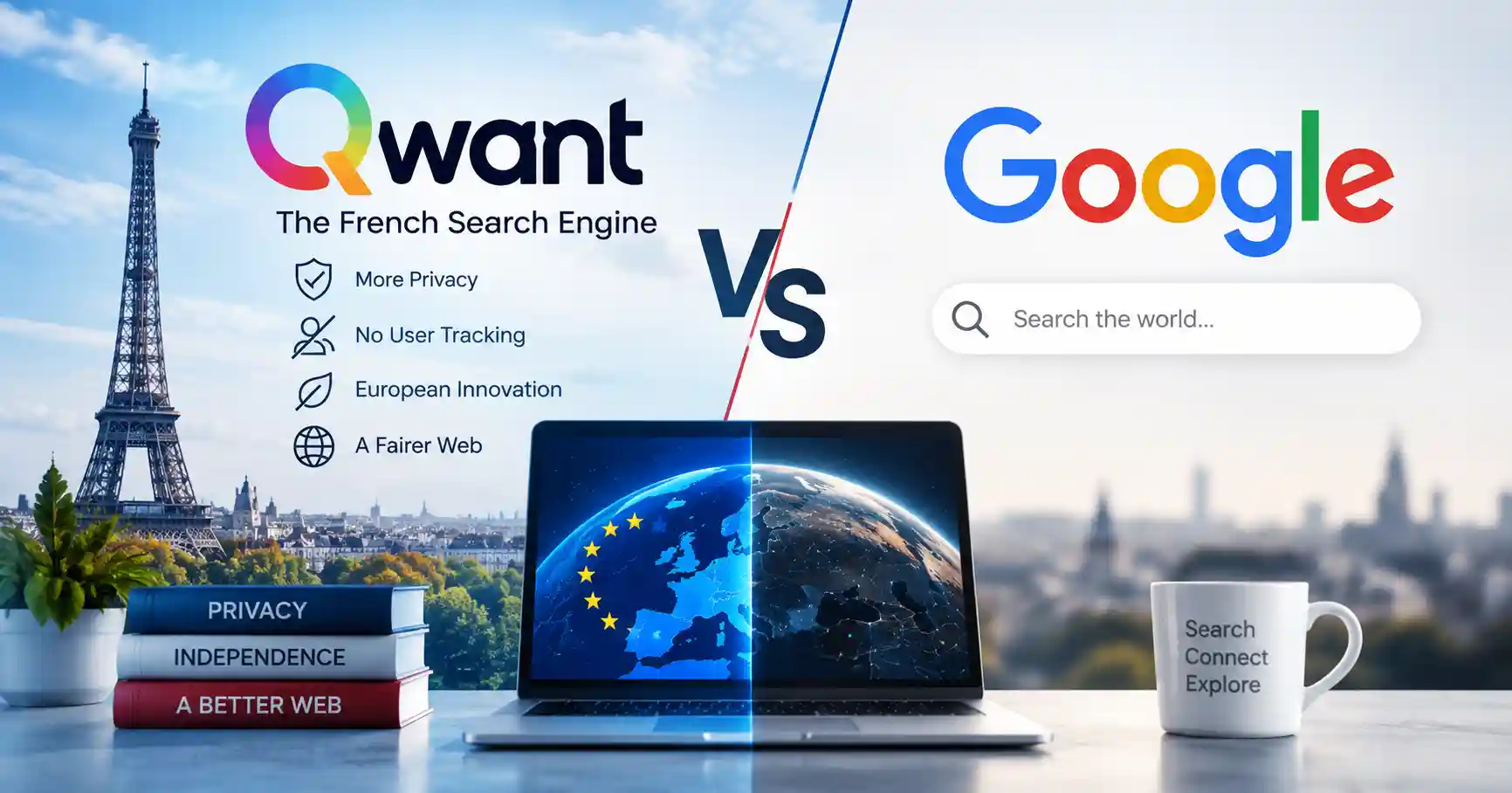
What if you could search the web without handing over quite so much information about yourself?
That’s the basic idea behind the Qwant search engine, a French search platform that has spent years trying to offer something different from Google. Rather than competing only on the size of its index or the number of features it can squeeze onto a results page, Qwant has built much of its identity around privacy, European technology and less personalized search.
Hardly a fresh concept. Search Engine Journal caught Qwant and its sweeping ambitions way back in 2017, aiming squarely to dethrone Google. Explosive early growth relied heavily on privacy as an impenetrable shield.
Yet, the search landscape mutated drastically since those days, Today? The entire game looks totally unrecognizable.
Google now competes with traditional search engines, AI search tools, answer engines and privacy focused alternatives. Qwant shifted gears too. By partnering with Ecosia to build a sovereign European search index, they completely broke away from those towering American monopolies. It was about time.
So, is Qwant still just a niche Google alternative, or could its approach become more important as people rethink online privacy?
What is the Qwant search engine?
Qwant is a French search engine that dropped back in 2013 with a hard focus on user privacy. Their pitch is simple. They claim they never keep your search history for profiling, nor do they sell off your personal data. And your results? They aren’t skewed by what you searched for last week or what you like.
That sets up a sharp contrast to the tailored experience Google gives you, Picture two folks typing the exact same thing into the search bar. Google tries to build a profile for each and shifts the answers, Qwant does the opposite. They want the core search to stay neutral, ignoring your past entirely.
Privacy nerds find that pretty compelling. Because of this exact stance, Qwant always pops up when people start looking for solid alternatives away from Google.
Why does Qwant want to challenge Google?
The interesting thing about Qwant vs Google isn’t simply that one is French and the other is American.
It’s about two different philosophies of search.
Google built an enormous ecosystem around search, advertising, maps, video, shopping, mobile devices, browsers and increasingly AI. Qwant always tried to stand apart, they swore search didn’t need deep user profiling.
The Search Engine Journal piece laid it out clearly. It flagged Qwant’s focus on privacy, their wide grab bag of search categories. And their big swing at the heavy hitters in the industry. It mentioned plans to make cash through ads without breaking that privacy promise.
That last part? That matters.
Privacy doesn’t mean Qwant has no business model. Search advertising can still exist without building the same kind of long term behavioral profile around every user. Qwant says advertisements can be based on the query rather than an extensive personal profile.
In other words, the pitch is fairly simple:
You search. Qwant answers. Your search history doesn’t need to become the product.
Is Qwant really a private search engine?
Privacy is Qwant’s main hook, sure. But we should probably look past the glossy marketing.
The company insists it doesn’t hold onto search data to build personal profiles, steers clear of selling user info, and ditches tracking or advertising cookies.
And yet, Privacy isn’t a blanket no data promise here.
France’s data protection watchdog, the CNIL, pointed out back in February 2025 that whatever Qwant processes can still count as personal data. They had to remind the firm about basic legal duties. That detail counts. You have to view privacy pitches through the lens of real world data handling and actual laws.
So calling Qwant a privacy focused search engine hits closer to home than pretending zero information ever touches their servers.
That nuance actually helps users. Privacy isn’t a simple yes or no switch. The real issue boils down to specifics. What gets scooped up, the motive behind it, retention windows, and whether a profile gets spun out of it.
How does Qwant compare with DuckDuckGo and other Google alternatives?
Qwant isn’t alone.
DuckDuckGo has built a large part of its identity around private searching. Brave Search brings search results into Brave’s privacy minded browser world. Ecosia goes another way. It links its search ads income to environmental work.
Then there are AI first services such as Perplexity and Google’s own AI search experiences, which are changing what people expect from a search engine.
This makes the modern Google alternative market much more interesting than it was in 2017.
Qwant’s European identity is another differentiator. In 2024, Qwant and Ecosia announced the creation of European Search Perspective, a joint venture intended to develop a European search index. The companies said the project would improve European language search and reduce reliance on external search indexes.
That’s potentially more significant than another minor search interface redesign.
Owning or developing more of the underlying search infrastructure gives European search companies greater control over how their search technology evolves.
Can Qwant actually replace Google?
Here’s where the story gets more complicated.
Qwant doesn’t need to replace Google for its strategy to matter.
Google owns the search game. They hold the infrastructure, the habits, the ads, and the reach, Pulling someone away from a search bar they have trusted for years? Tough ask.
Still, Qwant has an opening, they can target specific crowds. Privacy focused folks just might make the jump.European organizations interested in digital sovereignty may have another. Users who simply want a different search experience have yet another.
And the market itself is becoming less dependent on the old idea that everyone has to use one search engine for everything.
That’s probably the more realistic way to look at Qwant.
The company doesn’t have to turn every Google user into a Qwant user overnight. It needs to make the alternative useful enough that people have a reason to try it and stay when it works.
As TechCrunch reported when Qwant and Ecosia announced their European search index project, both companies had historically depended heavily on Microsoft’s Bing technology, while the new initiative was designed partly to reduce that dependence and create a stronger European search foundation.
That’s a much bigger ambition than simply launching another search homepage.
What does Qwant mean for SEO and search marketers?
Marketers miss this piece at their own peril. If search splinters apart, pinning all your hopes on Google alone turns into a dead end strategy. Sure, Google still matters. But companies now face a sprawling web of discovery channels: old school engines, AI chat interfaces, social feeds, giant marketplaces, and direct answer tools.
That shifts the ground beneath our feet. Basics like clean writing, tight technical SEO, genuinely helpful pages, and solid brand entities count for a whole lot more now.
Take visibility past standard rankings. Our guide to technical SEO for AI search
digs into why machines and AI models still require proper crawling and clear site architecture to grasp your stuff. You can also track the shifting search landscape in our guide to AI driven personalized search.
Nobody is saying drop Google entirely. That misses the mark. Just stop betting the farm on it, Search habits are branching out, and privacy concerns drive a lot of that change.
So, what makes Qwant interesting in 2026?
The original Qwant story was basically a young French startup having a go at Google with privacy as its shield.
The 2026 version? Way bigger.
Now, Qwant anchors a much wider debate. We are talking European digital sovereignty, privacy first search, independent infrastructure, and where web discovery goes next.
Look at their tie up with Ecosia to build a European search index. It proves they care about more than just the little search box you type into. They are looking at the pipes underneath the floorboards.
That is why you still keep an eye on Qwant.
Will it ever dethrone Google for most internet users, Unlikely. But copying the giant isn’t the point.
The real opening for them is simple: show the world that search can make money, respect privacy, and actually work well all at once.
AI is shifting how we find stuff online, Honestly, having more than one serious way to search might save the web.
FAQ’s
Qwant started in France back in 2013. It’s a French company, and today it bills itself as a search engine for Europe. A privacy focused one, mind you.
Not everyone needs the same kind of search. Google has a huge set of tools and links them together in a tight way. Qwant puts more focus on privacy and uses search that feels less tailored to you. Which one is best really comes down to what matters most to you when you search.
Qwant says it is a search engine built around privacy. It also claims it keeps search data from being used for profiling, and it does not sell personal data.
Even with that claim, Qwant does handle some information. In France, CNIL has said that part of what Qwant processes can count as personal data.
Qwant calls itself a real rival, but lacks Google’s pure dominance. It falls way short, Not even close.
Qwant now offers search tools that are linked to AI, like Flash Answers. The team is also working on European search systems. The goal is to back new tech later, including AI.
Conclusion
Qwant kicked off with a simple idea, really: Could a search engine actually deliver good results without gobbling up all your personal info?
Ten years on, that very question still smarts. What with AI search blowing up, privacy worries piling up, and digital sovereignty a constant buzz, it arguably matters more than ever.
Beating Google? Not the point. Qwant’s true victory lies in something simpler: showing there’s more than one legitimate way to search the web.

Kumar Swamy is the CEO of Itech Manthra Pvt Ltd and a dedicated Article Writer and SEO Specialist. With a wealth of experience in crafting high-quality content, he focuses on technology, business, and current events, ensuring that readers receive timely and relevant insights.
As a technical SEO expert, Kumar Swamy employs effective strategies to optimize websites for search engines, boosting visibility and performance. Passionate about sharing knowledge, he aims to empower audiences with informative and engaging articles.
Connect with Kumar Swamy to explore the evolving landscape of content creation!