Ever wonder why one page sits comfortably on Google’s first page while another, covering almost the same topic, barely gets noticed?
SEO has never been about one magic trick, but the latest data gives us a clearer picture of what professionals think matters most. A new survey of 131 SEO professionals, conducted by Zyppy and reported by Search Engine Land, asked experts to rate 103 potential ranking factors.
The result is pretty interesting: relevance came first, backlinks remained highly influential, and content quality ranked third. Original research and first party information also stood out, while scaled AI content with little added value was viewed much less favorably.
So, what are the Google’s top ranking factors actually telling us about SEO in 2026? More importantly, what should you do with this information?
What are Google’s top ranking factors in 2026?
There isn’t a secret checklist that guarantees position #1. Google uses many automated systems, and rankings can vary depending on the query, page, location, freshness and other signals. Google itself says its systems use a variety of signals to find the most relevant and useful results.
But the 2026 survey gives SEO professionals a useful priority list.
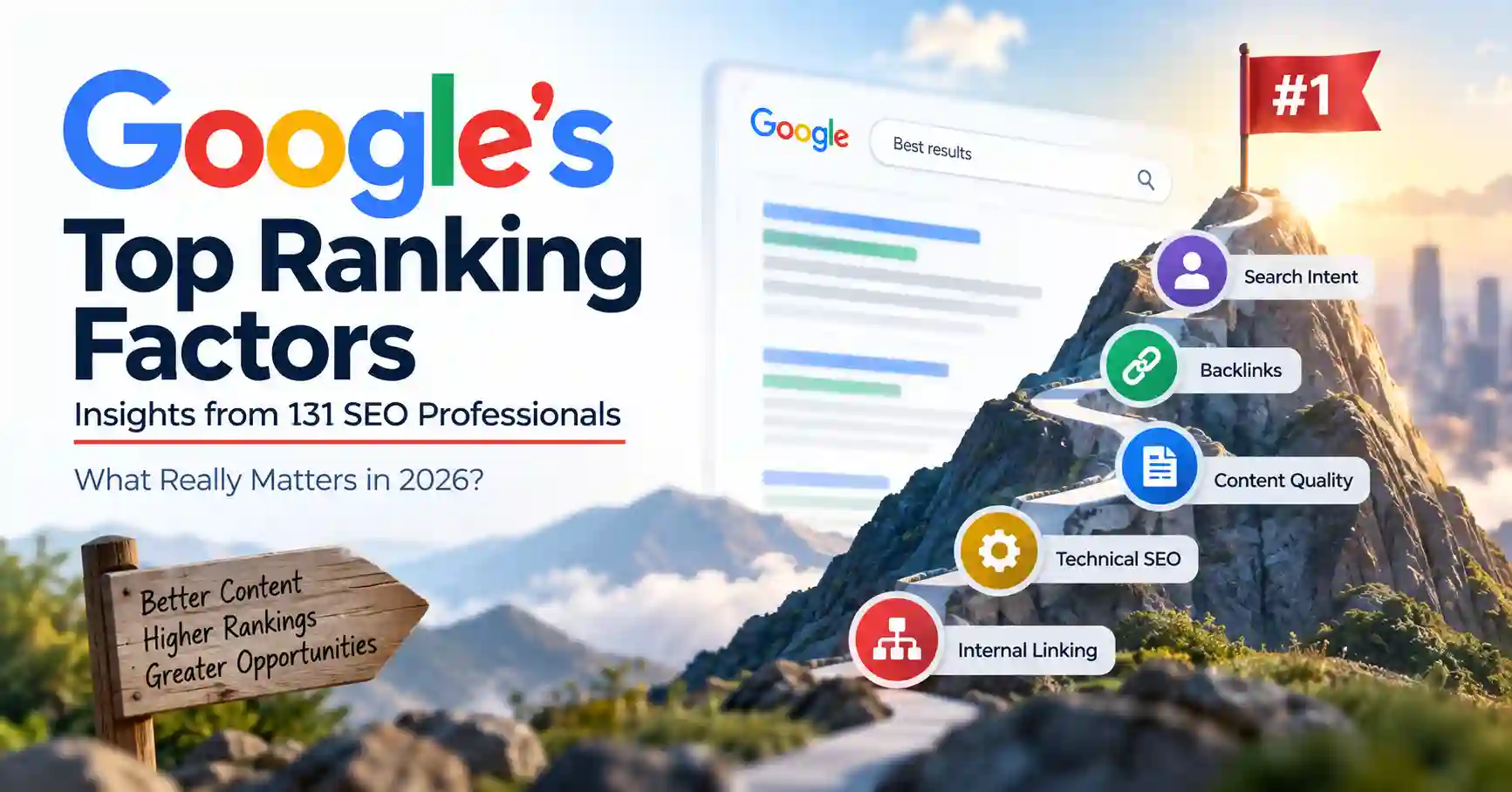
The strongest areas are:
- Search intent and relevance
- Backlinks and authority
- Content quality
- Original research and first party information
- Technical SEO
- Internal linking
- Brand and reputation signals
- User satisfaction
- Page experience
The interesting part is that these factors aren’t really separate islands. They work together.
A page can have excellent content but weak visibility if nobody trustworthy links to it. Another page may have plenty of backlinks but fail because it doesn’t actually answer the searcher’s question.
That’s why modern SEO ranking factors are better understood as a system rather than a collection of isolated tricks.
Why is search intent one of the most important Google ranking factors?
Imagine searching for “best SEO tools.”
You likely do not need a 500 word explanation of SEO tools. What you want is a side by side look, key features, costs, and a clear list of good points and weak points. Some quick picks also help.
That is what search intent means.
In a 2026 survey, people ranked search intent match as the top single factor for getting pages to rank. Put simply, SEO works best when you first figure out what the reader is trying to do.
Google also focuses on meaning. The goal is not just to repeat an exact keyword. It is about what the query is really asking.
Google’s Search Essentials says to use the terms that users actually type in important spots on the page. It also says to write content that is genuinely useful for the person reading it.
Before writing an article, ask:
What does the searcher want right now?
Are they trying to learn something? Compare products? Find a service? Solve a problem?
Once you know that, the content format becomes much easier to decide.
Our guide on keyword research and organic rankings can also help when you’re building this part of your SEO strategy.
Do backlinks still matter for Google rankings?
Yes. Despite years of predictions that backlinks are “dead,” they clearly haven’t disappeared.
In the 2026 survey, backlinks came in second overall. About 54.8% of the people said they pick backlinks as one of Google’s top three ranking factors.
Participants also liked links from sites they trust. They also favored links that match the topic being discussed.
At the same time, spam links were treated as a major downside.But there’s an important distinction.
100 random backlinks aren’t necessarily better than 10 excellent ones.
A good link from a well known site, an industry page, or a trusted source can help more than many weak links from sites that do not fit.
Google’s own guides say that link signals are still used in its ranking work, and that PageRank is part of the mix.
So instead of asking, “How many backlinks do I need?”, ask:
Who would naturally want to reference this page?
Original research, useful statistics, expert commentary, case studies and genuinely helpful resources are much easier to promote than another generic article repeating what everyone else has already said.
As SEO researcher Cyrus Shepard put it in the survey coverage, the “death of backlinks” has been greatly exaggerated.
Is content quality still one of the biggest SEO ranking factors?
Absolutely. In fact, content quality ranked third in the new survey.
But “quality content” doesn’t simply mean writing a 2,000 word article and sprinkling keywords throughout it.
Google’s current guidance emphasizes original information, substantial coverage, useful analysis, accuracy and content that provides more value than competing pages.
That’s where original research becomes especially powerful.
Suppose ten websites publish articles about the same SEO trend. Nine repeat statistics they found elsewhere. The tenth adds its own data, examples, screenshots, experiments or observations.
That tenth article has something the others don’t.
AI generated writing desperately needs common sense. Sure, AI handles research, sorts information, and launches a draft. But churning out endless generic filler without genuine human value, Not a winning long term plan. Let us be real here. A far smarter approach uses technology simply to accelerate the grind, never to replace authentic expertise. If you genuinely want your content to stand out in both traditional web searches and modern AI discovery engines, readers must walk away with actual, substantive worth every single time.
How important are technical SEO, internal links and page experience?
Technical SEO lacks glamour. Nobody jumps out of bed thrilled to fix broken canonical tags. Yet it matters. Google has to discover, crawl, parse, and index your pages before any real ranking happens. On top of that, Google pushes for a solid page experience, that means strong Core Web Vitals, mobile friendliness, tight security, and clean layouts. Skip this stuff at your own peril.
There are a few basics worth checking:
- Can Google crawl the important pages?
- Are the pages actually indexable?
- Does the site work properly on mobile?
- Are important pages linked internally?
- Does the site load reasonably quickly?
- Is HTTPS enabled?
- Are intrusive elements getting in the way of the content?
Internal linking deserves extra attention.
Solid internal links map your pages for search engines, revealing topic clusters. More than that, they effortlessly carry readers along a trail of genuinely helpful content.
For example, this article can link to related content about how to get keyword rankings to the top of Google, giving both users and search engines additional context.
How can you use these Google search algorithm insights to rank higher?
Here’s the part that matters most.
Don’t take the survey and turn it into a giant checklist of 100 SEO tasks.
Instead, prioritize the fundamentals.
1. Start with search intent.
Study the current search results. Look at what Google is already rewarding and identify what users expect to see.
2. Make the page genuinely better.
Don’t just rewrite the top ranking articles. Add original examples, data, opinions, screenshots, experiments or practical steps.
3. Build relevant authority.
Earn links by creating resources people actually want to reference. Digital PR, original research and expert contributions can be far more valuable than bulk link building.
4. Strengthen your internal links.
Connect related articles naturally and use descriptive anchor text.
5. Fix technical problems.
Make sure Google can access and understand your important content.
6. Improve the reading experience.
Clear headings, short paragraphs, useful lists and fast loading pages help people find answers without fighting their way through a wall of text.
7. Build trust.
Show who created the content, demonstrate experience, cite credible information when appropriate and keep important information accurate.
Google’s message is clear: make content for people first, not for search engines. A basic idea, right? Still, it’s pretty easy to forget when you’re staring at endless keyword charts, Honestly, people slip up on this all the time.
What do these search engine ranking factors mean for AI search?
This is the part many older SEO articles miss.
Google’s search is leaning into AI. But traditional SEO still matters. Google itself says its advice on making good, unique content, that applies to its AI searches too.It specifically recommends making content accessible, useful and easy to understand.
That means the same fundamentals still matter:
relevance + original information + expertise + accessibility + useful structure + authority.
In fact, good AI visibility often starts with good traditional SEO.
An AI, frankly, just wants your page, it needs to grasp it, summarize it, perhaps even cite it. Offer direct answers, fresh insights, and a clean layout.
You don’t need two content strategies. Not for Google, not for AI. They’re the same. Build content that humans trust and machines can understand.
FAQ’s
Come 2026, SEO wizards prioritize search intent and relevance above all. Yet, Google’s a watchful observer, with a veritable constellation of ranking signals no single element secures top placement.
Sure enough, backlinks snagged second in the 2026 survey, still, don’t just dump them true quality and relevance, that’s the real key.
Google isn’t banning AI content, not really. The real question they’re asking is this: Is it useful? Is it new? More importantly, was it made for people, or is it just some clever trick?
Nah. Google suggests solid Core Web Vitals are good, but they won’t automatically put you at the top. Page experience is just one piece in a huge ranking puzzle.
No set schedule for this. How fast a page shows up? It depends on the competition, its authority, search intent, Plus, content quality, links, technical health, even the search query itself.
Conclusion
And the upshot of the survey? Not some hidden SEO ranking factor, funnily enough.
It’s almost the opposite.
The fundamentals still matter.
Understand the searcher. Create something genuinely useful. Add information competitors don’t have. Earn relevant authority. Make your site technically accessible. Connect your content properly. And give people a good experience once they arrive.
That’s a much more sustainable way to approach the Google’s top ranking factors than chasing every algorithm rumor that appears on your feed.
And honestly, that’s good news. You don’t need to outsmart Google. You need to become the result that deserves to be found.

Kumar Swamy is the CEO of Itech Manthra Pvt Ltd and a dedicated Article Writer and SEO Specialist. With a wealth of experience in crafting high-quality content, he focuses on technology, business, and current events, ensuring that readers receive timely and relevant insights.
As a technical SEO expert, Kumar Swamy employs effective strategies to optimize websites for search engines, boosting visibility and performance. Passionate about sharing knowledge, he aims to empower audiences with informative and engaging articles.
Connect with Kumar Swamy to explore the evolving landscape of content creation!