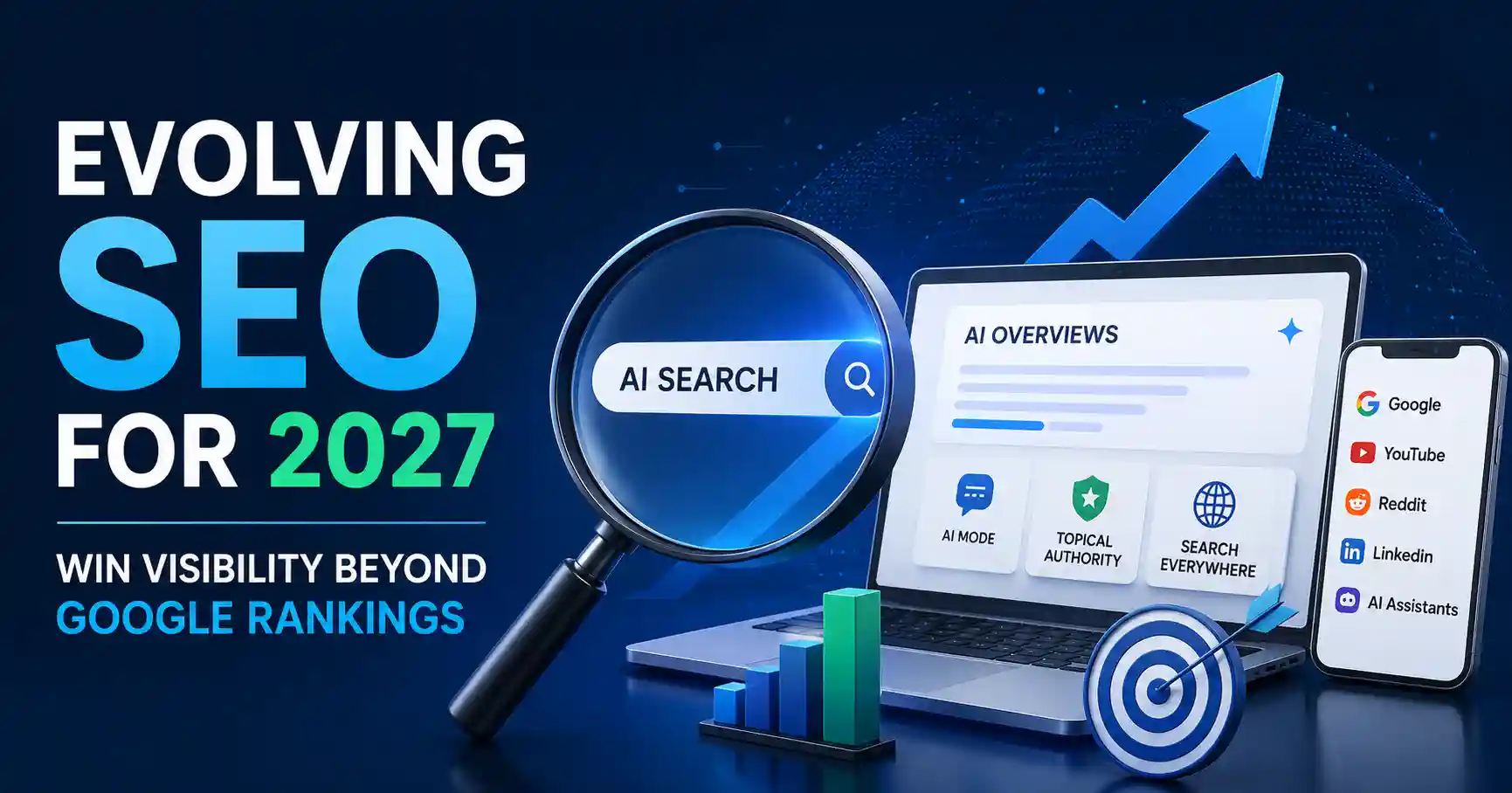
What if your website ranks well on Google yet gets completely ignored by the exact people you want buying from you?
That sounds backwards. For years, we were told top rankings equaled instant traffic, fat lead lists, and loyal customers. The math was simple. Search is changing, though. People don’t just type short keywords into a box anymore. They throw messy questions at ChatGPT, lean on AI summaries, scroll through Reddit threads, watch YouTube clips, and pull answers straight from zero click results.
This is why upgrading your SEO for 2027 has nothing to do with hunting down fresh keywords or sweating the latest Google tweak. You have to figure out where your audience actually looks, who they trust. And how your brand shows up across all those messy places.
The good news? Traditional SEO isn’t dead. Far from it. Google still matters enormously. But the definition of search visibility is getting much bigger.
What does evolving SEO for 2027 actually mean?
For a long time, SEO planning started with one question: “What keyword should we rank for?”
In 2027, that question is too narrow.
A better question is: “Where will our audience look for this answer, and how can we become one of the sources they trust?”
That’s the big shift.
Google’s AI Overviews and AI Mode can summarize information before someone clicks a traditional result. Meanwhile, AI tools like ChatGPT, Gemini, Claude, and Perplexity harvest data everywhere to spit back one chatty response, a shift Search Engine Land highlights too. Forget kissing up to Google. SEO now means truly grasping your user across multiple platforms. Drop traditional keywords? Nobody said that, Keep the technical fixes and backlinks.
It means connecting those fundamentals to a much wider search journey.
How are AI Overviews and AI Mode changing SEO?
Imagine someone searches for “best cybersecurity software for a small business.”
Previously, they might scan several blue links, open comparison articles, visit software websites, and make a decision.
Now, an AI powered search experience can summarize the options, compare features, explain trade offs, and provide links to supporting sources.
That’s a very different user journey.
AI Overviews and AI Mode are therefore changing what a “ranking” actually means. Your page may still rank organically, but the user could encounter your information through an AI generated answer before ever seeing your traditional listing.
Google itself says the fundamental SEO best practices still apply to AI features such as AI Overviews and AI Mode.
So don’t throw away your SEO checklist. Instead, make your content easier to discover, understand, trust, and reference.
Clear headings, strong internal linking, useful answers, original information, structured content, and technically accessible pages all become even more valuable.
If you’re already working on this area, our guide to AI for SEO and search visibility is a useful next step.
Why is topical authority becoming more important than publishing more content?
Here’s a common SEO trap: publishing 50 articles that barely scratch the surface of 50 different keywords.
It feels productive.
It isn’t always useful.
Search engines and AI systems increasingly need to understand the relationship between topics. That’s where topical authority comes in.
Instead of writing one generic article about “SEO,” build a connected collection of genuinely useful resources around SEO. Cover search intent, technical SEO, content optimization, AI search, internal linking, analytics, and related questions.
Think of it like building a library rather than throwing books into a warehouse.
This also connects closely with semantic SEO. Search engines don’t simply look for an exact keyword anymore. They try to understand concepts, entities, relationships, and context.
Ahrefs’ recent research highlights query fan out as an important development in AI search. One user question can lead an AI system to explore several related searches before producing an answer.
That means one page answering one tiny keyword variation isn’t enough.
A stronger strategy is to cover the topic deeply enough that your site can answer the different questions surrounding the main subject.
Our guide to technical SEO for AI search also explains why crawlability, structure, internal links, and machine readable content still matter in this new environment.
Is search everywhere optimization the next big SEO shift?
Search no longer lives inside one search box.
People search on Google, YouTube, Reddit, TikTok, LinkedIn, Amazon, social platforms, and increasingly inside AI assistants.
That’s why search everywhere optimization deserves a place in your 2027 SEO strategy.
The idea is pretty simple: don’t ask only how to rank your website. Ask where your customers are actually looking for information.
For example, a software company might need:
- Google visibility for product comparisons
- YouTube videos for demonstrations
- Reddit participation for real world discussions
- LinkedIn content for professional credibility
- AI visibility for conversational product recommendations
These aren’t completely separate marketing activities. They can reinforce one another.
A useful YouTube tutorial can appear in search results. A genuine Reddit discussion can influence what people think about a brand. An expert’s LinkedIn post can strengthen brand recognition. Those signals can then contribute to a broader discovery journey.
In other words, your website doesn’t have to be the only place where your brand proves its expertise.
Why will original experience matter more than generic AI content?
Let’s be honest: AI can produce an article about almost anything in seconds.
That’s exactly why generic information is becoming less valuable.
If ten websites publish nearly identical explanations of a topic, what makes one worth citing?
Usually, it’s something the others don’t have.
Original research.
First hand experience.
Proprietary data.
Real examples.
Expert opinions.
Screenshots.
Experiments.
Product testing.
A useful point of view.
Search Engine Land highlights a vital truth here, Genuine human conversations pack infinitely more punch than just another bland automated summary. Keep that firmly in mind for twenty seven. Sure, software excels at digging up facts, organizing messy notes, and polishing drafts. Still, algorithms lack actual conviction. They can never replace having a real, lived perspective to share.
As SEO strategist Lily Ray has often emphasized in discussions around search quality, demonstrating real world experience and credibility is becoming increasingly important as search systems get better at identifying useful information.
The winning question isn’t “How much content can we publish?”
It’s “What can we publish that other websites can’t easily copy?”
How should businesses measure SEO success in 2027?
This might be the biggest change of all.
For years, SEO reports have focused heavily on rankings, impressions, clicks, and organic traffic.
Those metrics still matter. But they don’t tell the whole story anymore.
Suppose your brand appears in an AI answer, but the user doesn’t click your website. Did SEO fail?
Not necessarily.
Direct visits, word of mouth, and future brand searches still matter. Yet traffic driven by artificial intelligence might drop in volume, while stubbornly delivering vastly superior conversion value. Exactly.
Recent Ahrefs research shows growing interest in measuring AI visibility based on actual traffic and business outcomes rather than simply counting brand mentions.
So your SEO dashboard for 2027 should start looking beyond rankings.
Track things such as:
- Organic traffic and conversions
- Branded search growth
- AI citations and mentions
- Referral traffic from AI platforms
- Engagement and assisted conversions
- Visibility across important communities
- Video discovery and engagement
- Leads influenced by organic search
The goal isn’t to collect more metrics for the sake of having a bigger spreadsheet.
It’s to understand whether search visibility is actually helping the business.
What should your SEO strategy look like before 2027?
No need to rebuild everything overnight. Start with the basics and expand from there. First off, get your technical SEO solid, Your important pages must be crawlable, indexable, fast, and easy to understand. Second, revisit your content strategy, Cut down those thin pages thrown together just because a keyword tool suggested them. Build stronger topic clusters instead, Third, find out where your audience actually hangs out outside of Google. If your customers live on Reddit, YouTube, LinkedIn, or some other platform, your SEO approach has to acknowledge that reality. Fourth, pack your content with original insight. Stop just rewriting whatever already ranks at the top. Finally, measure brand visibility beyond old school rankings. The broader direction is clear enough: SEO is shifting from search engine optimization into search experience optimization.
Google still matters. Keywords still matter. Links still matter. Technical foundations still matter.
But the brands that adapt will think beyond the blue link.
FAQ’s
Yes, SEO is still important. It works with AI search now. It also works with social search. Video matters too. Community discovery matters as well.
AI search, AI Overviews, AI Mode, topical authority, search everywhere optimization, original content, brand building, and community visibility are among the major areas to watch.
Google is still a big way people find things and visit sites. At the same time, AI is changing how people look for and read information.
A company should spend time making content that is easy to read, reliable, and useful. It should also be written so search engines and AI tools can find it and understand it. There is no secret method that uses AI alone to replace solid SEO work.
Not necessarily. Publishing more isn’t automatically better. A smaller collection of detailed, original, well connected resources can be more valuable than hundreds of thin articles targeting minor keyword variations.
Conclusion
The future of evolving SEO for 2027 isn’t about finding one secret ranking factor.
It’s about becoming useful wherever your audience searches.
AI Overviews may answer the question. AI Mode may continue the conversation. Reddit may provide the human experience. YouTube may demonstrate the product. Google may still deliver the click.
Forget simple rankings. Your brand needs omnipresent content people actually seek out, Honestly, that is the smartest search strategy now. You have to optimize so audiences genuinely remember your name, trust your word implicitly, and eagerly tell friends.
