Have you ever handled hundreds of technical SEO problems, and then, somehow, your manager or client asks just one thing: “What revenue did this generate?”
It feels annoying in a way almost every SEO professional has met before.
In contrast to paid advertising, where conversions can often be seen immediately, technical SEO tends to work in the background. You improve crawlability, mend broken links , sharpen Core Web Vitals, or fix indexation messes, and then the results rarely show up as an immediate jump in sales. Instead, these fixes set up the groundwork for ongoing, durable organic expansion.
So yeah, proving technical SEO ROI is still among the hardest tasks in digital marketing.
The positive side is that measuring technical SEO ROI is not easy, but it also isn’t truly impossible. If you use the right indicators and a sensible reporting approach, you can show the business value of technical work more clearly.
Why is technical SEO ROI harder to measure than other marketing channels?
Most marketing channels have straightforward attribution.
For example:
- Paid ads generate clicks and conversions.
- Email campaigns produce measurable open and click rates.
- Social media campaigns show engagement and traffic.
Technical SEO works differently.
Its purpose is to improve how search engines crawl, understand, and index your website.
Examples include:
- Fixing crawl errors
- Improving page speed
- Optimizing Core Web Vitals
- Cleaning duplicate content
- Implementing structured data
- Improving internal linking
These activities support every other SEO effort rather than producing instant business results.
As SEO consultant Nina Lopez says:
“Technical SEO rarely creates growth by itself. It removes the obstacles preventing growth.”
That’s why measuring ROI requires a broader perspective.
Which business metrics should you connect to technical SEO?
Instead of measuring individual fixes, measure outcomes.
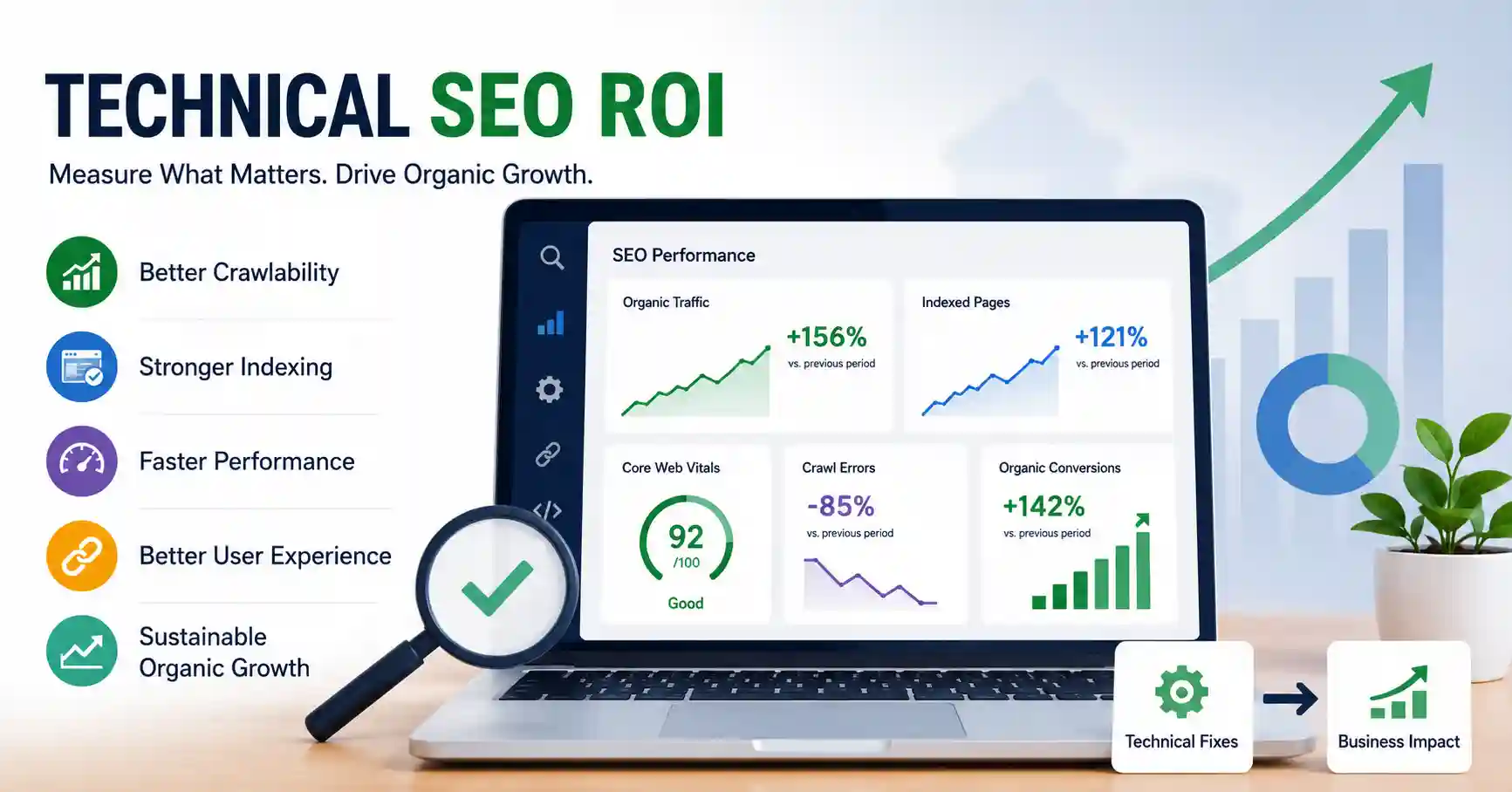
Useful technical SEO metrics include:
Organic traffic growth
Compare traffic before and after significant technical improvements.
Crawl efficiency
Monitor how search engines discover and index pages.
Index coverage
Track improvements in valid indexed pages.
Core Web Vitals
Measure page experience improvements over time.
Organic conversions
Evaluate whether technical improvements support higher conversion rates.
These indicators help connect technical work with business performance rather than isolated SEO tasks.
Why don’t rankings improve immediately after technical fixes?
Many website owners expect instant results.
Unfortunately, search engines don’t work that way.
After implementing technical changes, Google still needs to:
- Crawl updated pages
- Process changes
- Re-evaluate quality signals
- Update search indexes
Depending on the website, this process can take days or even weeks.
That’s why patience is an important part of technical SEO reporting.
Organizations improving their measurement strategy should also read 3 Ways to Build a More Complete SEO ROI Model, which explains how broader business metrics create more meaningful SEO reporting.
How can you demonstrate the value of technical SEO?
The best approach is to tell a complete story.
Instead of saying:
“We fixed 500 crawl errors.”
Explain the business outcome:
- Crawl efficiency improved.
- More important pages were indexed.
- Organic visibility increased.
- Additional pages began receiving traffic.
- Organic conversions improved over time.
Business leaders understand outcomes better than technical reports.
Charts that show improvements across several months communicate the value more clearly, before and after compared to long lists of finished tasks. In contrast to long lists of completed tasks, these charts tend to make the impact visible, month over month and then again after each update.
Which technical SEO improvements usually produce the highest ROI?
Not every technical issue has the same business impact.
Focus first on improvements affecting:
Crawlability
Help search engines access important pages.
Indexation
Ensure valuable content appears in search results.
Site speed
Improve user experience and page performance.
Mobile usability
Support users across all devices.
Internal linking
Strengthen topic relationships and distribute authority.
When you prioritize the higher impact tasks you get better long-term results than you keep chasing small technical warnings, even if they look urgent at first glance. It’s more effective to focus on what actually moves the needle rather than dwelling on every little issue, because that tends to consume time and attention.
Businesses modernizing their optimization process should also explore The New SEO Stack: What Replaces Your Old Toolset, which explains how technical SEO now works alongside AI-powered workflows and advanced analytics.
Can AI make technical SEO reporting easier?
Absolutely.
AI can help SEO teams:
- Identify technical issues
- Prioritize fixes
- Summarize crawl reports
- Detect patterns
- Generate stakeholder-friendly reports
However, AI should support—not replace—human analysis.
Even experienced SEO specialists still bring in the strategic mindset needed, to link technical changes with business results in a clear way, and sometimes in a measured path forward.
What should stakeholders expect from technical SEO?
One of the biggest challenges isn’t technical.
It’s communication.
Technical SEO should be presented as a long-term investment rather than a quick win.
Stakeholders should understand that technical improvements create:
- Better crawling
- Stronger indexing
- Faster websites
- Improved user experience
- Sustainable organic growth
These benefits often compound over time.
For official guidance on technical SEO best practices, Google Search Central Documentation remains one of the most valuable resources available.
Final Thoughts
Technical SEO may not deliver overnight results, but it does lay down the base for basically every successful organic growth plan
Instead of trying to pin immediate revenue on each tiny technical change, marketers should emphasize showing how optimization helps crawlability and indexation, strengthens the way people experience pages, and supports long term search presence.
The strongest SEO reports weave technical tasks into business impact that actually matters.
When you tell that story cleanly, proving technical SEO ROI gets a lot easier.
So, how does your team evaluate whether technical SEO projects are really working? Drop your method in the comments below.
FAQs
Why is technical SEO ROI difficult to measure?
Technical SEO tends to help long-term organic growth more than it pushes immediate conversions, so trying to attribute the results directly is a bit harder and less precise.
Which metrics are most useful for technical SEO reporting?
Organic traffic, crawl efficiency, the index coverage and Core Web Vitals, also organic conversions, these are valuable indicators in general, yet they often feel connected ,in practice.
How long does technical SEO take to show results?
Depending on the website, and on the changes that were made, the outcome might take several weeks or even months to show up completely. Sometimes, results appear early, but fully visible status can arrive later, for example after a while.
Can AI improve technical SEO reporting?
Yes. AI can take care of analysis and spot patterns, then help compress the reporting part, while human expertise gives the more strategic interpretation, and the final picture is still more grounded.
Is technical SEO still important in the AI search era?
Yeah, AI powered search still really depends on websites that are technically reachable, properly organized, and generally top quality, in other words there has to be a certain structure and readability to it.

Kumar Swamy is the CEO of Itech Manthra Pvt Ltd and a dedicated Article Writer and SEO Specialist. With a wealth of experience in crafting high-quality content, he focuses on technology, business, and current events, ensuring that readers receive timely and relevant insights.
As a technical SEO expert, Kumar Swamy employs effective strategies to optimize websites for search engines, boosting visibility and performance. Passionate about sharing knowledge, he aims to empower audiences with informative and engaging articles.
Connect with Kumar Swamy to explore the evolving landscape of content creation!