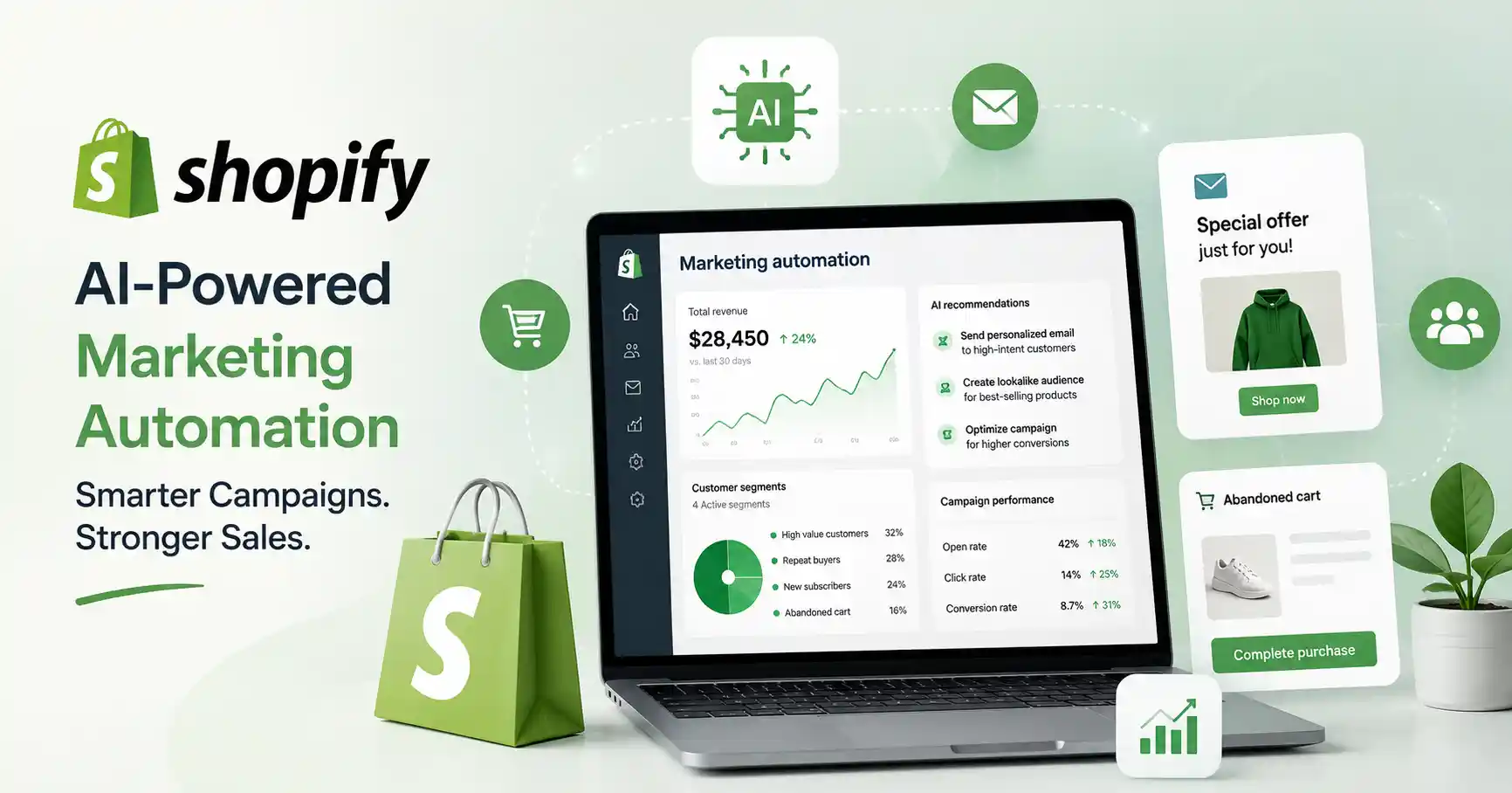
Have you ever thought, your online store could just magically create marketing campaigns by itself, choose the right customers, and tweak performance without you spending hours on manual stuff?
That is basically what Shopify is trying to solve, and it’s not a small goal.
As ecommerce keeps getting more competitive, merchants deal with more pressure, not only for ads, but also for customer engagement, email campaigns , audience segmentation and performance tracking all at the same time. For many businesses, especially smaller teams, that workload can pile up fast, like really fast.
To meet this challenge, Shopify rolled out an AI powered marketing automation tool. The intention is to help merchants streamline their marketing efforts and strengthen customer engagement using intelligent automation.
This also matches a wider trend in ecommerce and digital marketing. Artificial intelligence is no longer only used for analyzing data. It is actively helping businesses make marketing decisions.
For Shopify merchants, this could be a significant step toward smarter and more efficient growth.
What is Shopify’s AI powered marketing automation tool?
Shopify’s new solution is trying to simplify marketing operations for ecommerce businesses in a more easy way.
Rather than dealing with every piece of a campaign by hand, merchants can lean on AI, automate repetitive work and also sharpen decision making.
The platform is designed to support:
- Customer targeting
- Campaign automation
- Personalized marketing
- Audience segmentation
- Performance optimization
In simple terms, this tool acts like a digital marketing assistant that runs all day long behind the scenes, and then does things quietly.
This development really points out how marketing automation software is playing an even bigger role in ecommerce these days.
As a digital marketing strategist , Nina Lopez explains:
“The future of ecommerce marketing isn’t doing more work . It’s building smarter systems that do the work for you.”
Shopify’s latest launch seems to embrace exactly that principle, or maybe something close enough.
Why is AI becoming essential for ecommerce marketing automation?
Modern ecommerce generates enormous amounts of customer data.
Businesses must understand:
- Shopping behavior
- Purchase history
- Product preferences
- Customer journeys
- Engagement patterns
Trying to manage this info manually, it’s getting harder and harder
That’s where ecommerce marketing automation helps, because it’s not really workable to keep going the same way.
AI systems can spot patterns, foresee what customers might do next, and suggest marketing tactics way faster than human teams can do on their own.
Benefits include:
Faster campaign creation
AI can help generate and launch campaigns more efficiently.
Better personalization
Customers receive more relevant messaging.
Improved efficiency
Marketing teams spend less time on repetitive tasks.
Enhanced customer experiences
Automation helps deliver the right message, at the right time too.
As customer expectations keep rising, intelligent automation is becoming more of a competitive necessity instead of a luxury.
How can Shopify merchants benefit from AI driven customer segmentation?
One of the most valuable applications of AI is customer segmentation.
Traditional segmentation often relies on basic criteria such as:
- Age
- Location
- Purchase history
AI can go much deeper.
It can identify patterns based on:
- Browsing behavior
- Product interests
- Buying frequency
- Lifetime value
- Engagement levels
This allows businesses to create highly targeted campaigns.
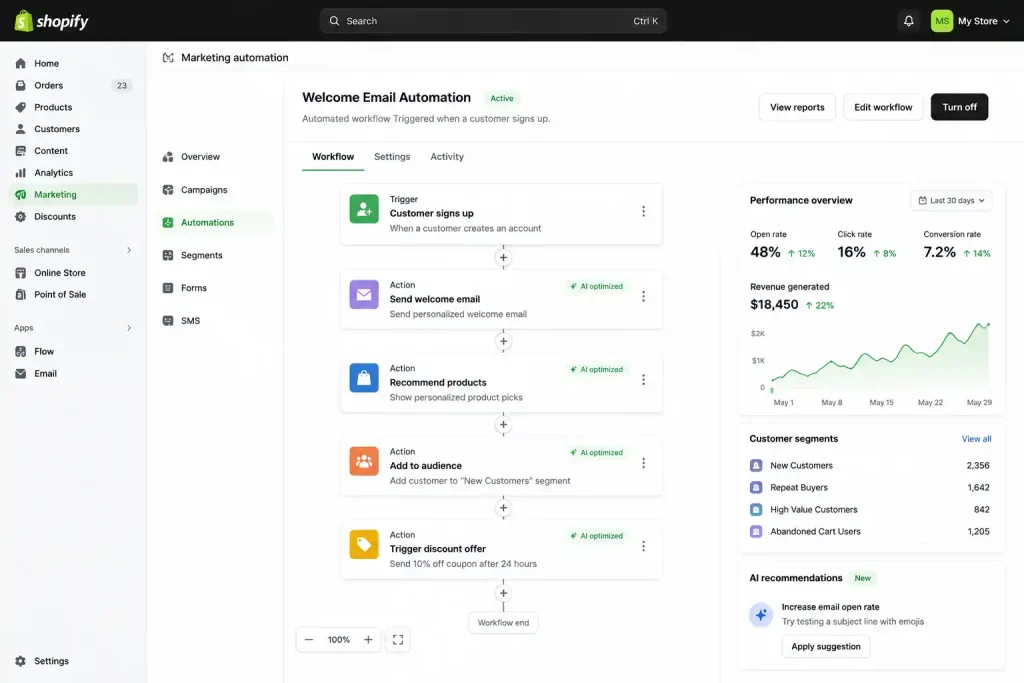
For example:
A customer who frequently browses products but rarely purchases may receive different messaging than a loyal repeat buyer.
These personalized experiences often improve:
- Conversion rates
- Customer retention
- Revenue growth
- Marketing efficiency
The more accurately businesses understand their customers, the better their marketing results tend to be.
What role does AI play in personalized marketing campaigns?
Consumers are now expecting more personalized experiences, more directly.
Those generic marketing messages, they just do not land the same way anymore. Not like before.
So , because of that personalized marketing is becoming a real priority for ecommerce brands, more or less.
AI helps businesses personalize:
- Product recommendations
- Email campaigns
- Promotions
- Audience targeting
- Content delivery
Instead of building one single campaign for everybody, marketers can deliver more tailored experiences to different customer groups, you know.
This frequently lifts engagement and boosts conversion performance, too .
Businesses exploring broader AI advertising trends should also understand Google launches AI agent for Ad Manager, which demonstrates how AI is increasingly shaping campaign optimization across marketing platforms.
The future of marketing is becoming increasingly individualized.
AI makes that possible at scale.
Could Shopify’s AI tool change the future of digital marketing?
Potentially, yes.
The introduction of AI marketing tools, shows a bigger change in the industry. You can see it in how marketing platforms are moving away from pure reporting systems, and into decision support ones. It is not just about displaying numbers anymore. AI now assists businesses with things like:
- Interpret information
- Identify opportunities
- Automate actions
- Improve outcomes
This shift can be pretty valuable for small and medium sized businesses that do not have big marketing teams.
Automation helps level the playing field, in a very practical way, if we are being honest.
Companies can reach those capabilities that used to need a lot of resources, and specialized expertise too.
So the outcome becomes more efficient digital marketing, and it is more approachable for more people.
What should merchants consider before relying on AI automation?
While AI offers impressive capabilities, human oversight remains important.
Successful businesses still need:
Clear goals
AI performs best when objectives are well defined.
Quality data
Accurate information improves AI recommendations.
Brand consistency
Automation should align with company values and messaging.
Strategic oversight
Human expertise still stays important for the long term planning, even if AI is involved.
The approach that really works best ties AI efficiency to human creativity, and the need for judgment as well.
Businesses interested in the growing relationship between automation and advertising should also review OpenAI conversion focused ads, which highlights how AI is influencing campaign performance across multiple marketing channels.
The future isn’t AI versus marketers.
It’s AI working alongside marketers.
How does this fit into the future of ecommerce?
The ecommerce industry is moving toward increasingly intelligent systems.
Future platforms will likely offer:
- Predictive marketing
- Automated campaign management
- Personalized customer experiences
- AI powered analytics
- Intelligent customer support
Shopify’s latest announcement is another sign that automation is turning into this core component of ecommerce success.
Firms that step into these tools early might see little advantages in efficiency, customer connection, and growth.
For merchants looking to understand ecommerce automation best practices, Shopify Marketing Automation Documentation provides valuable guidance on automated workflows and customer engagement strategies.
Final Thoughts
Shopify’s AI powered marketing automation tool looks like another big step forward in how ecommerce marketing is evolving, you know, in practice.
It helps merchants automate campaigns, give customers a more customized journey, and generally push up marketing effectiveness and efficiency so advanced marketing abilities feel easier to reach.
Even if AI cannot replace your strategic thinking it still can cut down on a lot of the manual workload, and maybe also guide companies toward better choices.
The future of ecommerce marketing feels like it is moving toward more automation, more personalization, and more intelligence in the way things run.
Shopify’s newest launch is a pretty clear sign of where the industry is headed, honestly.
How do you feel about AI handling more marketing tasks ? Would you feel comfortable trusting AI to automate your ecommerce campaigns. Drop your thoughts in the comments below.
FAQs
What is Shopify’s AI powered marketing automations tool?
It’s an AI driven solution that helps online commerce businesses automate marketing campaigns, audience focusing, and customer engagement activities, with fewer manual steps
How does AI improve ecommerce marketing, really?
AI reviews customer data, handles repetitive chores, boosts personalization, and helps tune campaign results. In practice it can also surface patterns humans miss, pretty regularly.
What is customer segmentation in AI marketing?
Customer segmentation is when AI divides customers into groups by behaviors, interests, and purchasing rhythms, so targeting lands more effectively.
Can small businesses get real value from AI marketing automation?
Yes. AI tools can give smaller shops access to advanced marketing powers without needing huge teams or extensive budgets.
Does AI replace human marketers?
No. AI supports automation and optimization, while human marketers still bring the strategy, the creativity ,and the brand guidance that matters most.

Kumar Swamy is the CEO of Itech Manthra Pvt Ltd and a dedicated Article Writer and SEO Specialist. With a wealth of experience in crafting high-quality content, he focuses on technology, business, and current events, ensuring that readers receive timely and relevant insights.
As a technical SEO expert, Kumar Swamy employs effective strategies to optimize websites for search engines, boosting visibility and performance. Passionate about sharing knowledge, he aims to empower audiences with informative and engaging articles.
Connect with Kumar Swamy to explore the evolving landscape of content creation!