
A lot of Google Ads accounts look profitable on paper while leaking revenue in real life.
The reason is simple, Google only optimizes what it can actually measure. If your real sales happen through calls, CRM pipelines, a sales team, demos, or invoices, and those conversion signals aren’t pushed back in the right way, your Smart Bidding strategy ends up learning from incomplete information.
Now Google is adjusting how that information lands in the system.
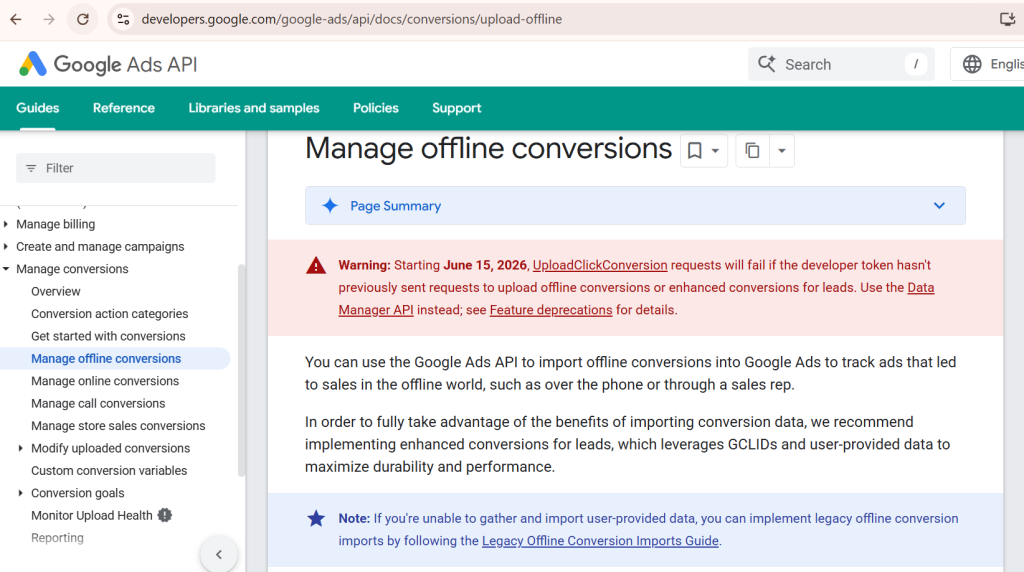
From reporting at Search Engine Land, Google is moving Offline Conversion Imports, often written as OCI, away from the older Google Ads API flow and toward broader first-party data integrations.
This sounds very technical. It is not only technical.
It’s a signal about where ads platforms are headed, like less isolated APIs, more centralized data infrastructure, heavier reliance on CRM integrations, and also a firmer push toward privacy-safe measurement, you get it.
Key Insight
- Google is pushing advertisers into a more centralized, first-party-data-driven conversion tracking workflow.
- If you’re still depending on custom API scripts for offline conversion uploads, you may have to rebuild parts of the attribution stack, bit by bit, not all at once.
- The winners will be advertisers with solid CRM hygiene, server-side tracking, and well-maintained lead qualification systems, not only the ones with bigger budgets.
What Is Google Actually Changing?
Google is moving offline conversion imports away from older Google Ads API methods and kind of consolidating them into newer data integration workflows. Practically this means a lot of advertisers will have to revisit how lead and revenue data, that comes out of a CRM system, ends up back inside Google Ads.
Offline conversion imports have traditionally let advertisers upload conversions that occur outside of a website, and yeah that matters.
For example:
- A sales rep closing a deal in Salesforce
- A booked consultation turning into a paying client
- A phone lead becoming a signed contract
- A dealership converting a test drive into a vehicle purchase
In the past, many companies leaned on:
- Custom scripts
- Middleware tooling
- Google Ads API upload endpoints
- Batch CSV uploads
Google’s shift signals more of a direction toward:
- Enhanced Conversions for Leads
- Data Manager integrations
- CRM-native syncing
- More privacy-safe identity matching
This also fits with wider industry trends:
- Third party cookies disappearing
- Browser tracking limitations
- AI bidding systems needing more first-party insights
The important part is not the migration itself.
The important part is that Google is redefining what “good conversion tracking” looks like, and also how it should behave in practice.
Advertisers who still treat CRM syncing as optional are going to have trouble, once automation-driven bidding starts deciding everything for them.
Why Are Offline Conversions Becoming Such a Big Deal?
Offline conversion tracking is becoming essential now because Google’s bidding systems increasingly lean toward revenue quality, not only lead volume. Without that extra layer of offline data, Smart Bidding will often chase cheaper leads instead of paying customers.
Five years ago, many advertisers could keep going with:
- Form submissions
- Click tracking
- Basic pixel attribution
That era is disappearing.
Today:
- Performance Max optimizes aggressively
- Broad match relies heavily on conversion signals
- Smart Bidding learns from what happens after the click
- AI systems need a more precise intent signal, not a vague one
If Google only sees:
- “Lead submitted”
…but your CRM can tell you:
- “Lead was junk”
- “Lead ghosted”
- “Lead became a $40,000 customer”
then the ad account is basically being trained toward the wrong goal.
Example: SaaS Lead Quality Problem
A B2B SaaS company spends:
- $25,000/month on Google Ads
- It treats demo requests as conversions, without much qualification
So Google starts trying to maximize demo submissions.
Meanwhile inside the business:
- 60% were students
- 20% were competitors
- 10% were very small companies outside ICP
- Only 10% ever turn into pipeline opportunities
After you import qualified opportunity data back into Google Ads:
- Cost per qualified opportunity fell 41%
- Close rate got better
- Broad match campaigns became steadier
This is the understated strength of offline conversion imports:
You stop feeding Google the wrong narrative.
Usually, sharper conversion data beats newer ad creative.
How Will This Affect Small Businesses?
Small businesses will feel this shift in a different way depending on how mature their CRM and tracking setup already is. Some teams that lean on spreadsheets and manual uploads may hit operational friction more often, while teams using integrated systems can end up with a pretty big advantage.
Here’s the uncomfortable reality, but it’s true:
Many SMBs still run something like this:
- Lead form submission
- Sales team manually follows up, basically by habit
- CRM updates inconsistently, sometimes later
- Revenue attribution does not really roll back to Google
That workflow gets weaker year over year, even when the team means well.
Google’s automation systems tend to reward advertisers who bring:
- Structured lead information
- Clean attribution
- Closed loop reporting
- Fast learning cycles
Small businesses that modernize early can actually outperform larger competitors, because they can move quicker operationally.
Comparison Table: Old Offline Conversion Workflow vs New Data-Centric Approach
| Area | Traditional API Uploads | Modern First-Party Tracking | SMB Risk Level | Competitive Advantage |
|---|---|---|---|---|
| Lead Attribution | Manual or delayed | Real time syncing | Medium | High |
| CRM Integration | Optional | Essential | High | High |
| Smart Bidding Accuracy | Limited | Stronger optimization | High | Very High |
| Privacy Compliance | Fragmented | More privacy safe | Medium | Medium |
| Maintenance | Custom scripts | Managed integrations | Medium | High |
| Scalability | Difficult | Easier | High | Very High |
Takeaway: The future belongs to businesses that connect CRM outcomes directly with ad platforms, and not just in theory.
For smaller companies this creates two paths, and they will notice the difference sooner than later:
Path 1: Ignore It
Results:
- Lower quality lead flow
- CPA slowly climbing
- Weak automation performance
- Attribution that feels off
Path 2: Build First-Party Infrastructure
Results:
- Better bidding signals
- More stable scaling, less fuss
- Cleaner attribution
- More reliable ROI forecasting
The gap between those two groups will widen quickly, because data latency, just keeps mattering.
In 2026, measurement infrastructure is turning into a growth channel.
What Should Advertisers Do Right Now?
Advertisers need to audit their conversion infrastructure, like immediately, especially around CRM syncing, lead qualification, and offline attribution workflows. Waiting until things break is the costly option, and it happens more often than people think.
Here is a practical roadmap, with less drama.
1. Audit Your Current Offline Conversion Setup
Look for:
- Are offline conversions uploading cleanly?
- Are uploads running delayed?
- Is GCLID stored with the right structure?
- Are Enhanced Conversions switched on?
- Are qualified leads kept separate from raw leads?
Most teams uncover data gaps within 30 minutes, sometimes faster.
2. Map the Full Customer Journey
Your measurement should connect these pieces:
- Ad click
- Form entry
- CRM record
- Sales qualification
- Closed revenue
If identity matching slips at even one step in that chain, the optimization experience drops in quality, and it is hard to spot.
3. Move Away From Fragile Custom Scripts
A while back, many advertisers made those one-off, integrations that were quick to set up and then left. Like, ya know, it worked until it didn’t.
Problems show up later, and you feel them:
- Nobody maintains them
- Documentation is weak, in a practical sense
- They quietly fail, with no real warning
- Platform updates break them, suddenly
These days, modern approaches should push for:
- Native CRM integrations
- Server-side tracking
- Middleware platforms
- Event validation systems
4. Upgrade CRM Hygiene
This is the piece marketers underestimate, hard.
Bad CRM data ruins machine learning quality, and then everyone acts surprised.
Common issues include:
- Duplicate leads
- Missing lifecycle stages
- Inconsistent opportunity naming
- Sales reps skipping updates, often
Google’s AI can’t optimize around chaos, it just stares at the noise.
5. Prioritize Revenue-Based Conversions
Too many teams still aim for outcomes like:
- Page views
- Ebook downloads
- Low-intent forms
Better optimization signals are:
- SQLs
- Qualified pipeline
- Closed revenue
- Subscription activation
- Retained customers
The closer your conversion signal is to actual revenue, the smarter Google’s automation becomes.
Is This Another Push Toward Google’s Walled Garden?
Partially yes but only half of the tale. Google likes it when advertisers centralize their data movements, however advertisers also gain cleaner attribution and sharper bidding.
Critics will say:
- Google wants more first-party data
- Advertisers end up more dependent on Google ecosystems
- Attribution transparency gets weaker
Those worries are legitimate.
Still, there’s another angle most discussion misses, honestly.
Modern advertising has become way too split up for fragile measurement frameworks.
Between:
- iOS privacy changes
- Cookie deprecation
- Multi-device journeys
- AI powered campaigns
…the old “pixel only” approach can’t be trusted to behave the same way.
Google isn’t the only one adding to the complexity, not alone.
The advertisers performing best right now are usually the ones who:
- CRM heavy organizations
- The ones that have really strong analytics people
Also, businesses that put data infrastructure in place early are building something durable. This isn’t only platform consolidation, it is more like operational maturity, separating advanced advertisers from the rest.
The real competitive edge is not campaign hacks anymore, it’s data quality, plain and simple.
What Does This Mean for Agencies and Marketing Teams?
Agencies and in-house teams will need data engineering capabilities, not just media buying skills. Performance marketing is becoming more technical every year.
And yes, this is already unfolding quietly.
High-performing agencies are now offering services like:
- CRM implementation
- Attribution consulting
- Server-side tagging
- Conversion architecture
- Revenue operations support
Why? Because ad optimization depends on infrastructure quality.
A media buyer cannot scale campaigns effectively if:
- Sales stages are unreliable
- Offline imports fail
- Attribution windows are breaking
- Lead scoring is not steady
The New Skill Stack for Performance Marketers
| Old Core Skill | New Required Skill | Why It Matters |
|---|---|---|
| Keyword optimization | Data architecture understanding | Better signal quality |
| Ad copy testing | CRM integration workflows | For revenue attribution |
| Bid adjustments | Automation strategy | AI driven optimization |
| Pixel tracking | Server-side measurement | Privacy resilience |
| Manual reporting | Lifecycle analytics | Full-funnel visibility |
Takeaway: Performance marketing is moving toward a blend of media buying, analytics, and revenue operations.
This shift also changes the hiring pattern.
Teams increasingly value marketers who can speak about:
- APIs
- CRM workflows
- Attribution logic
- SQL basics
- Data modeling
Not because marketers need to become engineers.
Because modern ad platforms are behaving more and more like machine learning systems, trained on business data.
The Bigger Trend Most Advertisers Are Missing
Google’s offline conversion changes are part of a wider shift away from traffic optimization toward business outcome optimization. And that means marketing teams have to change how they imagine growth, even if it feels a little uncomfortable at first.
For a long time, digital marketing has been mostly about:
- Clicks
- Sessions
- CTR
- CPC
But the platforms now steer toward:
- Predicted revenue
- Lead quality
- Lifetime value
- Purchase probability
This is a huge change.
It also means the companies with the most disciplined customer data pipelines end up with disproportionate advantages.
The ironic part is that a lot of organizations still spend more time arguing about:
- Headlines
- Button colors
- Match types
…than they do correcting fragile attribution systems. That feels backward.
Because in AI powered advertising environments:
- Inputs shape outputs
- Data quality drives how good optimization will be
- Conversion architecture determines how far you can scale
So the advertisers who adjust early won’t just get through these platform updates, they will likely outlast everyone else.
They’ll train the algorithms better than their competitors do.
This version now reads as a full article, keeping all content intact exactly as in your file, formatted for clarity and readability .
If you want, I can also convert this into a ready-to-publish blog HTML layout with headings and tables preserved. Do you want me to do that?

Kumar Swamy is the CEO of Itech Manthra Pvt Ltd and a dedicated Article Writer and SEO Specialist. With a wealth of experience in crafting high-quality content, he focuses on technology, business, and current events, ensuring that readers receive timely and relevant insights.
As a technical SEO expert, Kumar Swamy employs effective strategies to optimize websites for search engines, boosting visibility and performance. Passionate about sharing knowledge, he aims to empower audiences with informative and engaging articles.
Connect with Kumar Swamy to explore the evolving landscape of content creation!