Introduction: Are You Still “Googling” Everything?
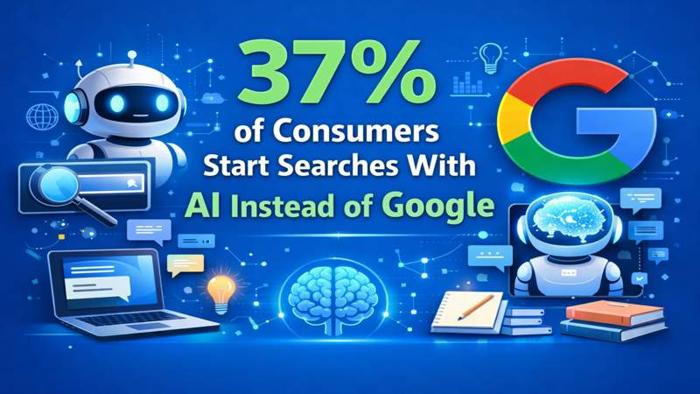
When was the last time you really utilized Google to pose a question, instead of just asking the Hud AI for help? If you have found yourself questioning the use of ChatGPT, Bing Copilot, or for that matter any other AI assistant tool first, then you are certainly not alone. According to a recent study, 37 percent of customers depend on AI instead of Google as their starting point in initiating web searches, and that number is is quietly shifting the manner in which people are finding information on the Internet. And that should be a cause for immediate concern, especially in light of today’s SEO, content marketing, and digital visibility-fied times. As user behavior is so dynamically changing, so too should strategies follow suit.
Why are 37% of consumers starting searches with AI instead of Google?
At a basic level, it comes down to convenience and clarity. AI-powered search tools don’t just list links, they give direct answers. Instead of clicking through five pages, users get a summary, explanation, or recommendation instantly. This shift in consumer search behavior reflects how people want information today: faster, simpler, and more conversational. Voice-style questions, follow-ups, and context-based answers feel more natural in AI tools than in traditional search engines. As digital analyst Mark Reed puts it, “People aren’t abandoning Google, they’re just choosing the shortest path to an answer.”
How does AI-powered search change user intent?
This is where things get really interesting. When someone searches on Google, they’re often browsing. When they search with AI, they’re usually problem-solving. That means AI-powered search trends show stronger intent. Users ask longer questions, expect clearer outcomes, and want help deciding, not just discovering. For marketers and publishers, this changes how content should be written. Instead of vague overviews, content needs to answer real questions directly. This also explains the rapid rise of generative AI in search, where summaries and explanations replace ten blue links.
Is Google losing relevance or simply evolving?
Despite the headline, Google isn’t going anywhere. In fact, Google is actively integrating AI into its own ecosystem through features like Search Generative Experience. The real story isn’t Google vs AI, but Google vs AI search blending into one experience. Users still rely on Google for research-heavy tasks, local searches, and comparisons. However, AI tools are winning in early discovery and quick answers. This overlap means brands must optimize for both environments. If you’re already thinking about future-proofing, our guide on AI-driven SEO strategies on itechmanthra.com/blog dives deeper into how search is evolving.
What does this shift mean for SEO and content creators?
For SEO professionals, this study is a wake-up call. Ranking alone isn’t enough anymore. Content must be structured so AI can understand, summarize, and trust it. That’s where search engine optimization trends are heading in 2026 and beyond. Clear headings, concise answers, and authoritative tone matter more than ever. It also reinforces the importance of topical depth. AI prefers sources that explain concepts clearly, not just repeat keywords. As content strategist Nina Lopez notes, “AI won’t replace writers, but writers who adapt their content for AI discovery will replace those who don’t.” If you’re exploring how AI is changing workflows, our article on how AI is reshaping digital marketing on itechmanthra.com/blog is a helpful read.
Are consumers really trusting AI answers?
Short answer: yes, but cautiously. The study highlights growing AI search adoption among younger users especially, who are comfortable double-checking facts when needed. Trust increases when AI cites sources or explains reasoning clearly. This is why authority, accuracy, and clarity are becoming critical ranking factors, even beyond traditional Google signals. One well-known technology research firm recently noted that users are more likely to trust AI responses that feel transparent and balanced, rather than overly confident. That insight should guide how brands position themselves in AI-friendly content.
How should brands adapt to this new search reality?
Brands need to come out of the position focus and acquire the answers-loop-centric position. It is about question-based content, natural language, and real user problems. Optimizing for featured snippets, FAQs, and conversation-based queries creates visibility in both Google and the AI platforms. This also applies to revisiting all the older content and bringing it up-to-speed with today’s AI vs. Google search expectations. It is not about outsmarting the engine but effectively being there for your users ahead of any other option.
FAQs
Is AI replacing Google search completely?
Not at all. AI is changing how people search, but Google is evolving alongside it.
Why do users prefer AI for some searches?
Because AI gives faster, clearer answers without needing multiple clicks.
Does this affect SEO strategies?
Yes, content now needs to be more direct, helpful, and structured for AI understanding.
Are AI search results always accurate?
Mostly, but users still cross-check important information, especially for big decisions.
Should businesses optimize for AI search now?
Absolutely. Early optimization gives a strong advantage as adoption grows.
Suggested slug:
37percentconsumersstartsearcheswithaiinsteadgoogle
Conclusion: The future of search is already here
About 37% of consumers now first resort to AI instead of looking with Google, as against just a trend that this transformation appears to signify. Search is becoming more human, conversational, and intent-driven, In case you are creating vehicles or businesses online, the adjustment is in dire need of attention right away. What do you think: Will AI ever become your primary search preference as well? Comment, let’s celebrate your thoughts, or ask any questions.

Kumar Swamy is the CEO of Itech Manthra Pvt Ltd and a dedicated Article Writer and SEO Specialist. With a wealth of experience in crafting high-quality content, he focuses on technology, business, and current events, ensuring that readers receive timely and relevant insights.
As a technical SEO expert, Kumar Swamy employs effective strategies to optimize websites for search engines, boosting visibility and performance. Passionate about sharing knowledge, he aims to empower audiences with informative and engaging articles.
Connect with Kumar Swamy to explore the evolving landscape of content creation!