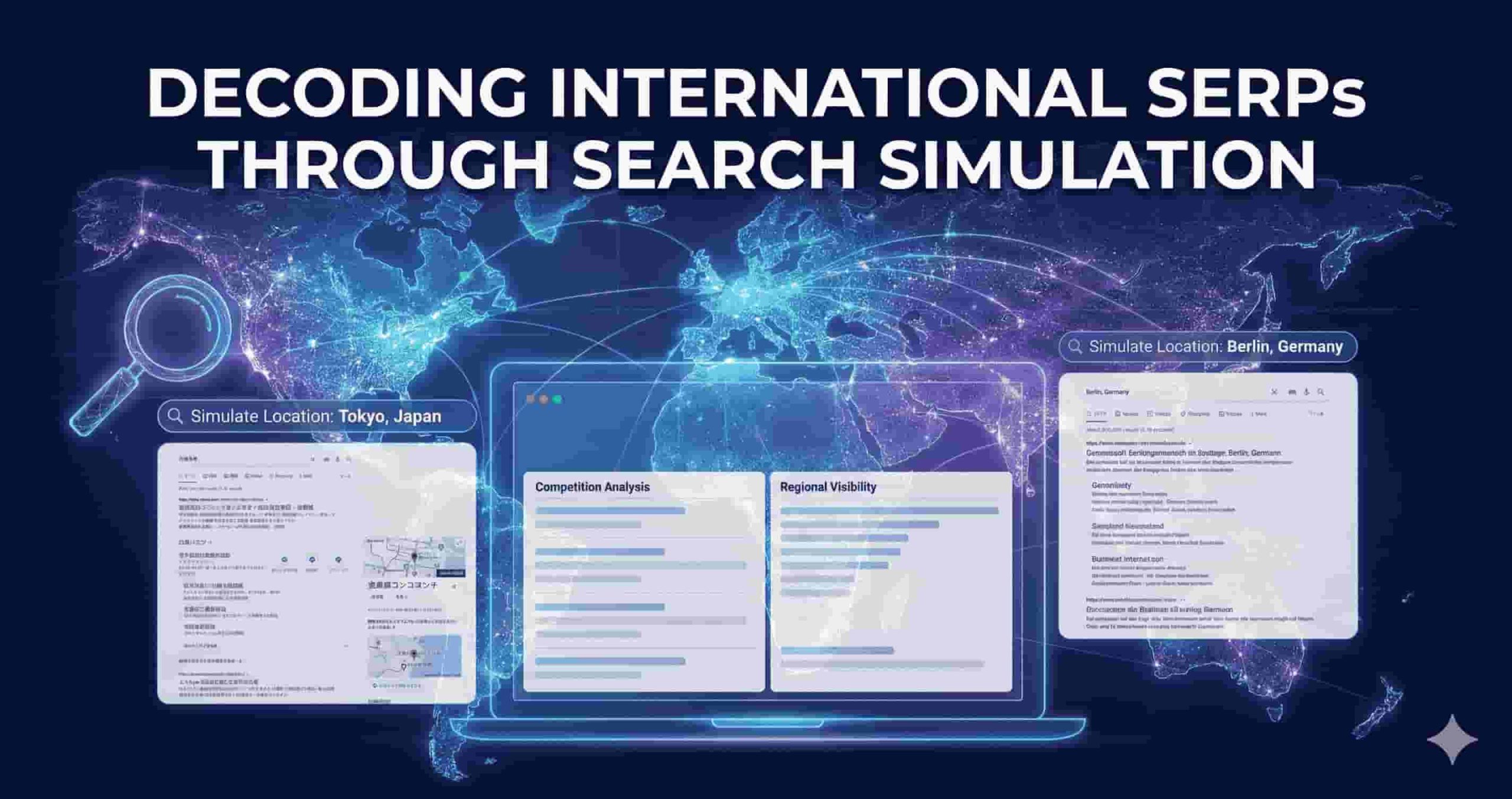
The modern digital landscape is no longer global in the way marketers once understood it. While brands may operate internationally, search itself has become radically local. The search engine results page (SERP) is no longer a single, objective ranking of the “best” answers to a query. Instead, it is a dynamic, hyper-personalized interface shaped by geography, device, language, and behavioral signals.
For global enterprises and advanced digital marketing teams, this fragmentation introduces a fundamental challenge: you cannot compete in markets you cannot accurately observe.
This is where search simulation becomes not just useful, but essential. The ability to view search results as a local user in another country or even another neighborhood has evolved into a core capability for international PPC, SEO and competitive intelligence.
Why Global Search Intelligence Is Broken by Default
Search engines have moved far beyond simple keyword matching. Modern algorithms prioritize predictive relevance, aiming to infer what a user really wants based on contextual signals rather than just the query itself.
At the center of this system is locality.
Modern algorithms prioritize predictive relevance, aiming to infer what a user really wants based on contextual signals rather than just the query itself. To truly understand how Google perceives your own site’s performance across these regions, mastering Google Search Console for international tracking is a vital first step.
The Hidden Architecture of Search Personalization
Search personalization operates on multiple layers simultaneously:
- IP-based geolocation
Google can infer a user’s location with city-level precision, adjusting results based on:- Local businesses
- Regional pricing
- Availability of services
- Legal or regulatory differences
- Browser and device signals
HTTP headers such as:- Accept-Language
- User-Agent
- Device type (mobile vs desktop)
determine which content formats and languages are prioritized.
- Behavioral history
Even when logged out, Google uses:- Previous queries
- Click patterns
- Interaction history
to influence rankings and SERP features.
For analysts operating outside the target market, this creates a systemic blind spot.
A researcher in London attempting to analyze competition in Tokyo will never see the same SERP as a user in Tokyo no matter how many browser settings are changed.
Incognito mode does not solve this problem. VPNs only partially solve it. As a result, manual auditing is structurally flawed for international analysis.
Search Simulation: Escaping the Personalization Bubble
Search simulation tools were created to address exactly this limitation.
Instead of attempting to “trick” Google through IP masking alone, platforms like isearchfrom.com allow analysts to explicitly define the search context including country, city, language, and device before the query is executed.
This enables a neutral, depersonalized view of the SERP, approximating what a first-time local user would see.
Why This Matters Strategically
Search simulation allows teams to answer questions that are otherwise impossible to validate:
- Why does a competitor dominate search results in Germany but not France?
- Are their rankings driven by SEO strength, paid ads, or local relevance?
- What ads are actually shown to users in São Paulo versus Berlin?
- Are competitors investing in real localization or just translating copy?
Without simulation, these insights remain speculative.
Spying on International PPC: From Estimates to Reality
Most competitive advertising tools provide modeled data, not ground truth.
Platforms like Semrush, Similarweb, and SpyFu are excellent for:
- Market sizing
- Trend detection
- Keyword discovery
However, when it comes to live ad verification, estimates are not enough.
The Role of the Google Ads Transparency Center
Since 2023, Google Ads Transparency Center has introduced a new level of openness by allowing users to:
- View all active ads by a verified advertiser
- See regions and languages targeted
- Analyze creative variations and campaign duration
This is a powerful starting point but it does not show:
- The keywords triggering the ads
- The exact SERP layout
- Local extensions or placement priority
That gap is filled by search simulation.
A Practical Workflow for International Ad Intelligence
An effective global auditing workflow combines macro tools with micro verification:
- Identify priority markets
Use Similarweb or Semrush to locate where competitors are gaining traction. - Review ad inventory
Use Google Ads Transparency Center to analyze:- Messaging
- Localization depth
- Market prioritization
- Simulate local SERPs
Use isearchfrom.com to:- Enter the exact country, city, and language
- Test specific keywords
- Observe real-time ad appearance
This final step reveals critical details that static tools cannot:
- Local ad extensions (location, pricing, callouts)
- Whether ads are mobile-only
- Whether messaging is culturally adapted or generic
Decoding Bidding Intent Through Keyword Classification
Not all keywords reflect the same strategic intent. International competitive analysis becomes far more actionable when keywords are segmented into:
- Brand keywords – defensive protection
- Non-brand keywords – market capture
- Competitive keywords – conquesting
For example, if a global education platform allocates the majority of its spend to non-brand terms in foreign markets, it signals:
- Aggressive expansion
- Willingness to absorb higher acquisition costs
- Long-term category ownership goals
By exporting keyword sets from SpyFu or Semrush and verifying them locally via isearchfrom.com, teams can identify “consider-buying” gaps queries competitors are monetizing abroad while you remain absent.
Localization Quality as a Competitive Signal
Search simulation also exposes how seriously competitors take a market.
Key indicators include:
- Native-level language nuance vs machine translation
- Local pricing or currency references
- Cultural framing in value propositions
- Use of Dynamic Search Ads in local languages
Poor localization in high-value markets often signals opportunity. If competitors rely on generic, lightly adapted ads, a brand with true local messaging can outperform even with smaller budgets.
The Regional Ranking Paradox: Why NYC ≠ LA
One of the most common executive questions in SEO is:
“Why do we rank #1 in one city and #5 in another?”
This discrepancy is not random it is algorithmic.
Core Drivers of Regional SERP Divergence
- Local intent activation
Queries with implicit local intent trigger filters that elevate:- City-specific relevance
- Proximity
- Local authority signals
- Landing page substitution
Google often changes which page ranks not just its position.- NYC may surface a /new-york/ page
- LA may fall back to a generic national page if no local equivalent exists
- Competitive density
Some metros are simply more optimized:- Advanced schema usage
- Dense citation networks
- Strong review ecosystems
A national brand can dominate one city while being nearly invisible in another.
Using Search Simulation for Geographic SEO Audits
Search simulation allows analysts to:
- Compare SERPs city by city
- Inspect Local Packs and Local Service Ads
- Identify which competitors appear in which neighborhoods
By simulating searches from multiple ZIP codes, teams can map:
- Visibility radius
- Ranking drop-off points
- Areas of competitive weakness
This transforms SEO from a national abstraction into a geo-grid strategy.
The Technical Core: How Location Emulation Really Works
At an advanced level, accurate simulation depends on UULE parameters.
What Is UULE?
UULE is a base64-encoded location string used internally by Google to define search origin with high precision.
Unlike:
- Country TLDs
- Language settings
- VPN IPs
UULE forces Google to interpret the query as originating from a specific city or region.
Manually generating UULE parameters is possible but impractical at scale. Tools like isearchfrom.com automate this process, ensuring:
- Accurate encoding
- Consistent results
- City-level precision
Why VPNs Are No Longer Enough
VPNs solve only one layer of localization: IP address.
They do not:
- Remove personalization history
- Reset behavioral signals
- Avoid datacenter IP detection
- Emulate device-level differences
Search simulation platforms provide:
- Clean environments
- Mobile/desktop switching
- Faster iteration
- Higher data reliability
For professional-grade analysis, simulation has replaced VPNs as the preferred approach.
From Observation to Strategy
The true value of search simulation lies not in spying but in understanding intent.
It enables teams to:
- Reverse-engineer competitor logic
- Adapt messaging to local psychology
- Allocate budgets with geographic precision
- Identify underserved neighborhoods and markets
In an era where visibility is determined at the city and even street level, global rankings are no longer the goal. Local dominance is.
Conclusion
As digital markets continue to fragment, success belongs to organizations that can see clearly across borders.
Search simulation tools led by platforms like isearchfrom.com provide the infrastructure required to:
- Decode international competition
- Validate regional performance
- Move from assumptions to evidence
In 2026 and beyond, the strongest brands will not simply track what competitors are doing.
They will understand why, where, and how and respond faster and smarter as a result.
For any professional serious about global SEO, PPC, or competitive intelligence, search simulation is no longer optional. It is the foundation.

Nishanth Kumar is the Lead SEO Strategist at iTech Manthra. With over a decade of experience in the digital marketing landscape, he specializes in technical SEO, link-building strategies, and search engine algorithms. Nishanth has helped hundreds of businesses scale their organic presence through data-driven marketing and sustainable “white-hat” techniques. He is passionate about decoding Google’s ever-changing updates to help brands stay ahead of the competition.