
Most of the time, a pay-per-click account doesn’t fail because of a bad strategy but because it follows ‘good advice’ too strictly. Here’s something you may not want to hear: the same “best practice” concepts used to scale campaigns in 2018 are now limiting performance in 2026. Platforms like Google Ads have evolved much faster than any textbook marketers have been following. If you’re still doing ‘perfect’ A/B testing, you might be on the right track to predict results, but growth could be a different story. This article is about when structured PPC strategies should be put on hold and how breaking the rules can give you an edge.
Why “Best Practices” Are Holding Your PPC Back
Best practice PPC strategies, designed to reduce risk by controlling variables, isolating changes, and ensuring statistical significance, have produced strong profits from 2018 until 2026. But here’s the catch: being optimized for saving time usually kills breakthrough results. Here’s why:
- One thing at a time: Traditional tests often recommend testing one variable at a time, but this can slow down your learning process.
- Statistical significance: The obsession with this concept often delays decisions. By waiting too long, you miss out on faster, more impactful changes.
- CTR and CPA focus: While these are important, they often miss the bigger picture engagement, lifetime value (LTV), and other more telling metrics.
Meanwhile, competitors who test quickly and with less control are feeding the algorithm more data and winning more auctions.
What Happens When You Break PPC Testing Rules?
Short Answer: You trade precision for speed and in modern online marketing, speed usually wins. Breaking rules doesn’t necessarily mean chaos. It’s a decision to remove constraints to speed up learning.
| Approach | Traditional PPC Testing | Modern PPC Testing |
|---|---|---|
| Variable Control | One variable at a time | Multiple variables |
| Speed | Slow (weeks/months) | Fast (days) |
| Goal | Statistical certainty | Directional insight |
| Risk | Low | Medium |
| Outcome | Incremental gains | Breakthrough wins |
Real-Life Example (Not from the Source)
A DTC skincare brand ran two variations:
- Version A: “Dermatologist-approved formula”
- Version B: “Clearer skin in 7 days or your money back”
Rather than following a traditional A/B test, they tested:
- Headline + Offer + Landing Page Angle
The result was:
- CTR: Increased by 42%
- Conversion rate: Improved by 28%
- CPA: Decreased by 19%
This would never pass a traditional A/B test, but it outperformed significantly.
Key takeaway: Messy testing can yield clean wins.
Should You Still Follow A/B Testing Principles?
Short Answer: Yes but selectively. A/B testing should be used for optimization, not exploration.
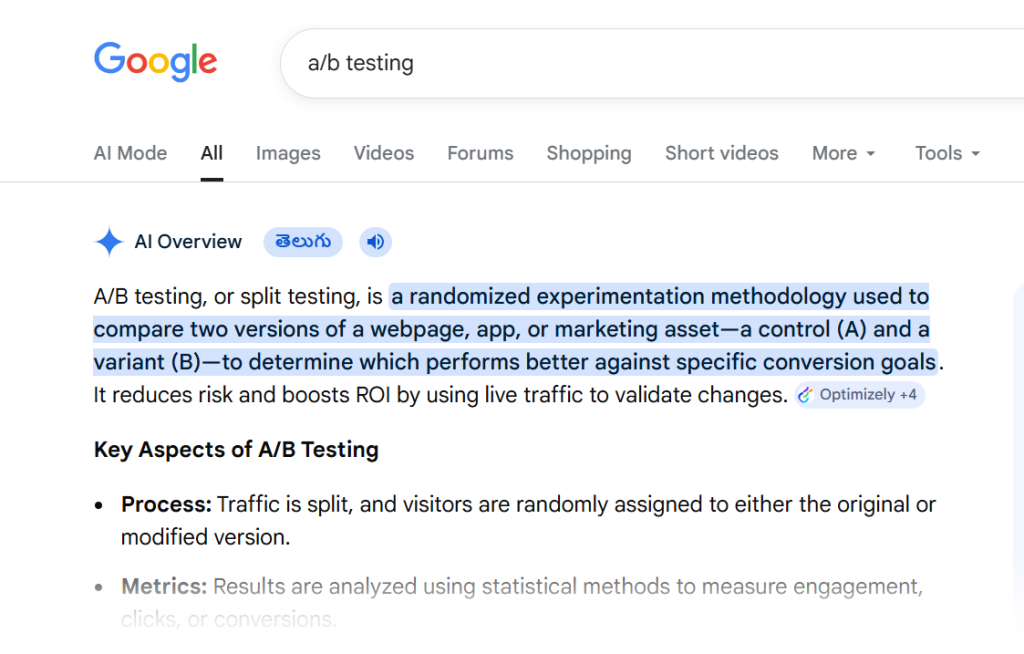
There are two distinct phases in PPC:
- Exploration (Break the Rules):
- Test wild combinations.
- Pair more than one change at a time.
- Race against time to gather data.
- Optimization (Follow the Pattern):
- Focus on what’s been working.
- Avoid unnecessary tweaks.
- Aim for performance consistency.
Most marketers focus too much on optimization and forget that finding winning combinations is more important in the early stages.
Key takeaway: Use structured tests to refine winners, not to find them.
How Small Businesses Can Beat Big Ad Spenders
Short Answer: By testing faster and taking risks that large organizations can’t afford.
While enterprise brands require approvals, follow strict guidelines, and avoid risk, small businesses can:
- Launch multiple experiments in a day.
- Pivot messaging quickly.
- Test unconventional ideas.
Here’s a strategy for SMBs:
- Instead of testing one ad variation per week, launch 5-10 variations simultaneously with different hooks, offers, and landing pages.
- Kill losers fast, and double down on winners.
Step-by-Step: Hyper-Pec and High-Velocity PPC Testing Framework
- Define your core hypothesis:
- Example: “Urgency messaging will outperform feature-based messaging.”
- Create 3 – 5 bold variations:
- No small tweaks test entirely different approaches.
- Launch all variations simultaneously:
- Avoid staggered testing delays.
- Set early death metrics:
- For example: CTR below X% or CPA above Y.
- Find winners based on strong signals, not perfect outcomes.
- Refine with controlled experiments:
- Now, apply traditional A/B testing.
Insights : Test quickly, eliminate losers, then optimize with a precise approach.
What Are the Risks of Breaking PPC Best Practices?
Short Answer: You risk false positives but if managed correctly, the upside outweighs the downside.
The risks of breaking the rules include:
- Distorted signals due to noise.
- Over-scaling false winners.
- Wasting money on poor-performing versions.
How to Mitigate These Risks:
- Set guardrails, not rigid rules.
- Monitor trends over time, not just daily spikes.
- Combine testing data with business metrics (revenue, LTV).
| Factor | Strict Best Practices | Rule-Breaking Approach |
|---|---|---|
| Accuracy | High | Medium |
| Speed | Low | High |
| Innovation | Low | High |
| Budget Efficiency | Stable | Variable |
| Breakthrough Gains | Rare | Frequent |
How Platforms Like Google Ads Changed the Game
Short Answer: Automation thrives on more inputs and data diversity rather than rigid testing frameworks.
Google’s machine learning doesn’t think in terms of statistical analysis but instead looks for patterns. It works best when:
- It receives a variety of inputs.
- It has access to big data.
- It can track behavioral cues.
When you limit your testing:
- You reduce the diversity of signals.
- You slow down learning cycles.
When you increase testing volume:
- You give the algorithm more data.
- You speed up optimization cycles.
That’s why broad match and smart bidding often outperform highly controlled setups.
Key takeaway: It’s not about perfect tests; it’s about giving algorithms diverse signals to optimize faster.
Where the Original Perspective Misses the Mark
There’s an incomplete perspective on breaking best practices, often ignoring:
- Budget: High-frequency testing requires money. If you have a smaller budget (₹20,000/month), be more selective. If you have more budget (₹2,00,000/month), be more aggressive.
- Account maturity: Mature accounts benefit more from exploration, while new accounts need foundational structure first.
- Creatives: Testing quickly won’t matter if your creatives aren’t compelling. Speed without quality can only lead to failure.
Key takeaway: Testing quickly works, but creatives still need to stand out.
Conclusion: The New PPC Mindset
PPC is no longer a science experiment; it’s more of an iterative product. With today’s platforms, you should:
- Launch fast.
- Learn fast.
- Kill fast.
- Scale fast.
This means getting comfortable with imperfection. If your testing feels “safe,” it’s probably too slow. If it feels a bit chaotic, you’re probably closer to how modern PPC operates.
Key takeaway: Speed in testing leads to faster learning and better results.

Kumar Swamy is the CEO of Itech Manthra Pvt Ltd and a dedicated Article Writer and SEO Specialist. With a wealth of experience in crafting high-quality content, he focuses on technology, business, and current events, ensuring that readers receive timely and relevant insights.
As a technical SEO expert, Kumar Swamy employs effective strategies to optimize websites for search engines, boosting visibility and performance. Passionate about sharing knowledge, he aims to empower audiences with informative and engaging articles.
Connect with Kumar Swamy to explore the evolving landscape of content creation!