Introduction
Do you ever wonder what will happen when ads start appearing inside your AI conversations?
This is no longer theoretical. OpenAI tells us how the advertisements will be inside ChatGPT, thereby transforming the conversation around AI monetization, user privacy, advertising, and digital age attention.
Integration of advertising into AI responses significantly changes the course. For users, this perhaps allays some concerns about trust and transparency. For digital advertisers, it opens an entire platform for advertising on AI with potentially a large audience.
Let’s make this visual so that everyone can make heads or tails out of it.
What Does “OpenAI Details How Ads Will Work in ChatGPT” Mean?
When OpenAI details how ads will work in ChatGPT, they’re basically detailing how advertising could come into play while allowing proper functioning of conversations driven by AI programs.
Some of the roles the ads will not likely fulfill, as typically seen in banners and pop-ups, would as follows:
Clearly Marked as Sponsored Content Appear where it fits and pertinent.
There will be ads not interrupting the core responses.
The Social Footprint of AI Monetization
This is going in line with a growing trend of monetizing AI models and platforms. Under this premise, AI would be set free for access, albeit with revenue generation.
It appears they are focusing on trusting the consumer. As one digital marketing analyst said, “AI platforms survive on credibility; if users feel they are being manipulated, they will leave.”
OpenAI cannot give up their credibility.
Why Is OpenAI Rolling out Ad Posts on ChatGPT Now?
Simply put, it’s to scale up.
OpenAI’s ChatGPT went through explosive growth after starting its flagship chatbot. Huge AI models are incredibly costly to run. Infrastructure, model training, massive computation—all add to the billions.
Introducing advertising does the following:
Helps scale up a sustainable revenue model
Preserves free-tier access
Identify for AI: a junction point into online marketing?
In the broad ChatGPT monetization model, ads would be among optional services, e.g., ChatGPT Plus and enterprise offerings.
Thus, if competitors like Google and Meta are operating ad-driven models to sustaining revenue streams, we are still looking at a foreseeable path towards adoption of AI platforms.
What will the ads of ChatGPT be like, and how are these ads different from those one sees online?
This is where stuff becomes very inteWeoseping.
Traditional online ads snatch people out of their rapt state by prompting them at the wrong moment in the wrong place. AI is a realm where context takes the upper hand.
The asumption is that ads can work like that in AI chat setting:
– They will appear only when relevant to the user query;
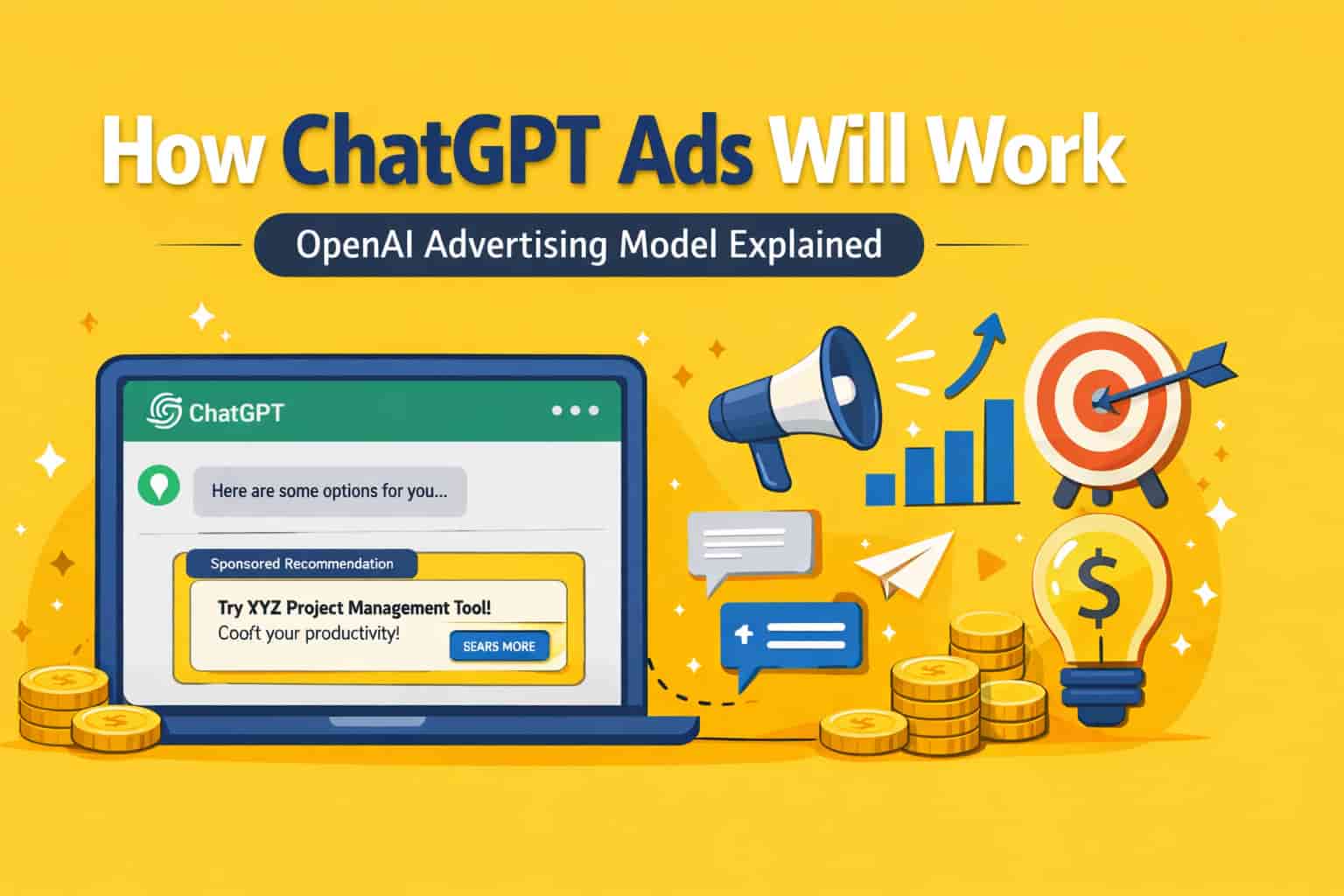
– They will be clearly marked as sponsored;
– They will not be mistaken for native AI answers.
When someone searches “best project management software,” AI could display a sponsored recommendation along with the normal information.
That resonates with the 2026 digital advertising trends orientation on personalized content with contextual relevancy.
Transparency will still be of utmost importance; if the ads smell of hidden venom or manipulation, there will be a backlash from the users.
Will ChatGPT Ads Jeopardize User Privacy and Trust?
Privacy is a major concern-again: whenever a platform enters advertising, questions are shouted:
Are my data being misused?
Is my conversation meaningful?
Is personalization off the books?
And OpenAI has already stressed the privacy prerequisites. Really, the most rigid privacy policies can never be breached in the AI advertising platform.
Here’s how technology-policy expert Daniel Reeves puts it: “When advertisements are involved, AI companies must over-communicate about privacy. Silence creates suspicion.”
To briefly sum it up, trust is everything.
If users believe that ChatGPT is helpful, fair, and open, then ads might not seem too bad. If not, then alternatives will pop up in no time.
What About the Brands and the Marketers?
For marketers, this is a massive breakthrough.
Can you imagine an AI conversation within a high level of intent process where a product recommendation is fitted in? It would be more efficient than the traditional search ads.
AI-powered search ads represent a shift from keyword targeting to intent targeting.
Instead of keywords, advertisers would probably be able to reach out to the user when they are seeking something really specific:
“What is the best CRM Software for startups?”
“What is a good laptop for video editing?”
“What is a good secure investment app?”
This languished category gives birth to conversational commerce when it is considered in other discussions about the OpenAI advertising model.
Brands that embrace this early may gain early-adaptation leverage in what will be a dominant advertising channel.
Will Ads Change the Way We Use ChatGPT?
Possibly, but not necessarily in the negative scope.
Well, even if:
The ads are somewhat advising in aspect
Free access stays no matter what
They don’t break the user experience entirely
Then, in some respect or another.
Conversations that go out of balance
Trust deteriorates
Users account the jump to other competitors
The shop will be all right.
OpenAI correctly notices the critical issue here, with these directions on how to work with ads within ChatGPT. This, in an attempt, short-circuits speculations that might arise to plant something in the vacuum.
Transparency is not only something to consider on a board meeting but is something you must canonize and implement into your strategy if you are in the current AI business.
FAQs about OpenAI’s Ads in ChatGPT
1. Is ChatGPT going to be run mainly on ads?
Not necessarily. Ads are expected to be considered only where that would render ad-supported free subscriptions as viable, while keeping paid plans ad-free.
2. Will ads affect the AI’s responses?
The responses displayed may be contrived by advertisers and can be denoted explicitly by unique ad tags.
3. Are your private messages sold to advertisers?
There is no indication to suggest that private conversations are actively being advertised. Therefore, it can be assumed that privacy measures will always be upheld.
4. How do ChatGPT ads differ from what you see in Google Ads?
Unlike traditional keyword bidding on search engines, a ChatGPT ad would be more inclined towards conversational intent and contextual relevance.
5. Could businesses direct ChatGPT to advertise?
Some details have yet to be ironed out, but the prospect for brand participation in a structured format is made possible by an ad model evolved by OpenAI.
Conclusion
With this announcement, OpenAI has opened up the study of how advertisements will operate in ChatGPT as AI advanced.
We are on the brink of where conversational AI meets digital advertising–a user experience. Things at the swift end of the spectrum are for trust among users, and opportunities for brand loyalty enthusiasts. In case anything about OpenAI, it would be about its integrity.
It’s neither whether ads might appear nor whether they would be in line with enhancing or disrupting the AI experience.