Introduction
After letting your marketing campaign run for a while and checking in on the numbers, do you ever ask yourself whether such results are truly meaningful?
You and your friends are not alone in the matter: Given problems in measurement schemes and static reports, it’s quite hard for many marketers to judge if their marketing efforts are actually making a difference.
Against this backdrop, the flywheel re-imagines measurement as a continuous exercise to enhance marketing learning, optimization, and growth.
When marketing data and marketing attribution models are combined with performance insights into a more dynamic framework within product and marketing strategies-another objective that should now be accomplished.
So let’s try to understand the concept’s essence and the principles, or rather the benefits, why so many marketing leaders are adopting it.
What is the Marketing Measurement Flywheel?
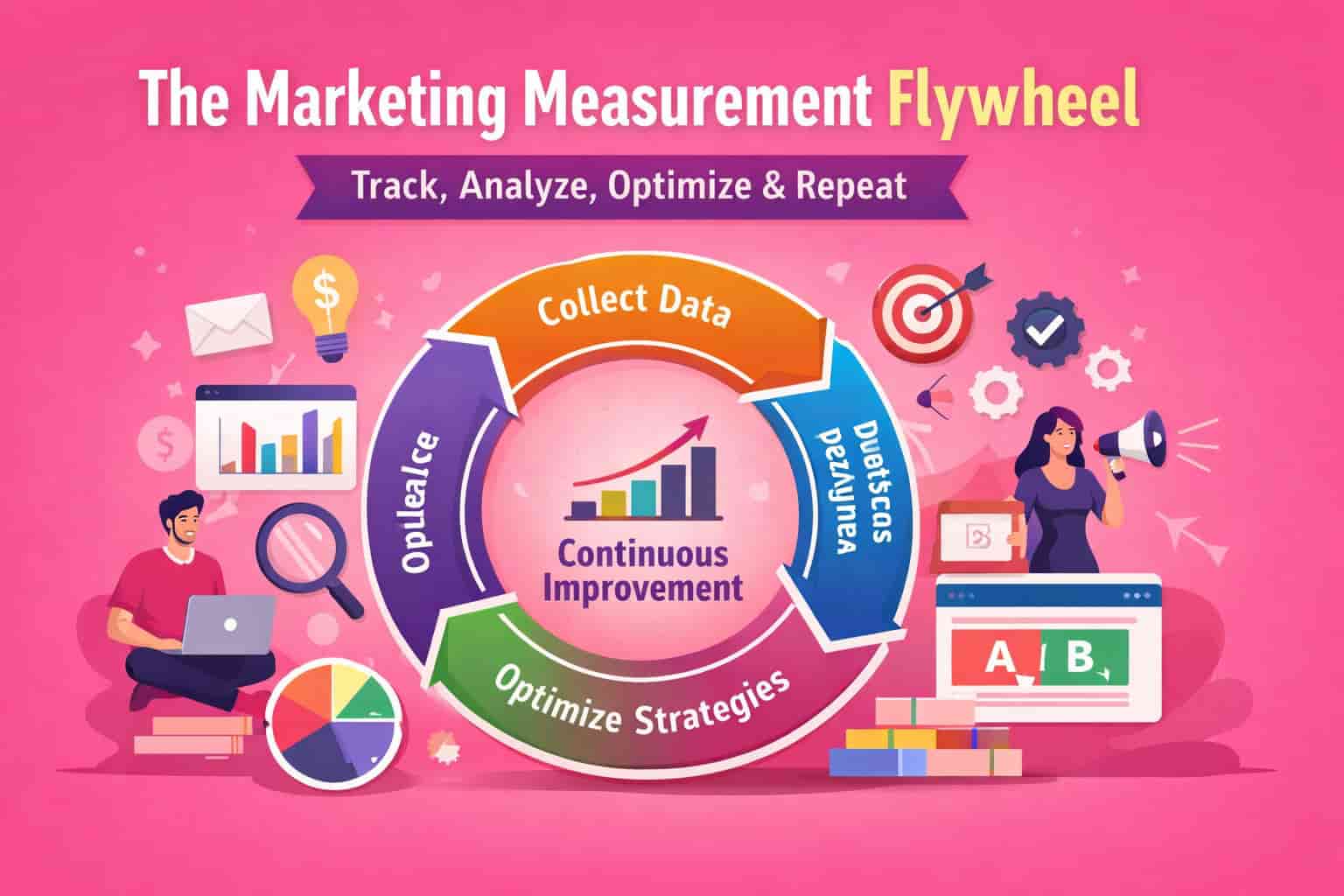
The marketing measurement flywheel is a continuous loop connecting marketing actions, data, insights, and optimization. Marketers do not only report performance results; they channel precious insights back into the marketing campaigns to increase future post-campaign performance.
Just think of that flywheel spinning, gaining momentum from every marketing action.
Its basic cycle is as follows:
Gather marketing data from campaigns, channels, and interactions with customers
Measure performance metrics what worked best, and which ones did not work at all
Use sophisticated marketing analytics tools to derive some insights
Optimize strategies based on analysis of the data
Run better campaigns series through to completion and run them again.
In comparison with traditional marketing measurement methods, which aim at campaign results only while promising continuous improvement, the flywheel model is more palatable.
As marketing strategist Daniel Brooks puts it,
“Marketing measurement should not stop with a final report. It should be the engine to make smarter decisions every time you launch a campaign.”
And here is the result: this outlook from many organically-growing organizations sees them replacing staid reporting with data-informed marketing strategies.
What Makes the Past Marketing Metrics Insufficient Nowadays?
For years, marketers evaluated success with the help of simple metrics such as clicks, impressions, or last-click attribution. However today, customer paths are more intertwined than ever before.
A single individual might:
See a social media ad
Read a blog post
Watch a product video
Click a Google search result
Convert after receiving an email
Say the attribution model is last click and you may give the credit to just that final interaction while ignoring all the touchpoints that feed into the conversion.
All these reasons are why there has been increased adoption of multi-touch attribution methods and highly advanced marketing analytic momentum.
Today’s marketing measurement should include:
Cross-channel customer journeys
Consumer lifetime value (CLV)
Long-term brand health
How well campaigns are scaling up_FOR_INCREMENTAL-GROWTH-.
The marketing measurement flywheel fulfills this task by constantly evaluating customer behavioral data and thereby efficiently improving marketing strategies being pursued.
You may wish to know more on data-driven digital strategies about optimizing digital marketing. Let me guide you in the direction:
How Does It Actually Work?
Broadly defined, the marketing measurement flywheel is all about marching on with marketing strategies on a continuous feedback loop.
1. DATA COLLECTION
Every action involved in marketing helps collect data, concerning: visits to the website, ad click-throughs, number of leads, customer contacts, and many others.
Tools belonging to the areas of CRM, analytics dashboards, and marketing automation software scatter throughout channels the ways to gather such data.
This is a critical phase in developing marketing performance measures that accurately reflect customer conduct.
2. MARKETING ANALYSIS AND INSIGHTS
Once the data is collected, it is analyzed to discern patterns.
Every Q&A might include
Which channels do most of the collaborated leads come from?
Which campaigns have proven vital from a revenue generation standpoint?
Where does the final chance drop-off in the documented funnel occur?
These answers will help modern businesses with the required marketing analytics tools to see and prove these connections.
3. Optimization and Experimentation
The data is used in creatively proposing better campaigns, like tweaking ad targeting; beefing up landing pages; funnel optimization via alternate messages; and endless trial and error in “email sequences.”
It is at this juncture where we delve into the heart of experimentation, for one can never tell with any degree of certainty regarding the said lock-up conversion rate optimization (CRO) as it has already coined itself in terms of a better marketing performance model.
4. Strategic Improvement
Procuring all the instructions, the marketers will apply those in the next chapter of execution.
The new strategy will ensure a better degree of refraction and refeeding than ever before, letting the cycle get into even greater efficiency, thereby letting that ROI grow better and better every time.
Why is Data-Driven Marketing Essential to the Flywheel Model?
Marketing measurement flywheel by its foundation is data-driven marketing.
It would be foolish of marketers to make any decisions without the performance data to back them up.
This way of marketing provides the following benefits:
Improved Budget Allocation
Eventually, companies can decide which channel makes the best ROI.
Enhanced Customer Targeting
Data exposes which audiences engage the most with specific campaigns.
More Accurate Prediction
With precise historical performance, marketers can manage to predict the future more accurately.
In the words of marketing specialist Sarah Chen,
“Data-driven marketing turns measurement from guessing and instead makes it a strategy. The more data you analyze, the more intelligent your campaigns become.”
In case you’re going for some very high-level digital marketing techniques, they have talked in this guide from Think with Google about how marketers use data to improve performance:
Which are the Tools Deployed in Building a Marketing Measurement Flywheel?
Building an effective marketing measurement flywheel demands a proper administration technology stack.
The data-driven marketing measurement tools promised below are common tools usually used by modern marketing teams:
Marketing analytics platforms
Platforms like Google Analytics, HubSpot, and Adobe Analytics monitor campaigns and engage in meticulous behavioral tracking against source systems.
CDP (customer data platform)
These platforms enable their clients to get a comprehensive view of the customer, collecting customer details across all the different potential touchpoints.
Attribution modeling tools
This, as is so, makes a useful tool in sorting out which marketing channels are contributing in any way to the conversion process.
Experimentation platforms
An experimentation platform designed for the optimization of campaigns is a place where real productivity can be derived from how campaigns are performing.
All these tools put together further a conjoined space for measuring and optimizing marketing performance.
It is also an opportunity for businesses wishing to scale the frontier with AI-enhanced analytics à la automation or similar and should acquaint themselves with some pointers found in any AI marketing resources:
And How Can Businesses Begin Using This Marketing Measurement Flywheel?
You do not need to reinvent the marketing architecture to adopt the marketing measurement flywheel.
To put this in action for yourself, you can begin by taking one or two straightforward measures:
1. Define specific marketing goals
Work on determining what real campaign success looks like for you, be it in-terms of lead collection, revenue earned, engagement, or customer acquisition.
2. Measure those metrics which are both meaningful and connect directly to business outcome
Never focus on vanity metrics.
3. Look into unifying all marketing data sources
Combine data from the advertising platforms, websites, CRM systems, and email marketing tools.
4. Build a test-heavy culture
Lay emphasis on training teams to apply as much experimenting as possible to their efforts so that learning from the activity is in the front-line of prefererence over preset and use such learnings to tailor campaigns the best way possible at a given time.
5. Initiate insights to help in realization while running campaigns
Operationally, the most impactful part of building a framework is to close the loop employ insights gained from data to inform developing future campaigns.
These steps shall signal the bootstrap process, and then the marketing flywheel will actively accumulate kinetic energy.
Marketing Measurement: The Road Forward
The world of marketing measurement is in transition today, largely affected by technological advancements.
Artificial intelligence, predictive analytics, and automation are already reshaping how marketers analyze campaign performance.
Take a close look at future marketing measurement systems that will likely concentrate on:
Real-time marketing analytics
AI-powered attribution models
Predictive costumer insights
Unified cross-channel data platforms
These technologies will further revolutionize the marketing measurement flywheel, allowing businesses to take improved marketing decisions on the fly.
FAQs
What is a marketing measurement flywheel?
Marketing measurement flywheel is a continuous process where marketing data is used to drive ongoing optimization for future campaigns as well as to collect, compile, analyze, and optimize data rather than static reports.
Why is marketing measurement important?
Marketing measurement allows a business to understand what kind of campaigns are effective, what channels provide the best ROI, and how client behavior affects marketing performance.
What marketing attribution models?
Marketing attribution models deal with making platforms like advertisements, emails, social media touchpoints, and the like count for conversion credit assignment.
How does data collecting improve marketing tactics?
Data-driven marketing operates by intelligence from the actual performance and forms information wherein logic guides the optimization of programs and targeting of audiences to ensure better conversion.
Do small businesses have the ability to utilize the marketing measurement flywheel?
They can. The marketing measurement flywheel: with immediate results to campaign metrics, campaign analysis at all times, and development of marketing tactics.
Conclusion
The marketing measurement flywheel provides a distinct transition point from historical reporting to continuous improvement. This means marketers are able to gauge results again and again, having further data that creates insight to experiment strategies.
This helps businesses stay flexible, informed, and adaptable in a world of omnichannel customer journeys.
You feed the flywheel with data and insights creating a much stronger marketing operation.
What’s your take on this framework for measuring marketing?
We welcome you in the comments. Your perspective is important to us, so feel free to air your thoughts or questions.

Kumar Swamy is the CEO of Itech Manthra Pvt Ltd and a dedicated Article Writer and SEO Specialist. With a wealth of experience in crafting high-quality content, he focuses on technology, business, and current events, ensuring that readers receive timely and relevant insights.
As a technical SEO expert, Kumar Swamy employs effective strategies to optimize websites for search engines, boosting visibility and performance. Passionate about sharing knowledge, he aims to empower audiences with informative and engaging articles.
Connect with Kumar Swamy to explore the evolving landscape of content creation!