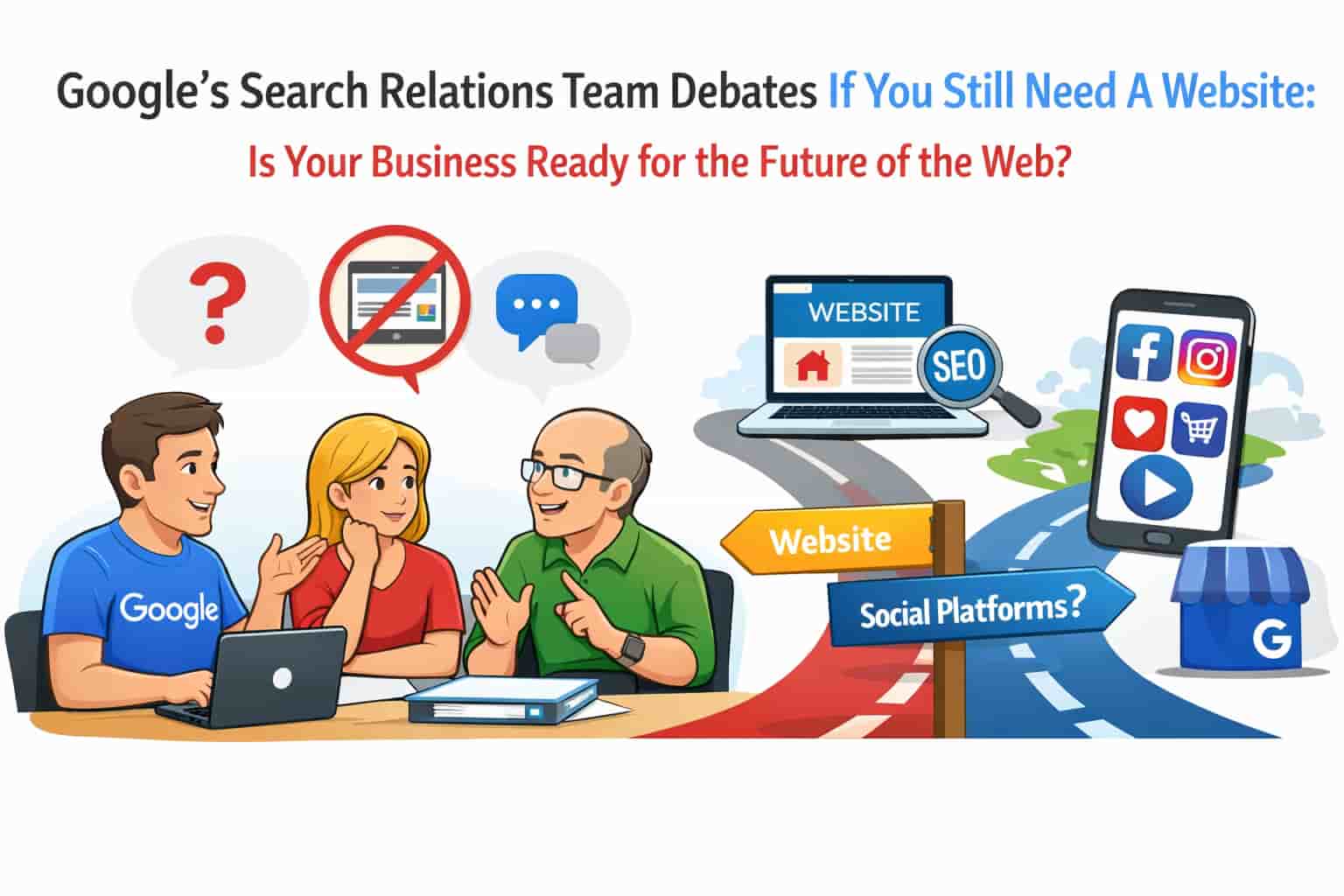
In the fast pace of the evolving digital landscape, have you ever thought if your business still needed a website? With social media platforms on the rise, online marketplaces as well as mobile applications vociferously vying to dominate, is it possible that our idea of just some website might be somewhat outdated in some quarters? And, logically speaking, are we still in need of one to operate online?
The very validity of the idea of a website in the digital age is being put into contention by the Search Relations Team at Google, and it is causing a quite fervent debate in the business world. If you’re hesitant to regard the website as being a lost cause, you are by no means alone. This discussion underlines how critical the issue is in order to readdress online presence.
Where Is the Argument Going?
The debate at the forefront focuses on whether a website still remains the most effective way for businesses to begin establishing an online presence. Websites have historically been the keystone of online marketing, SEO, and branding platforms, but as Google’s search algorithms continue to evolve and other channels are gained prominence, such as apps, many businesses are starting to question the utility of their website, making them consider social media, marketplaces like Amazon, or apps as alternatives for establishing an online presence in place of their traditional website.
Why does this matter now?
In the evolving world of digital marketing, the Search Relations Team wield an inordinate influence in the industry. Very definitely, their views on the necessity of a website now or in the very near future are likely to significantly affect the digital strategies adopted by businesses. It might get a bit challenging with small businesses when they’d have to concentrate most of their resources on a heap of other things, while still trying to keep a website up and running. As the online world keeps evolving, businesses are supposed to work out if using a website is the best, least expensive, viable strategy or whether carrying another entity should be more advisable.
Is a Website Still Needed, and Valued, as Per Google’s Search Algorithm?
Yes, Google’s algorithm still values, in large part, websites for SEO ranking. However, the catch is, Google rates higher those websites that provide the best user experience and relevant information. If a website doesn’t meet the E-A-T criteria, it could rank lower than social media or online directories that do an excellent job of user engagement.
According to John Mueller on the Google Webmaster blog, what distinguishes sites in search rankings isn’t so much their mere presence or absence but their delivery of value in reality: content quality, user experience, and user value-first approach is key, regardless of whether you are publishing content on a traditional website, social media page, or a business listing accordingly.
Do Businesses Still Survive without a Website?
While the answer is very much dependent on the business and its objectives, many companies have proved there is good business sense to be gained without them being strictly dependent on their own Web presence. Some eCommerce entrepreneurs sell products on platforms like Amazon and Etsy or Instagram; thus, you may be doing business without an independent website. Being web-independent can only go so far, though. On the downside, the entrepreneur will be subject to the terms and conditions of Amazon or Etsy and the obligations of their own labor, so this has a drawback: not imprinting or imprinting with an expectation they may pull the rug from under you.
And this is a bonus for social media. Often, these platforms will offer an impressive amount of visibility. Furthermore, they are extremely user-friendly and impart accountability, all of which drive sales and conversions. However, while excellent for growth and branding in the future, one must reckon with the fact that there may be less flexibility and control than with one’s own website.
Should a Website Still Be Built?
Yes, definitely yes for larger development; it secures brand identity, protects your user data, and drives up SEO ranking. You can make an experience that will be unique and personalized, key elements that help build customer loyalty and authority. This will have an increasing impact on what decisions are made so that digital growth in the future becomes an explanatory process.
While you may have, for one, tied your business mostly to social media and marketplaces, your website should be seen as the face of your whole brand, your home plate. This is where you can use your most direct form of CTAs to drive traffic, collect leads, and create more engaging and long-form content.
What Role Does Social Media and Other Platforms Play in Today’s Digital Landscape?
When optimizing websites for methods other than SEO or branding, do websites give way to social media networks as a priority? One social networking tool may also support relationship-building, product or service exhibition, and the exhibition of an engaging domain to underline their significant signposts. It would also help establish a connection between consumers and businesses in the most relaxed and familiar way. Therefore, Google My Business, an aspect of this effort, is by far the most emphatic example encompassing dependence on any other website. Providing the entity with a free way to take charge of its online presence on Google search and Google Maps, it ends up translating into good endearment with the wider public while not requiring manual editing for building some amount of site visits. Smaller businesses say that their respective scores on Google My Business serve as a makeshift website, competing on par with organized ones with the right optimization.
Does Worship Stand a Chance Henceforth?
The future of websites isn’t bleak as some predict; but it is understandable that companies should adapt and develop. The intention of Google’s Search Relations Team is to focus on mobile-friendly optimizations, local-search related, and content relevance, advocating that business adapt with each future change in technology and be more flexible, considering more social platforms, apps, and other resources to meet consumer expectations.
As the web is evolving, the necessity for having a traditional website would now depend on the industry and the audience you want to target as well as the advertising goals of your business. With this said, the website will continue to engender the digital ecosystem. Although sharing the digital spotlight with other digital platforms, nonetheless, the website as a site will always remain an important part of the stage.
FAQs
1. I sell on Amazon or eBay. Do I still need a website?
Numerous other businesses that Verizon provides help for don’t really need a website too much unless a business person is ready for the positives- of being more in control of the brand and customer relationships-a website would only be helpful. In this way, your SEO tactics will come from you.
2. What should be given preference on a website, content or looks?
Content is king prefer content over design. Google takes into account content, not design, as a major criterion in rating websites.
3. How should I go about reconciling perplexity and burstiness when rewriting content?
Indeed, some careful considerations tend to lean towards lower perplexity and higher burstiness in the future. While preparing the content, it needs to be taken care of.
Conclusion
Do you still need a website? The answer for small businesses and e-commerce operations may not be as clear-cut as before. While a website is still a must for branding, SEO, and user experience, Facebook and Instagram are offering tough competition, let alone Google My Business. The decision to have a website should basically depend on the goals you have in focus and the target audience to address.

Kumar Swamy is the CEO of Itech Manthra Pvt Ltd and a dedicated Article Writer and SEO Specialist. With a wealth of experience in crafting high-quality content, he focuses on technology, business, and current events, ensuring that readers receive timely and relevant insights.
As a technical SEO expert, Kumar Swamy employs effective strategies to optimize websites for search engines, boosting visibility and performance. Passionate about sharing knowledge, he aims to empower audiences with informative and engaging articles.
Connect with Kumar Swamy to explore the evolving landscape of content creation!