Introduction
Have you ever wondered why Google suddenly shows different types of links or extra explanations when you’re searching? You’re not alone. With Google updating links in AI Mode and expanding its Web Guide test to the main All tab, search results now feel more “assisted” than ever. And honestly, this update is going to impact everyone from everyday searchers to SEOs, creators, and online businesses.
Google’s pushing deeper into AI-enhanced search experiences, trying to make search not just faster but more understandable. Let’s break down what’s really changing and why this matters right now.
What does Google updating links in AI Mode actually mean?
When Google launched AI Mode (formerly called SGE), it used AI summaries to answer queries at the top of the page. But there was one big problem users couldn’t easily see where the information came from.
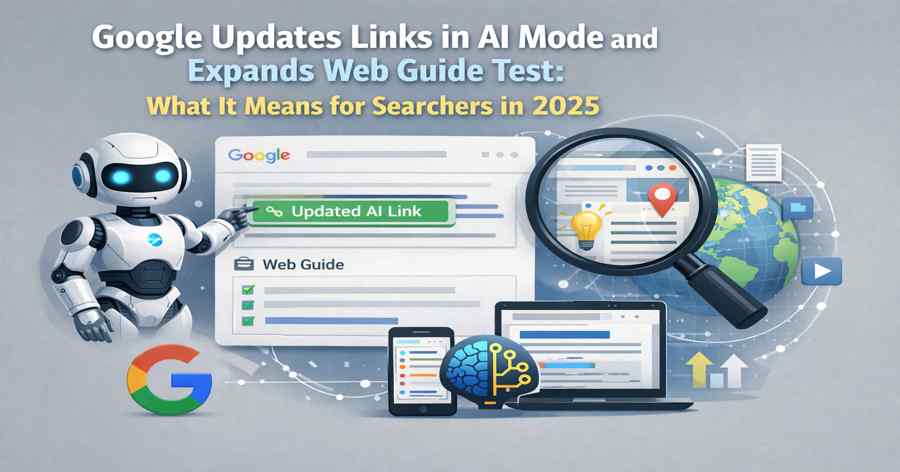
Now, Google’s making AI Mode more transparent by improving how links appear inside those AI summaries.
Here’s what’s changing:
- Links are now more visible and placed contextually
- Citations are clearer and show why a page is recommended
- Better attribution to publishers (important for SEO creators)
- Easier click-through to deeper content
This is Google’s attempt to balance AI answers with original publisher content. As one digital analyst puts it, “If Google wants AI Search to stay credible, it needs to respect and highlight the sources feeding it.”
Why is Google expanding the Web Guide test into the All tab?
Earlier, Web Guide was visible only in specific test formats. Now, Google has expanded it to the main All tab meaning every searcher may start seeing a new structured breakdown of a website’s pages.
Think of Web Guide like a mini sitemap preview built directly into search results. It helps users quickly explore a site’s important pages without clicking multiple times.
From Google’s perspective, this solves two issues:
- Users can scan content faster
- Good websites get more visibility
If you’ve ever published educational content, like the SEO real-time classes guide on itechmanthra.com/blog, you know how much this helps.
How do these updates affect SEO and website owners?
Short answer: more than you think.
Long answer: Google’s AI Mode and Web Guide features are shifting how people interact with search results. Here’s how this impacts SEO:
- Higher importance of structured content
- Clear headings and organized sections become crucial
- Pages with strong E-E-A-T signals get highlighted more often
- Internal linking may influence Web Guide previews
If you already optimize your blogs using conversational content and structured headings like the SEO trends article on itechmanthra.com/blog you’re ahead of many competitors.
As SEO consultant Mira Santos notes, “Google is slowly moving from ‘results engine’ to ‘guide engine.’ Websites that organize information better will rank better.”
Will AI Mode reduce traffic to websites or improve it?
This is the question everyone’s asking.
The truth? It depends on how well your content matches user intent.
AI summaries sometimes reduce clicks, but when Google displays clearer links inside AI Mode, good websites actually gain visibility. Users click more often because:
- The link appears inside a helpful context
- The summary guides people toward the right resource
- Trust increases when sources are clearly displayed
So, while AI Mode changes user behavior, it doesn’t automatically reduce traffic. It rewards high-quality, well-structured, trustworthy content.
What should creators and businesses do now to stay on top?
If you’re a content creator, SEO specialist, or business owner, here are practical steps to stay ahead of these Google updates:
- Write with clear intent and simple explanations
- Create structured pages with strong H2–H3 hierarchy
- Include FAQs (Google loves them for AI summaries)
- Use schema markup where possible
- Keep internal links meaningful and user-first
- Focus on topics with real expertise
If you’re confused about how to restructure your SEO strategy for 2025, check practical breakdowns from respected communities like Search Engine Journal (external reference).
FAQs
1. Does Google’s AI Mode replace normal search results?
Not really. It enhances search, but traditional results still matter a lot for rankings and traffic.
2. Will Web Guide show up for every website?
No. It appears only when Google believes a site has well-organized content and strong relevance to the query.
3. Do I need to change my SEO strategy immediately?
Not drastically just refine your structure, headings, and clarity. Those matter more than ever.
4. Are AI links clickable like normal results?
Yes, and now they’re even more visible thanks to this update.
5. Can these updates increase organic search traffic?
Absolutely. If your content aligns with user intent, AI summaries may highlight your site more often..
Conclusion
These updates Google improving links in AI Mode and expanding Web Guide in the All tab show just one thing: search is becoming more guided, more visual, and more AI-assisted.
If you create helpful, trustworthy content, these changes actually benefit you. Want to explore more SEO insights? Drop a comment, ask a question, or share this article with your team.

Kumar Swamy is the CEO of Itech Manthra Pvt Ltd and a dedicated Article Writer and SEO Specialist. With a wealth of experience in crafting high-quality content, he focuses on technology, business, and current events, ensuring that readers receive timely and relevant insights.
As a technical SEO expert, Kumar Swamy employs effective strategies to optimize websites for search engines, boosting visibility and performance. Passionate about sharing knowledge, he aims to empower audiences with informative and engaging articles.
Connect with Kumar Swamy to explore the evolving landscape of content creation!